





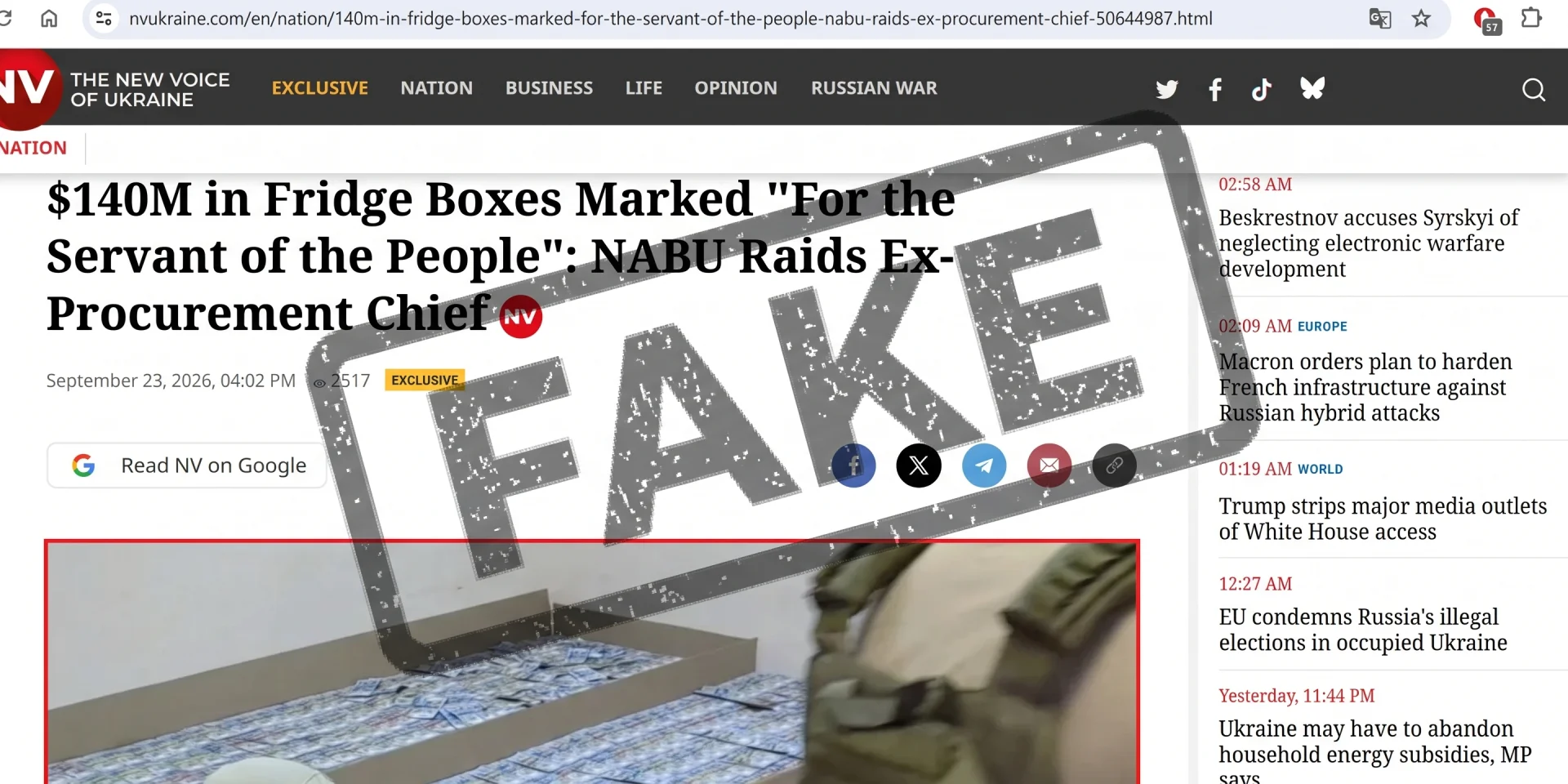
Fake New Voice of Ukraine website spreads fabricated NABU story in alleged Russian influence operation
KYIV, Sept. 25, 2026 — The New Voice of Ukraine (NV) announced Thursday that a falsified copy of its website was discovered, containing a fabricated article that alleged the National Anti-Corruption Bureau of Ukraine (NABU) had raided property connected to a former Ministry of Defense official. The fake website, which was found yesterday, consists largely of content snapshotted from NV on Sept. 23, according to an internal investigation, along with one article that the NV newsroom had not published. The article was published under NV branding despite not originating from the outlet, and it was distributed on social media and other online platforms as purported reporting by The New Voice of Ukraine. The page falsely attributed an accompanying image to NABU and claimed that the anti-corruption agency conducted a raid on property linked to Arsen Zhumadilov, a former official at Ukraine’s Ministry of Defense. The New Voice of Ukraine categorically rejects the allegations contained within the fabricated article, stating that it had no involvement in its creation or publication. “This is an influence operation, with clear traces to the Russian Federation,” said Romeo Kokriatski, managing editor of The New Voice of Ukraine. “After being alerted to this website’s existence, our newsroom immediately contacted all relevant authorities and has launched an internal investigation into the matter. We have already discovered that the story was spread by known Russian disinformation outlets even prior to the fake website being launched.”
The falsified copy of the NV website was painstakingly designed to appear legitimate, reproducing elements of NV’s layout, sections, branding, contact information and editorial materials. It also copies genuine NV articles and links, making the site nearly indistinguishable from the real outlet for casual readers. This level of fidelity is a hallmark of sophisticated disinformation operations, which seek to exploit readers’ trust in established media brands. The fabricated article, in particular, was presented as an NV exclusive, with a compelling narrative designed to generate outrage, distrust and confusion. By embedding the false story inside a cloned version of the website, the perpetrators hoped to lend it an aura of authenticity. The New Voice of Ukraine has stressed that the falsified copy has no connection to the outlet, its journalists, editors or owners. The official English-language website of NV is english.nv.ua, and the outlet has urged readers to verify the domain whenever they encounter stories attributed to The New Voice of Ukraine. The discovery of the fake website follows a troubling pattern of Russian influence operations targeting Ukrainian independent media, anti-corruption institutions and defense officials as Kyiv continues to resist Moscow’s aggression.
In response to the discovery, NV says it has already contacted all relevant authorities and launched an internal investigation. The newsroom is also taking the necessary technical and legal steps to seek the removal of the deceptive website and its content, as well as to notify search engines, hosting providers and domain service providers. These actions are intended to limit the spread of the false story and to prevent future attempts to impersonate the outlet. Kokriatski’s statement underscores the severity of the situation: the fake story was amplified by known Russian disinformation outlets even before the fake website was launched, suggesting a coordinated campaign rather than an isolated incident. This timing is particularly concerning because it indicates that the operators had pre-arranged distribution networks ready to push the narrative across social media, messaging apps and other platforms. NV has called on readers, journalists, officials and international partners to remain vigilant and to check the domain when encountering stories attributed to The New Voice of Ukraine. Anyone who encounters suspicious material presented as NV reporting can verify it by searching for the story on the official NV website at english.nv.ua.
The incident is a stark reminder of the information warfare that Ukraine has faced for years, especially since Russia’s full-scale invasion began. Russian influence operations have repeatedly sought to undermine trust in Ukrainian media, state institutions and international partners. The creation of fake websites that impersonate reputable news organizations is one of the most insidious tactics used in this information war. By cloning the entire NV website, the operators created a convincing environment in which a single fabricated article could be presented as legitimate journalism. The choice of subject matter is also significant. NABU has been a frequent target of Russian disinformation because it plays a central role in anti-corruption efforts in Ukraine. Discrediting NABU and spreading false allegations about raids on officials could serve broader Kremlin narratives that Ukraine is hopelessly corrupt and that Western aid is being misused. Similarly, the Ministry of Defense has been a focus of scrutiny and disinformation, particularly regarding procurement and wartime spending. The fabricated article’s allegation concerning Arsen Zhumadilov fits this pattern, as it attempts to create a false linkage between a former defense official, a high-profile anti-corruption raid and the supposed failure of Ukrainian governance.
The targeting of Zhumadilov, a former Ministry of Defense official, is notable because it appears designed to exploit public sensitivity around corruption in the defense sector. While NV did not publish any such story, the fake article’s allegations were crafted to seem plausible to readers familiar with ongoing anti-corruption efforts. The explicit attribution of an accompanying image to NABU was intended to make the story appear based on official information. This is a common technique in information operations: mixing true, verifiable and mundane details with fabricated claims to increase credibility. The fake article also played into existing narratives about defense corruption that have circulated in both domestic and international spaces. By tying a fabricated NABU raid to a former Ministry of Defense official, the operation could aim to achieve multiple objectives: undermining trust in NABU’s professionalism, casting Ukrainian media as unreliable, and diminishing international confidence in Ukraine’s defense institutions. The New Voice of Ukraine’s rapid rebuttal is intended to stop these narratives in their tracks, but the incident highlights how quickly false information can travel and how difficult it is to correct once it has been amplified by hostile actors.
For readers, journalists and public officials, the lesson from this incident is clear: information presented in the name of a respected outlet must be verified at the source. The New Voice of Ukraine urges everyone to be especially cautious with sensational stories shared on social media, particularly those that appear to originate from mainstream news organizations but are not linked from official websites. A fake domain may look almost identical at first glance, but checking the URL is the simplest way to confirm authenticity. The official English-language website is english.nv.ua; the official Ukrainian-language website remains the primary source for NV’s reporting. There are no exceptions to this rule, and NV has made it clear that it will never publish or endorse unverified allegations such as those in the fraudulent article. The New Voice of Ukraine is part of Media-DK Publishing, a privately owned and independent publishing entity, and its English-language edition has operated since January 2022. The outlet has a responsibility to its readers to defend the integrity of its brand against malicious impersonation, and it is doing so through legal, technical and public communication measures. As the investigation continues, NV’s leadership has expressed confidence that the coordinated nature of the attack will become more evident, and they have pledged to keep the public informed. In the meantime, the message to audiences is simple: if a story looks like NV, reads like NV, but is not on an official NV domain, it is not NV. The battle for truth is not fought only in courtrooms or newsrooms; it is also fought every time a reader decides whether to click, trust and share. The New Voice of Ukraine will continue its work, and it will not be silenced or misrepresented by those who seek to weaponize journalism. For any questions or reports of suspicious content, the newsroom can be reached through its managing editor, Romeo Kokriatski, at rkokriatski@nv.ua.