


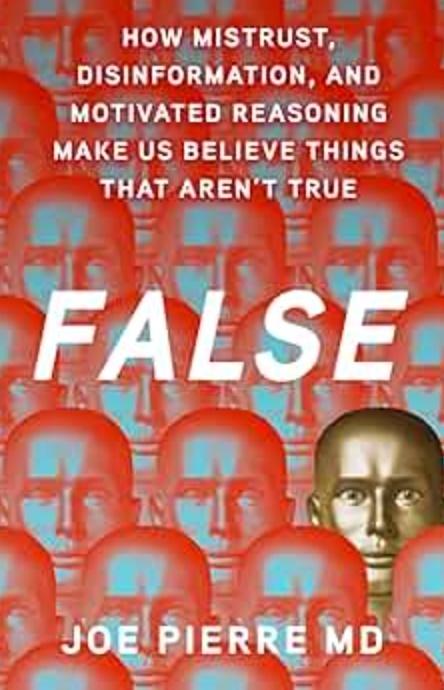
Unraveling the Fabric of Falsehood: A Deep Dive into Joe Pierre’s “False”
In an era saturated with misinformation, conspiracy theories, and the erosion of trust, psychiatrist Joe Pierre’s “False” offers a timely and intellectually rigorous exploration of why humans readily embrace beliefs that defy reality. Pierre, a seasoned clinician and professor at the University of California, San Francisco, weaves together insights from psychiatry, psychology, cognitive science, and social theory to dissect the phenomenon of false belief, from clinical delusions to the everyday distortions that shape our perceptions. This meticulously researched book serves as a crucial guide for anyone grappling with the fragility of truth in our contemporary world, and is especially relevant for mental health professionals, educators, and those working in public health.
Pierre’s ambitious undertaking begins by establishing that false beliefs, although pervasive, aren’t solely the domain of psychopathology. He posits a spectrum of belief formation, ranging from psychosis to common cognitive biases and socially reinforced misconceptions. Through compelling case studies, particularly those drawn from his experience with patients suffering from delusional disorder, Pierre anchors the abstract concepts of cognitive psychology in the concrete reality of clinical practice. He skillfully explicates complex theories, such as base rate neglect and heuristic-driven errors, making them accessible to a wider audience. This grounding in real-world experience lends credence and depth to his exploration of the human propensity for misbelief.
The central paradox of human cognition forms the crux of Pierre’s argument: the very mental faculties that enable our brilliance – pattern recognition, intuitive inference, and emotional salience – also make us susceptible to systematic errors. In the age of the attention economy, these vulnerabilities are readily exploited, leading to a proliferation of problematic beliefs. From seemingly harmless quirks to the dangerous embrace of conspiracy theories, from climate change denial to vaccine hesitancy, Pierre illustrates how these diverse phenomena represent points along a continuum of false beliefs, with overconfidence at one end and psychosis at the other.
Pierre distinguishes clinical delusions from conspiracy-driven beliefs not simply by their falsity, but by their unshakeable conviction, preoccupation, extension, and the distress they cause. While both a QAnon follower stockpiling supplies and a patient convinced of CIA surveillance might hold seemingly similar beliefs, Pierre argues that they occupy qualitatively different territories. True delusions, he explains, are marked by a self-referential structure and a reliance on subjective rather than objective reasoning. This nuanced understanding clarifies the complex relationship between everyday misbeliefs and the clinical manifestations of delusional thinking.
The first half of “False” meticulously unpacks the psychological mechanisms underpinning false beliefs. Pierre revisits familiar concepts such as confirmation bias, motivated reasoning, and the Dunning-Kruger effect, enriching them with clinical insights and empirical evidence. He introduces the concept of identity-protective cognition, borrowed from legal scholar Dan Kahan, which describes our tendency to prioritize group identity over objective accuracy in our reasoning. This exploration of the cognitive underpinnings sets the stage for understanding how these biases interact with the contemporary information ecosystem.
Pierre then introduces a compelling metaphor: the flea market of opinion, where, in the absence of epistemic gatekeeping, loudness, confidence, and tribal resonance trump nuance and accuracy. This marketplace, amplified by algorithms, creates a public sphere saturated with persuasive nonsense, where everyone is an expert and no one is accountable. The subsequent chapters on disinformation, conspiracy theories, and “bullshit” – speech indifferent to truth – lay the groundwork for the book’s second half, which focuses on potential remedies.
Pierre advocates for a multi-pronged approach to combatting the spread of false beliefs, encompassing both individual and societal interventions. He champions the “Holy Trinity of Truth Detection”: intellectual humility, cognitive flexibility, and analytical thinking – dispositions that can be cultivated through education, metacognitive practices reminiscent of cognitive behavioral therapy, and guided dialogue. He also stresses the importance of structural and institutional reforms, recognizing that personal virtues alone are insufficient to address the systemic nature of the problem.
The proposed remedies span five levels: individual, educational, media, platform, and civic. At the individual level, Pierre emphasizes the cultivation of the “Holy Trinity.” Educationally, he recommends media literacy programs modeled after Finland’s successful national strategy. For information systems, he advocates for prebunking – inoculating individuals against misinformation before exposure – over the less effective strategy of debunking. He calls on platforms and policymakers to implement stricter content moderation, accountability mechanisms, and the flagging of repeat offenders. Finally, at the civic level, he encourages fostering deliberative engagement across ideological divides, creating space for reasoned disagreement and rehumanization.
Pierre acknowledges the inherent messiness of defining “misinformation,” especially given the evolving nature of scientific knowledge and the complexities of truth in contested domains. He focuses on clear-cut examples of false beliefs, such as the PizzaGate conspiracy theory and unfounded claims about COVID-19 vaccines, rather than attempting to create an all-encompassing definition. He also distinguishes between misinformation and disinformation, the latter being deliberately created and spread with a specific, often malicious, intent. This distinction, while sometimes blurred in practice, highlights the difference between believing something that is merely wrong and believing a deliberate lie.
The book’s analysis delves into the “disinformation industrial complex,” introducing the metaphor of a food chain with apex predators at the top, actively creating and disseminating disinformation for profit or political gain. These actors exploit existing societal mistrust and actively cultivate further distrust in institutions of authority. Pierre emphasizes that this vulnerability to disinformation stems more from societal mistrust than from individual gullibility or ignorance.
Comparing Pierre’s work with that of philosopher Dan Williams, known for his work on the marketplace of rationalizations, provides a valuable perspective on “False.” While Pierre takes the existence of a “post-truth” world as a given, Williams finds the concept problematic, arguing that there never was a golden age of objectivity. Williams also critiques the field of misinformation research for its inherent subjectivity and the difficulty of objectively defining “misinformation” in complex, contested contexts. Despite these differing perspectives, Pierre’s focus on clear instances of misinformation and his rigorous methodology ensure that his thesis remains robust.
Pierre’s “False” offers a compelling and comprehensive analysis of the phenomenon of false belief. By situating misbelief at the intersection of normal cognition and environmental context, he avoids pathologizing individuals and instead highlights the interplay between personal cognitive habits and systemic factors. While emphasizing individual epistemic resilience, Pierre also acknowledges the need for deeper structural change, recognizing that both are essential to combatting the pervasive problem of misinformation in our society.