


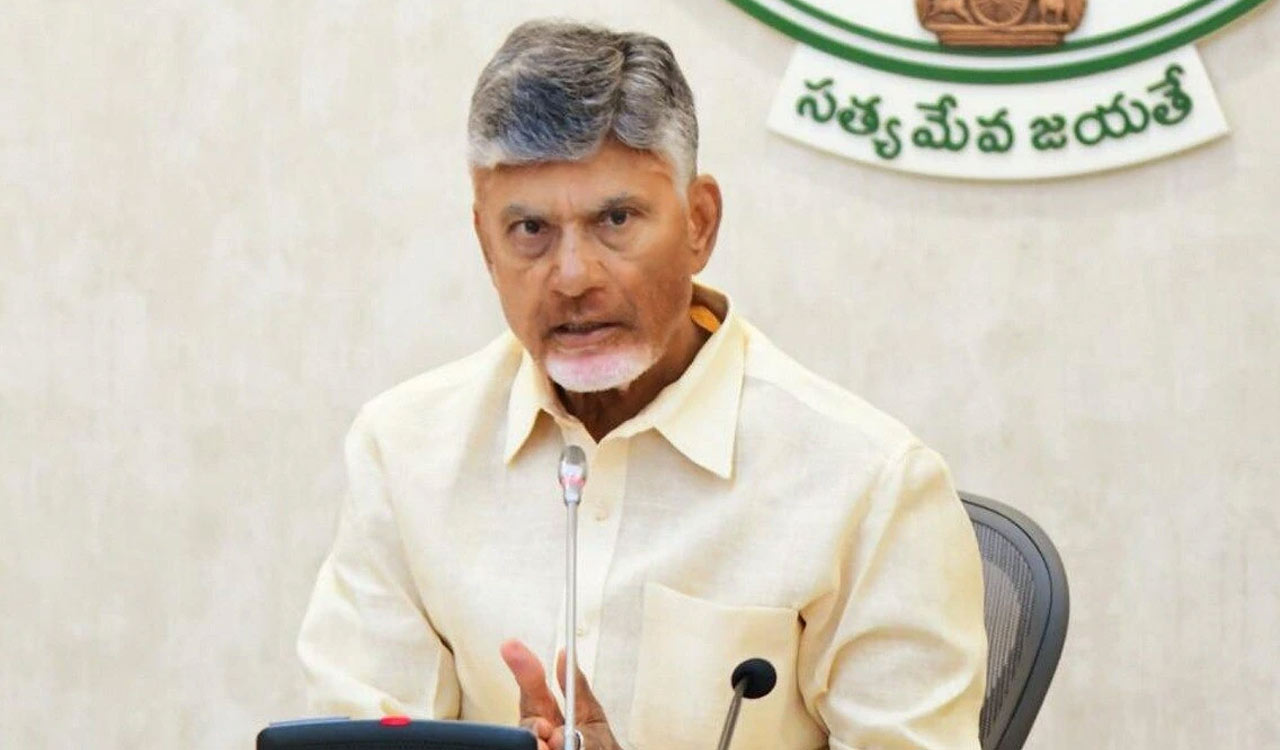
Naidu Defends Data Centres, Says Projects Will Deliver Lakhs of AI Jobs and Make Anakapalli a Knowledge Hub
ANAKAPALLI, August 22: Andhra Pradesh Chief Minister N Chandrababu Naidu on Saturday strongly defended the cluster of data centre projects coming up in the state, asserting that they would create lakhs of artificial intelligence-related jobs and help build a knowledge economy. Addressing a public meeting at Alamandakoduru village in Anakapalli district as part of the Swarna Andhra-Swach Andhra programme, Naidu said that a section of people was deliberately spreading misinformation about data centres without understanding their benefits. He pointed out that construction of data centres has not yet begun, yet complaints are already being made about falling water levels in the region. Naidu said one data centre project had already led to five, and if 5 GW capacity of data centres were to be established, the state could see the emergence of lakhs of AI professionals. “Some people are indulging in unnecessary misinformation against data centres. They do not know about the benefits that will flow from data centres,” he told the gathering. The chief minister’s comments come at a time when large-scale technology infrastructure projects across India have drawn both investment enthusiasm and public concern over environmental sustainability. Naidu sought to calm those concerns by projecting the projects as a catalyst for employment, with a particular emphasis on artificial intelligence, a field that he argued would dominate the future global economy. His speech set the tone for the rest of the event, in which he outlined the transformative potential of the district and contrasted his government’s approach with that of the previous administration. The Swarna Andhra-Swach Andhra programme, focused on development and cleanliness, has become a platform for the Chief Minister to directly engage with rural communities and showcase the state’s new industrial ambitions.
Naidu devoted considerable attention to the issue of water consumption, which has emerged as the main point of criticism against data centres. He said all the data centres put together would require only 3.5 TMC of water, and that the state had a clear plan to ensure supply. Water from the Polavaram project, he said, would be brought up to Anakapalli to fill all the ponds in the region. In the first week of September, Godavari River water would reach Anakapalli, he announced. These statements were intended to reassure residents that the technology boom would not come at the cost of drinking water or agriculture. Data centres typically need water for cooling systems, and in a state dependent on monsoons and reservoir storage, anxieties about water allocation are politically sensitive. Naidu’s argument was that the total demand was manageable and would be met through a combination of river water supply and storage infrastructure. He also highlighted the changing aspirations of the people, saying it was heartening to see children in the area talking about AI and data centres. He described it as a matter of pride that the country’s first quantum computer had come to Andhra Pradesh. This, he said, showed that the southern state was at the forefront of the next wave of technological development. By linking the data centre projects to educational ambition and local pride, Naidu sought to shift the debate away from resource consumption and towards opportunity creation. He also reminded the audience that the investment decisions were being made by global companies with long-term plans, not by fly-by-night operators.
The Chief Minister used the occasion to make a broader argument about Anakapalli’s economic rise. He recalled that there used to be a feeling that Anakapalli was lagging behind in investments. That perception, he said, had now changed completely. The district, he asserted, is attracting larger investments than Visakhapatnam, the old industrial heart of Andhra Pradesh. He pointed to the ArcelorMittal Nippon Steel plant project as one of the biggest examples of the new investment wave. In addition to steel, the region has drawn a number of major data centre projects over the past several years, including the Rs 1.35 lakh-crore Google data centre project near Visakhapatnam. Naidu stressed that Anakapalli district is transforming into a hub for all kinds of companies and is set to emerge as a knowledge economy. The combination of heavy industry, digital infrastructure, and human talent would create a unique ecosystem, he said. He highlighted that data centres would not only create direct jobs but also generate employment in construction, maintenance, security, logistics, and services. The presence of Google and other global technology firms would also send a strong signal to investors in other sectors. Naidu’s visionary language was aimed at building political support for projects that might otherwise face local resistance. He sought to present himself as a leader who could look beyond immediate challenges and plan for the long-term prosperity of the state. For residents of Anakapalli, the promise of a knowledge economy carries the hope of well-paid jobs and a better future for their children. For the government, the data centre projects serve as a flagship achievement and a central element of its narrative of development.
Naidu also turned his fire on the previous YSRCP government, accusing it of failing to provide basic infrastructure while claiming to focus on welfare. He said the previous government had not laid roads because it was busy with welfare announcements, but the current coalition government had transformed the quality of roads across the state. He cited this as an example of the difference between real development and populist gestures. The Chief Minister went on to reflect on the role of money in politics, arguing that people should take responsibility for negating the impact of money power so that politicians would refrain from committing mistakes. This was a veiled attack on the previous administration and its electoral practices. Naidu accused the previous government of “banking on destruction, crime and atrocities” and alleged that 30,000 people had died of ill-health because of spurious liquor. He also referred to several other alleged irregularities without going into detailed evidence. His rhetoric was intended to energise the party faithful and to remind voters of the governance failures that led to the change in government. It also served a strategic purpose: by painting the previous government as both corrupt and incompetent, Naidu hoped to deflect attention from any difficulties faced by his own administration. He called on citizens to be active watchdogs, because a society that rejects money power would force politicians to behave ethically. This part of the speech blended moral appeal with political messaging, a hallmark of Naidu’s public meetings. He repeatedly emphasised that his government was focused on outcomes and measurable development, not just symbolic gestures.
In the field of education and public employment, Naidu took a strong stand on teacher recruitment. He said the government had overcome around 300 alleged petitions against the ‘Mega District Selection Committee’ (DSC) to give jobs to candidates. The YSRCP, he complained, was now making allegations after the jobs had been given. “Not even one per cent of corruption has occurred in DSC and we will not let it happen,” he asserted. He then alleged that massive irregularities had occurred in the Group-I (2018) examination evaluation under the previous YSRCP government. According to Naidu, plumbers, domestic workers, attenders and electricians were among those who evaluated Group-I examination answer scripts at that time. Now, he said, when these truths are emerging, the opposition is speaking ill about DSC recruitment. The allegations are significant because recruitment examinations are a highly sensitive issue in Andhra Pradesh. Thousands of youth depend on these exams for government jobs, and any suggestion of manipulation can trigger public anger. Naidu’s assertion that the current government had conducted DSC without corruption was aimed at reassuring candidates and their families. His attack on the previous government’s evaluation process sought to establish that the YSRCP was in no position to lecture anyone on fairness. By recounting the alleged use of unqualified people to evaluate answer scripts, he tried to paint a picture of systematic corruption in the previous regime. He stressed that only people with the right qualifications and integrity should be involved in evaluating candidates for government positions. The issue is likely to remain contentious, with the opposition expected to respond to these allegations in the coming days. For now, Naidu has put the onus on the previous government to answer for its handling of the recruitment process.
Naidu also urged that sports be encouraged alongside education, and said the government had increased jobs under the sports quota from two per cent to three per cent. He lashed out at the opposition for questioning the sports quota jobs, insisting that these appointments were made in accordance with Central government policies. This announcement was meant to appeal to sportspersons and youth, an important constituency in any election state. The Chief Minister’s overall message was that Andhra Pradesh, and particularly Anakapalli, was entering a new era of development and opportunity. He called on the people to join hands with the government in creating a society free from the influence of money and corruption. The data centre projects, the steel plant, the quantum computer, and the improved road network were all part of an interconnected vision for the future. Naidu’s speech at Alamandakoduru was more than a routine public meeting address; it was an attempt to frame the political and economic narrative of the state for the coming months. He presented data centres as symbols of progress, not sources of environmental stress. He presented the previous government as a failed experiment that had harmed the state. And he presented himself as a leader with a clear plan for the future. Whether the opposition’s concerns about water use and recruitment will gain traction remains to be seen. The government will need to deliver on its promises of water supply and job creation to sustain the enthusiasm that Naidu seeks to generate. If it does, Andhra Pradesh could indeed emerge as a powerful example of technology-led development in India. If not, the misinformation narrative that Naidu dismissed may become increasingly difficult to counter.