


Data centre misinformation will not derail Andhra’s knowledge economy push: CM Naidu
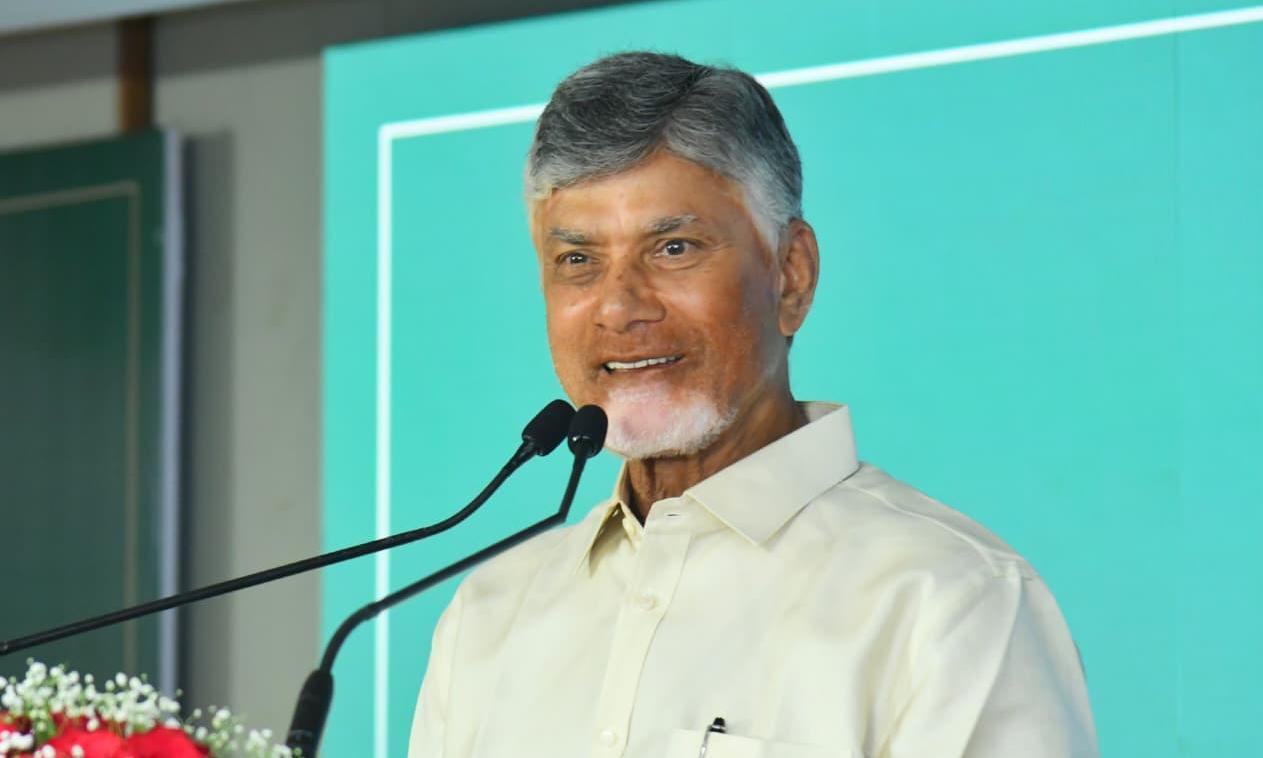
Anakapalli: Andhra Pradesh Chief Minister N Chandrababu Naidu on Saturday strongly defended the state’s emerging data centre ecosystem, accusing critics of spreading “unnecessary misinformation” without understanding the transformative benefits these projects will bring. Addressing a large public meeting at Alamandakoduru village in Anakapalli district during the Swarna Andhra-Swach Andhra programme, the Chief Minister said that construction of data centres has not even begun, yet certain sections are already complaining about depleting groundwater levels. He dismissed such claims as baseless and driven by ignorance, insisting that the state government’s push for data centres is part of a larger vision to make Andhra Pradesh a knowledge economy. Naidu’s remarks come amid growing political debate over the environmental and water impact of large-scale data centre projects, including the recently announced Rs 1.35 lakh-crore Google data centre near Visakhapatnam. The Chief Minister sought to reassure the public that water requirements for all proposed data centres would be minimal and fully manageable with the state’s irrigation infrastructure. He also took the opportunity to contrast his government’s development agenda with the previous YSRCP regime, accusing it of neglecting basic infrastructure and indulging in corruption and irregularities. The public meeting was part of the government’s outreach to highlight achievements and future plans, with Naidu focusing heavily on the region’s transformation into an investment hub.
The Chief Minister elaborated on the immense potential of data centres, noting that one project has already led to five more in the pipeline. He said that if data centres with a total capacity of 5 GW are established in the southern state, lakhs of AI professionals will emerge, positioning Andhra Pradesh as a major player in the global digital economy. Addressing concerns about water usage, Naidu clarified that all data centres put together would require only 3.5 TMC of water, a negligible amount compared to the state’s available water resources. He highlighted that water from the Polavaram Project would be supplied up to Anakapalli to fill all ponds, ensuring that local water bodies are rejuvenated rather than depleted. In the first week of September, he added, Godavari River water will be brought to Anakapalli, further strengthening the region’s water security. The Chief Minister expressed pride in the fact that children in the area are now talking about AI and data centres, calling it a sign of changing times. He also noted that the country’s “first” quantum computer has come to the southern state, a milestone that underscores Andhra Pradesh’s growing technological stature. By linking data centre development with education, innovation and future job creation, Naidu sought to counter the narrative that these projects are harmful to the environment or local communities.
Naidu went on to highlight the remarkable turnaround of Anakapalli district, which was once perceived as lagging behind in attracting investments. He asserted that the district is now drawing larger investments than even Visakhapatnam, citing major projects such as the ArcelorMittal Nippon Steel plant as evidence of this shift. The Chief Minister stressed that Anakapalli is transforming into a hub for all companies and is set to emerge as a knowledge economy, with data centres, steel manufacturing and other industries driving growth. He credited his government’s proactive policies and stable administration for creating an investor-friendly environment. Over the past few years, Andhra Pradesh has attracted several major data centre projects, including the landmark Google data centre project near Visakhapatnam, which involves an investment of Rs 1.35 lakh crore. These projects, Naidu said, are not just about infrastructure but about creating a future-ready ecosystem that will generate employment, foster innovation and attract global talent. He urged the people to understand the long-term benefits of such investments and not be swayed by false propaganda. The Chief Minister’s remarks were aimed at reassuring the local population that the government is committed to balanced development, where industrial growth and environmental sustainability go hand in hand.
In a sharp attack on the previous YSRCP government, Naidu accused it of failing to build roads while claiming to focus on welfare. He said the coalition government has transformed the road network across the state, bringing tangible improvements to rural and urban areas alike. Reflecting on the influence of money in politics, the Chief Minister said that people should take responsibility for negating the impact of money power so that politicians will refrain from committing mistakes. He accused the previous government of “banking on destruction, crime and atrocities,” and claimed that 30,000 people died of ill-health due to spurious liquor, along with several other alleged irregularities. Naidu’s criticism of the previous regime was sharp and personal, as he sought to draw a clear contrast between his government’s development-oriented approach and the alleged failures of the opposition. He argued that the previous government’s policies were driven by short-term political gains rather than long-term public welfare. The Chief Minister also touched upon the issue of welfare, saying that while welfare schemes are important, they cannot be a substitute for infrastructure development and economic growth. His remarks were met with applause from the crowd, reflecting the political mood in the region. By highlighting the alleged failures of the YSRCP government, Naidu aimed to consolidate support for his party and the coalition government ahead of future elections.
On the contentious issue of teacher recruitment, Naidu defended his government’s conduct, saying that it had overcome around 300 petitions against the Mega District Selection Committee (DSC) process to provide jobs to deserving candidates. He accused the YSRCP of making baseless allegations after the jobs had already been given, and asserted that not even one per cent of corruption has occurred in the DSC recruitment process. “We will not let it happen,” he declared, vowing to maintain transparency and fairness in all government recruitments. The Chief Minister also alleged that massive irregularities had taken place in the Group-I (2018) examination evaluation during the previous YSRCP government. He claimed that plumbers, domestic workers, attenders and electricians had evaluated Group-I examination answer scripts, a serious charge that he said is now emerging as the truth. Naidu said that when these “truths” are coming to light, the opposition is trying to deflect attention by talking ill about the DSC recruitment. He reiterated his government’s commitment to merit-based appointments and accused the previous regime of undermining the integrity of the recruitment process. The Chief Minister’s comments are likely to intensify the political battle over education and employment, both of which are key issues for voters in Andhra Pradesh. His defence of the DSC process was aimed at reassuring the youth and their families that the current government is committed to fair and transparent recruitment.
In addition to education, Naidu underscored the importance of sports, saying that sports should be encouraged along with academics for the holistic development of youth. He announced that jobs under the sports quota have been raised from two per cent to three per cent, a move that will benefit sportspersons across the state. The Chief Minister lambasted the opposition party for questioning sports quota jobs, saying that they are being given as per Central government policies. He argued that the increase in sports quota is a reflection of his government’s commitment to nurturing talent in athletics and other disciplines. Naidu’s remarks were part of a broader message about the need to create opportunities for the youth in every field, whether it is technology, industry, education or sports. He reiterated his vision of a “Swarna Andhra” (Golden Andhra) and “Swach Andhra” (Clean Andhra), where development is inclusive and sustainable. The Chief Minister concluded by urging the people to support the government’s efforts to transform Andhra Pradesh into a leading state in the country, and to reject the negative politics of the opposition. With a mix of development promises, political attacks and future vision, Naidu’s address at Alamandakoduru was a clear attempt to position his government as the architect of a new, prosperous and knowledge-driven Andhra Pradesh. The event also served as a platform to reinforce the government’s achievements and to set the agenda for the coming months.