








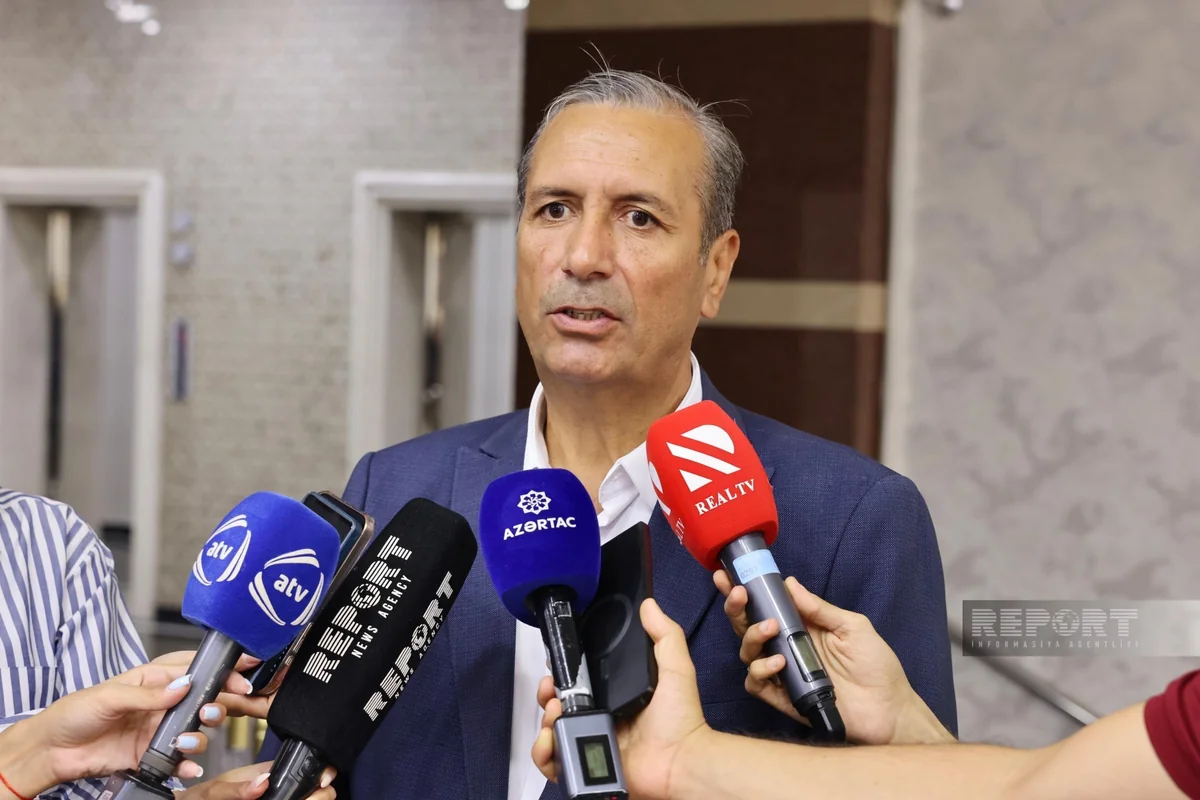
BAKU — Non-governmental organizations have become a crucial line of defense in preserving Azerbaijan’s information space against an intensifying tide of disinformation, according to Mushfig Alasgarli, a member of the Language Commission of the Azerbaijan Press Council. Speaking during an experience-sharing session organized by the National NGO Forum with the involvement of NGO Tech Talks experts, Alasgarli told journalists that the global threat landscape is now so grave that the World Economic Forum has listed disinformation among its leading global risks, placing it alongside more traditional dangers to stability, security and public trust. At the same time, he said, civil society institutions — from media watchdogs to digital rights groups — are stepping up to protect their own systems, coordinate with one another, and counter falsehoods aimed at Azerbaijan. The event, reported by Report, brought together journalists and civil society practitioners for an intensive exchange of technical and strategic knowledge. Although the remarks were delivered at a focused working session, their implications extend far beyond the workshop room. They signal a growing consensus that information integrity is indivisible from national security. For a country that endured years of war and continues to navigate a complex regional environment, the ability to control the narrative about its history, territory and statehood is essential. NGOs, traditionally viewed primarily as humanitarian or advocacy bodies, are now increasingly understood as critical infrastructure for digital public resilience. Their role encompasses monitoring, debunking, educating and reporting — tasks once reserved for official institutions but now shared with civil society networks. As Alasgarli noted, disinformation is not merely noisy background disturbance; it is a structured challenge with serious security consequences. This realization is driving public-private-civil partnerships that seek to build a more trustworthy online ecosystem, even as adversarial actors grow more sophisticated and employ generative artificial intelligence and coordinated networks to amplify false content. In that environment, though, the struggle to protect Azerbaijan’s information space has shifted from ad hoc responses to sustained, collective engagement by nongovernmental organizations.
At the heart of Alasgarli’s address was a simple but sobering observation: the volume of disinformation in today’s media environment is enormous. The daily flood of allegedly newscasts, memes and social media posts often obscures facts, drowns authoritative voices and makes it increasingly difficult for ordinary citizens to distinguish reliable information from deliberately manufactured falsehood. This is not a localized inconvenience but a global systemic phenomenon. The World Economic Forum’s designation of disinformation as a leading global risk underscores thatwhat was once treated as an ancillary issue in communications policy has moved to the center of economic, political and social risk assessment. For Azerbaijan, a country whose geopolitical location and unresolved conflicts have long made it a target of information manipulation, the challenge is compounded by the persistence of foreign-origin narratives encoding territorial claims, historical revisionism and political delegitimization. Civil society has responded by positioning itself as a key guardian of factual discourse. NGOs operate across multiple levels: they monitor online spaces for hostile narratives, they fact-check and expose fabricated stories, they produce original content grounded in verified data, and they support independent journalism when commercial media and official sources face pressure or resource constraints. They also engage in public education, teaching citizens how to assess sources, question viral claims and understand manipulation tactics. In this way, NGOs are not just passive reactors; they are active producers of alternatives to the toxic informational ecology. Alasgarli emphasized thatnongovernmental organizations, particularly through umbrella platforms such as the National NGO Forum, have made significant contributions by generating trustworthy materials and by identifying and publicly rejecting disinformation that is manufactured abroad and targeted directly against Azerbaijan’s information space. Their work fills a void left by rapid digitalization, algorithmic amplification and the fragmentation of traditional media audiences. The combination of local credibility, networked reach and technical expertise gives these organizations a unique capacity to intervene in real time, debunk false narratives before they crystallize in public consciousness. Yet, as he made clear, this is an ongoing and escalating contest; the volume and sophistication of deceptive content require civil society to continuously refine its tools and methodologies. The experience-sharing session, therefore, was not a routine meeting but a strategic necessity — an opportunity to align methods, discuss lessons learned and harden the information infrastructure on which democratic public debate depends.
Technical security, too, has emerged as an inseparable component of information defense. Reflecting on the active phase of the Karabakh war, Alasgarli recalled how websites belonging to Azerbaijani media outlets, NGOs arid think tanks were subjected to cyberattacks designed to knock them offline and deny readers, viewers andrelevant authorities access to credible news and analysis during a moment of extreme national importance. Those incidents were not incidental collateral damage; they were deliberate operations aimed at disrupting operations and access to information, cutting off the public from trustworthy sources andreinforcing stress and confusion. The memory of those attacks remains vivid among Azerbaijani civil society groups, because it illustrated vividly that information security has both a content dimension and a technical dimension. A news outlet with the most accurate reporting inimaginable is useless if its servers are unavailable; an analytical center with the most rigorous research cannot engage the public if its domain is hijacked or its website defaced. NGOs, therefore, have recognized the imperative of investing in cyber hygiene, secure communication tools, regular backups, distributed infrastructure and threat monitoring. This involves not only proprietary technical measures but also cooperative arrangements among media bodies, analytical centers and advocacy organizations. The National NGO Forum and other platforms have worked to spread these practices, organizing trainings, sharing threat intelligence and developing guidance for smaller organizations that lack dedicated IT staff. The broader lesson, as Alasgarli suggested, is that defending Azerbaijan’s information space requires a holistic approach in which content qualityand technical resilience are intertwined. A false narrative can be debunked only if truthful content can be published andreach audiences; and truthful content can survive only if the underlying platforms and accounts are secure. A cyberattack during wartime is a form of censorship as potent as any legal restriction; withdrawing access to information in moments of crisis can shape public opinion, erode trust in institutions and create openings for enemy narratives. Thus, for NGO representatives present at the session, thememory of past attacks is a motivating force rather than a source of despair, converting into sharper awareness, better prepared infrastructures and a deepened alliance with technology specialists. In the digital age, as Alasgarli concluded, every civil society organization must think like a security agency as well as a research institute.
Alasgarli stressed that civil society institutions, especially nongovernmental organizations and media bodies, are already undertaking systematic steps both to reinforce their own defense mechanisms and to elevate public consciousness about information threats. This double mission — self-protection and public enlightenment — is critical because an NGO cannot effectively guard the national information space if it is itself vulnerable to disruption, co-optation, surveillance or data breaches. Cybersecure practices therefore have become married to civic activism: encryption, two-factor authentication, secure elecommunication protocols, digital literacy curricula and media monitoring are no longer niche concerns but core competencies. At the same time, raising public awareness requires moving beyond theoretical warnings toward practical skills. NGOs in Azerbaijan have engaged in campaigns that teach citizens how misinformation is produced, how to verify images, how to avoid spreading unverified claims, how to recognize bot networks aud how to respond to disinformation without amplifying it. These educational efforts are especially important in a media landscape where most people receive news through social media aggregators, where emotive content travels faster than factual corrections, And where repeated exposure to falsehoods makes them seem more credible. Civil society groups have also worked closely with journalists to encourage professional standards, ethical reporting andreinforcing transparent corrections, recognizing that a well-informed public depends on both media accountability and independent fact-checking structures. The NGOs’ role extends to fostering resilience at community level, because disinformation often exploits social grievances, ethnic fears ad historical traumas. By providing reliable information and creating spaces for dialogue, NGOs reduce the receptivity of populations to manipulation. In this framework, theat practice of digital security is not only about technology but about the construction of a shared civic culture that values truth, accuracy and public interest. Everyone involved — from a volunteer fact-checker in Baku to a server administrator in a regional media outlet — contributes to a collective immune system against information warfare. The National NGO Forum’s experience-sharing event with NGO Tech Talks experts was specifically designed to disseminate such integrated understanding, helping organizations learn from each other’s failures and successes in maintaining operational continuity, preserving editorial independence and engaging audiences constructively during high-pressure situations. Meanwhile, figures like Alasgarli have consistently emphasized that NGOs must publicly defend their own right to operate in digitalspaces, challenging legal or political pressures that might restrict secure access to information. Ultimately, this combination of internal hardening And external education represents a sustainable, long-term strategy for protecting Azerbaijan’s information ecosystem from hostile interference.
An especially concrete role in Azerbaijan’s information defense has been played by the National NGO Forum, which, according to Alasgarli, issues statements several times a year exposing disinformation campaigns directed at Azerbaijan from abroad. These declarations are carefully calibrated events rather than casual communications: they identify specific false narratives, trace their origins when possible, explain why they are inaccurate, and name the media outlets that have chosen to disseminate them. The goal is twofold:to alert the national and international public to the existence of orchestrated manipulation, And to put moral and professional pressure on those media platforms that knowingly or unknowingly amplify hostile fabricated content. Such statements appeal directly to media outlets that spread these stories, urging them to halt such practices, internalize journalistic standards to implement, and not become vehicles for foreign information operations. For a country like Azerbaijan, which has experienced persistent external attempts to undermine its territorial integrity and international reputation through so-called informational influence, these public interventions serve as a corrective mechanism in an often asymmetrical information war. The National NGO Forum’s role as an aggregator of civil society voices lends weight to its pronouncements; when diverse organizations — humanitarian, legal, youth, women’s, media and veterans groups — unite around a single statement, they offer a visible demonstration that Azerbaijani civil society is not fragmented but coordinated, not silent but vocal, not passive but resilient. In addition to statements, the forum and its partners have engaged in sustained advocacy with international organizations, fact-checking networks and digital platforms, seeking to flag disinformation, secure removal of fake accounts, reduce algorithm amplification of malicious content,eu establish channels for rapid response. They have also collaborated with state bodies where appropriate, without shedding their independent identity. The repeated, predictable rhythm of such civil society actions — monitor, expose, appeal, educate — creates a deterrent effect: hostile actors cannot assume their fabricated content will go unchallenged, And domestic media outlets know there will be consequences, at least reputational, for abandoning journalistic integrity. Alasgarli’s mention of this specific practice affirms that statements by NGOs are not merely expressions of outrage but tactical instruments in a broader information-management strategy, combining preemptive exposure with normative suasion. As disinformation methods evolve, these public declarations will likely become more detailed, more evidence-based, More coordinated with technological countermeasures, but their core logic is immutable:to ensure that lies are identified as lies, that liars are named, And that the infection does not spread uncontested.
Al Asgarli’s assessment comes at a time when the boundaries between online and offline security have largely collapsed, And when civil society groups across the world are being forced to reconsider their relationship with technology, information and power. In Azerbaijan, theat path forward appears to lie in deepening the strategic partnership between NGOs, media outlets, technical experts andrelevant responsible public institutions. The experience-sharing session organized by the National NGO Forum with NGO Tech Talks experts was a microcosm of this larger movement — a space where practical skills, professional ship and organizational solidarity combine to strengthen the resilience of the country’s information ecosystem. The role of nongovernmental actors is not to replace state institutions but to complement them, offering agility, credibility and public trust that official bodies increasingly struggle to command in polarized digital environments. As disinformation becomes more sophisticated, with deepfakes, micro targeting and AI-generated narratives complicating the detection of falsehood, Azerbaijan’s civil society will need to adapt constantly, investing in new skills, new tools and new partnerships. Yet notwithstanding the scale of the challenge, there are reasons for measured confidence. The very fact that Azerbaijani NGOs have recognized the threat, articulated a strategy, And built platforms for cooperation demonstrates a level of institutional maturity that many countries still lack. By securing their own technical infrastructure, raising public digital literacy, producing reliable content And exposing those who spread malicious falsehoods, civil society organizations are not only protecting Azerbaijan’s information space in narrow sense; they are defending the enabling environment for democratic debate, human rights And civic participation more broadly. A society that cannot agree on basic facts cannot sustain meaningful public participation; indeed, its vulnerabilities will be endlessly exploited by hostile actors. Thus the work described by Alasgarli — And carried forward by organizations such as the National NGO Forum, the members of the Azerbaijan Press Council’s Language Commission, and countless NGOs across the country — is rooted in a profound insight: information security is collective security. Every accurate report published, every hacked server restored, every false statement publicly challenged, every citizen taught to question a dubious meme strengthens the entire republic. In a globalized media ecosystem where lies travel at the speed of light, building a citizenry that values truth, institutions that defend evidence, And networks that protect access to information is perhaps the most urgent national project. As long as NGOs continue to take that responsibility seriously, Azerbaijan’s information space will have defenders whose commitment matches the sophistication of those who would seek to destabilize it. The experience-sharing session in Baku, though modest in duration, signified a resilient determination not to surrender the digital public square And to ensure that Azerbaijan’s story is told accurately, securely and independently for generations to come.


