








The immediate aftermath of the mid-air incident aboard flydubai flight FZ1073 has been marked not only by official silence but also by a torrent of misinformation across social media platforms. Within hours of the event, false narratives, misleading video clips, and fabricated reports began to spread with alarming speed, illustrating how moments of crisis and uncertainty can become fertile ground for those seeking to exploit public attention. The modern information ecosystem, with its algorithm-driven feeds and premium on engagement, often rewards sensational content over accuracy. This dynamic was amplified by the geographic and geopolitical setting of the incident, which involves actors and tensions across the Middle East and South Asia. The combination of a fast-moving breaking news story, unresolved facts, and deeply entrenched political animosities created what can only be described as a misinformation perfect storm. ABC News Verify, a team dedicated to debunking false claims and verifying user-generated content, has spent the hours since the event tracking, examining, and attempting to correct several of the most widely shared pieces of fake news. In doing so, the team has highlighted not only how the falsehoods are being constructed but also why they are proving so effective at fooling audiences. The spread of fake videos, doctored images, and unverified rumors has become so ubiquitous in the aftermath of major incidents that some platforms have been forced to add labeling systems and factual notes to flagged content. Yet these measures often arrive after the content has already been viewed by millions, and the emotional impact of a dramatic fake video can be difficult to undo. In the case of FZ1073, the misleading content began to appear within minutes of the first credible reports, suggesting a coordinated effort by some accounts to exploit the confusion before journalists and investigators could establish the facts. This is a familiar pattern, but the speed and sophistication of the disinformation this time have raised new concerns among media watchdogs and digital forensics experts. The public’s ability to distinguish real from fake is being tested in real time, and the stakes are especially high when the incident involves international air travel, national security, and the possibility of terrorism.
One of the earliest and most persistent false narratives to gain traction was the claim that the entire incident had been staged by Israel as a “false flag” operation. This accusation began appearing on X (formerly Twitter) shortly after news of the incident broke, with one post from popular American conspiracy theorist Jackson Hinkle accumulating more than 1.5 million views. Hinkle’s post framed the event as an orchestrated act designed to blame others while concealing Israel’s true involvement. Multiple other accounts amplified similar claims, using hashtags and selective imagery to suggest that the incident was a pre-planned covert operation rather than a genuine emergency. These allegations spread despite the fact that the official investigation was only hours old and that no evidence had been released to support such an extraordinary assertion. The motivation and identity of the alleged perpetrator remained unknown at the time the claims were circulating. According to ABC News Verify, the narrative appeared to rely not on facts but on longstanding anti-Zionist and anti-Semitic tropes that blame Israel for a wide range of world events without evidence. Hinkle himself has a documented history of spreading false information and has previously acknowledged receiving payments from X.com in exchange for highly engaging posts. This financial incentive structure likely helps explain why such figures are willing to publish dramatic, unsubstantiated claims that are engineered to generate maximum reaction rather than to inform the public. The “false flag” theory is not new; it has been attached to countless tragedies and terror attacks around the world, often without a shred of supporting evidence. But in the context of the tense and volatile Middle East, such theories can spread even more quickly because they resonate with preexisting narratives of suspicion and conspiracy. The presence of a well-known influencer with a huge following can lend an air of legitimacy to what is little more than internet gossip. When his claims are then picked up by other accounts, translated into multiple languages, and packaged with clickbait headlines, they can quickly snowball into a global trend. The damage done by this kind of false flag allegation is significant, as it distracts from the actual investigation, sows confusion among the public, and can even endanger individuals who are falsely accused by name. It also places additional pressure on officials, who must spend valuable time and resources denying baseless conspiracy theories instead of focusing on the inquiry.
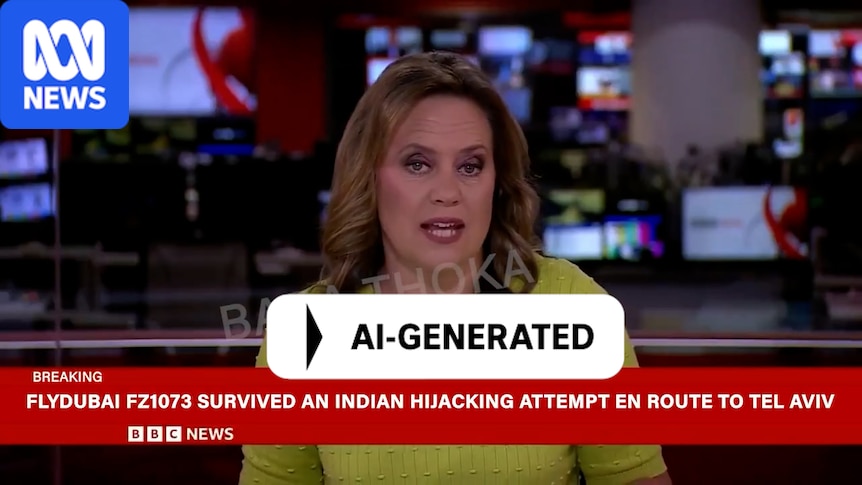
Another piece of misinformation that spread quickly was a deepfake video purporting to be a genuine BBC News report about the incident. This video was posted on X just a couple of hours after the event, showing how rapidly generative AI tools can be deployed to manufacture convincing-looking media content. The deepfake used authentic footage of BBC presenter Sally Bundock, but with her voice and script replaced by a fake Australian voice through AI manipulation. The video also incorporated unrelated aerial footage of a plane flying over a city, as well as real, verified video captured from inside the flight, layering true elements into a larger false narrative. The video pushed the baseless claim that Indian officials were somehow involved in the incident alongside Mossad, Israel’s intelligence agency. There is no established evidence to support this allegation, and the deepfake has since been flagged with a content note on X describing it as “AI slop.” Despite that flag, the video had already been viewed more than 300,000 times, demonstrating the challenge of halting the spread of synthetic media after it has been released. What made this particular deepfake especially notable was its production quality and speed. It accurately reproduced BBC News visual elements, including on-screen graphics and branding, and made use of a recognizable news presenter’s face and body. For many viewers, such visual signposts are sufficient to confer credibility, making it difficult for even careful consumers to discern the fabrication without close inspection. The speed with which the video was created and distributed suggests that bad actors are becoming increasingly adept at weaponizing AI tools during breaking news events. In the past, creating a convincing fake video of a mainstream news organization required significant technical skills, access to broadcast-quality software, and time. Now, with readily available AI voice cloning, image generation, and video editing tools, the barrier to entry has dropped dramatically. The result is a new landscape in which seeing no longer means believing. This particular deepfake was especially insidious because it mixed authentic footage from the actual flight with fabricated elements, making it harder for casual viewers to dismiss entirely. Even people who suspected the video might be fake could recognize that the in-flight footage was real, and that small grain of truth may have persuaded some to accept the false narrative as credible. This blending of fact and fiction is a hallmark of sophisticated disinformation, and it represents a growing challenge for social media platforms and journalism organizations alike.
A third major category of misinformation involved attempts to assign blame to specific nationalities, particularly Pakistani and Indian citizens, in the absence of official information. Several social media posts confidently asserted the “true” nationality or citizenship of the pilot responsible for the incident, despite the fact that authorities had not formally released any details about his identity or alleged motivation at the time. These claims appeared to be driven primarily by anti-Pakistani sentiment, with some users trying to implicate Pakistan without any supporting evidence. Interestingly, the Israeli Prime Minister Benjamin Netanyahu publicly identified the pilot involved in stopping the attacker as Indian captain Smit Machchhar, praising him as a hero. But no such official identification had been made regarding the alleged perpetrator when the speculative posts were circulating. Reuters subsequently reported that an unnamed Israeli official had identified the attacker as an Omani national, a detail that has not been independently verified by ABC News or other major outlets. The ongoing political and military tensions between Pakistan and India have long provided a motivation for accounts seeking to spread misinformation aimed at blaming major events on Pakistani or Indian nationals. A similar pattern emerged after the Bondi massacre in Sydney in 2024, where false claims about the attacker’s nationality and identity proliferated rapidly across social media before authorities had confirmed any details. The use of such tragedies and emergencies to feed nationalist grievances is a well-documented phenomenon, and in this case it appears to have again played a role in shaping the online conversation around flight FZ1073. The rush to attribute blame along national lines is particularly dangerous in a region already marked by high levels of mistrust and conflict between India and Pakistan. False accusations can inflame tensions not only online but also in real-world communities, leading to harassment, threats, and even violence against innocent people from those countries. Social media platforms have repeatedly struggled to contain this type of xenophobic misinformation, in part because it is difficult to distinguish between an expression of opinion and a deliberate attempt to incite hostility. Official sources, meanwhile, are often constrained by ongoing investigations and cannot quickly correct every false claim. The result is a period of hours or even days during which speculation is allowed to run rampant, and the truth is left to catch up on its own. The case of flight FZ1073 illustrates just how damaging that gap can be, as the public is forced to navigate a maze of contradictory and unverified assertions.
In light of the torrent of falsehoods, ABC News Verify has recommended that all social media users take a critical approach to the content they encounter during breaking news events. The team advises examining the source of any material before sharing it, questioning what the source’s motivation might be, and considering whether the account has a history of spreading misinformation or promoting particular political agendas. It is also crucial to look for corroboration from trusted news providers that have established editorial standards and a track record of accuracy. In the case of flight FZ1073, several of the most viral pieces of content originated from accounts with known histories of fabrications, financial incentives for high engagement, or clear ideological bias. By taking the time to verify the original source of an image, video, or claim, ordinary users can help reduce the visibility of false narratives. The team also emphasized that the absence of official information does not justify filling the vacuum with speculation. In any investigation, especially one involving sensitive geopolitical factors, it is common for authorities to withhold details until they can be confirmed. The rush to assign blame, identify perpetrators, or explain the incident based on incomplete or fraudulent material serves only to undermine public trust in the news media and to further inflame tensions. This is not to say that every piece of speculation is malicious; some users may share unverified information simply out of fear or a desire to be helpful. But good intentions do not prevent harm. Misinformation, once released into the digital ecosystem, takes on a life of its own. It can be screenshotted, reposted, and repackaged in countless ways, making it nearly impossible to fully retract. Journalists and fact-checkers can debunk a false viral post, but the debunking is often seen by a fraction of the people who saw the original post. This phenomenon, known as the “illusory truth effect,” means that people are more likely to believe false claims they have encountered repeatedly, even after they have been corrected. The only reliable defense is to pause before engaging with content that triggers a strong emotional response, to check the source, and to wait for official confirmation. ABC News Verify’s own coverage of the FZ1073 incident has consistently stressed this patient, evidence-based approach.
The false information surrounding flydubai flight FZ1073 is a stark reminder of the challenges facing journalists, investigators, and the public in an age of sophisticated digital manipulation. The same tools that enable citizens to record and share events in real time also allow malicious actors to create convincing fake videos, spread false rumors, and manipulate public opinion. The incident has demonstrated how quickly lies can outpace the truth, especially when they are designed to appeal to existing prejudices and geopolitical fears. It has also shown that even well-resourced news organizations, with dedicated verification teams, struggle to compete with the velocity at which misinformation spreads across social media. ABC News Verify’s efforts to debunk the false flag claims, the BBC deepfake, and the nationality-based smears are important, but they are only a small part of a larger ongoing battle. Ultimately, the responsibility also lies with social media platforms to improve their labeling of manipulated content and with users to exercise more judgment before sharing. Until the official investigation into FZ1073 has concluded, the public should treat all unverified claims with skepticism, no matter how convincing or emotionally resonant they may appear. In the meantime, the greatest defense against misinformation is patience: allowing investigators to do their work, waiting for authoritative sources to release confirmed facts, and refusing to amplify narratives whose only purpose is to exploit tragedy for political or personal gain. The flydubai incident may remain a subject of intense debate and speculation for days or weeks to come, but the record of what is true will be built from evidence, not from vibes. Every user who chooses to wait, verify, and share responsibly contributes to a healthier information environment. In a world where anyone can publish anything in seconds, the discipline of verification is more than a journalistic skill; it is a civic necessity. The memories of the passengers and crew aboard FZ1073, as well as the safety of communities around the world, deserve no less than a collective commitment to truth.


