



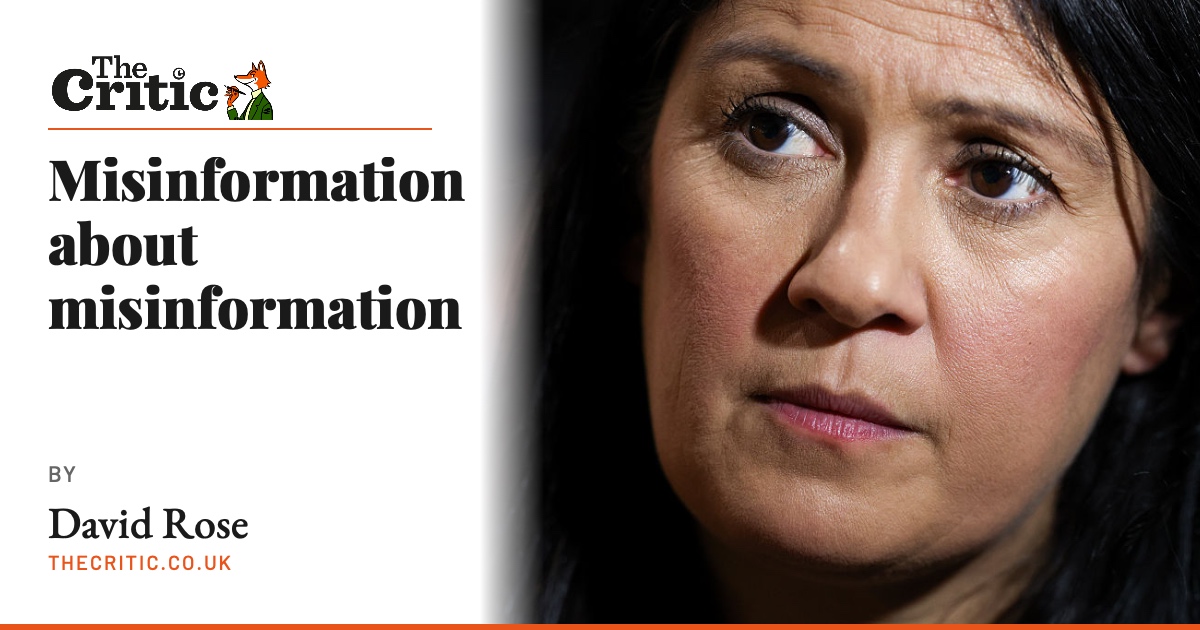
Britain is being moved toward the most extensive system of online speech regulation seen since the seventeenth century, according to a new critique of the Labour government’s plans. The phrase “misinformation about misinformation” was coined by five academics led by Ceren Budak of the University of Michigan in a paper published in Nature in June 2024, describing the gap between public claims about online falsehood and the actual research. The critique, published this week as a briefing for the Free Speech Union, applies that phrase to the evidential foundations of the current government’s proposals. Culture Secretary Lisa Nandy’s Green Paper, Watch this Space, suggests that algorithms governing social media and video-sharing platforms be compelled by law to give prominence to “regulated public service media”, so that outlets such as the BBC are “seen and heard in the fierce battle against mis and disinformation”. This is described as a zero-sum game: privileging the BBC will demote everything else. Lucy Powell, Labour’s Deputy Leader, wants the Representation of the People Bill amended so that platforms come under “some of the same requirements” of accuracy and balance as licensed broadcasters during election campaigns, a plan requiring a vast and non-existent apparatus of surveillance and censorship. Meanwhile, following amendments to the Online Safeguard Act, the media regulator Ofcom has instructed platforms to draw up protocols for restricting content during a “crisis”, defined as an “extraordinary situation in which there is a serious threat to public safety”. Beneath all of this sits a single document: a 136-page “evidence review” of mis- and disinformation commissioned by the Government Office for Science from a seven-person team at Sheffield University and published in May. It was commissioned to supply the “full evidence base” ministers admitted they previously lacked, and its tone was apocalyptic, concluding that online fake news “is now widely recognised as a systemic national risk”, that algorithms and business models contribute to its amplification and impact, and that “system-level interventions are needed”. It recommended statutory “quality signals” in ranking content, a state-linked “database of false and misleading narratives”, and official “prebunking” across education and public communications. Debates about what misinformation actually is, it added, “should not become a distraction from action”.
The review’s methodology is the first casualty of scrutiny. The review made no attempt to establish the extent of what was true or false on the internet. Instead, by its own account, its authors relied on summaries generated by large language AI models of 228 academic papers they had not read, and on monthly bulletins from the European Digital Media Observatory, a body that coordinates fact-checkers across the EU. Those bulletins record replies to questionnaires asking fact-checkers what subjects they have dealt with; the claim that health misinformation was “detected” every month means only that fact-checkers chose to check it. They do not record the number of misleading posts, the size of their audience, the standard by which they were judged false, or how many people believed them. Nor were the authors and their eleven “expert” reviewers equipped to make such judgements. The group included no climate scientist, no economist, no clinician, immunologist or epidemiologist, and no scholar of migration, although the report pronounces on misinformation about climate, EU financial policy, transgender sportspeople and “migrant entitlement”. It did include longstanding members of what has been termed the censorship industrial complex: Clare Melford, chief executive of the Global Disinformation Index; Chris Morris of Full Fact; Paula Gori, the head of EDMO itself; and Bob Ward, the London School of Economics communications officer whose output largely consists of complaints against journalists who question climate and energy policy. All are partisans in the contest the review was supposed to adjudicate, and their own work is cited repeatedly in its text: they were, the critique argues, literally marking their own homework. A freedom of information request by the article’s author elicited that the review cost the taxpayer £496,355.
The conduct of the Global Disinformation Index under Melford shows what this means in practice. The GDI, which she co-founded in 2018, does not correct falsehoods but tries to defund publishers by pressurising advertisers. It rates news websites for “disinformation risk”, compiles a “dynamic exclusion list”, and supplies it to ad agencies and their clients, so that outlets of which it disapproves are starved of revenue. In 2020, in the first wave of the Covid-19 pandemic, the GDI rebuked Senator Tom Cotton for suggesting on Fox News that the virus might have escaped from a laboratory in Wuhan, China. According to the GDI, through the broadcast of his words, a “debunked conspiracy theory” was being given “authority, validation and amplification”; it insisted that the lab leak hypothesis had been “fact checked and proven untrue” and that advertisers must withdraw from sites that echoed it. That position has not aged well, for many experts, governments and intelligence agencies have come to believe the likelihood is that the virus did escape from the poorly shielded Wuhan lab. In 2021 the GDI denounced a Spanish-language site that reported that a third of British deaths from the Delta variant were among the vaccinated, describing it as “clearly untrue”, and persuaded the restaurant chain Chipotle, whose advertisement sat beside the article, to withdraw support. Public Health England’s Technical Briefing 16, published on 18 June 2021, recorded 73 deaths in England among people confirmed to have the Delta variant; 34 were unvaccinated, ten had received one dose, and 26—36 per cent—had been fully vaccinated for more than a fortnight. More than half of the dead had received at least one dose. Meanwhile the GDI and its allies have redefined dis- and misinformation to include not only falsehoods but “adversarial narratives”: content that may be accurate but which, in the GDI’s judgement, sets people against an individual, an institution or “the science. In 2024 it told UnHerd that the site would stay on its advertiser exclusion list because it published gender-critical writers such as Kathleen Stock, whose views are protected under British law. For UnHerd, the consequences were severe: it estimated that it was receiving between 2 and 6 per cent of the advertising revenue its audience would normally command. Another leading component of the censorship lobby, the Centre for Countering Digital Hate, co-founded by Morgan McSweeney, now campaigns against the “new climate denialism”, a category that includes dissent not from the laws of physics but from Britain’s Net Zero energy policy, and voicing concern over the drawbacks of heat pumps and electric vehicles. It is a matter of record that between 2019 and 2023 the Foreign Office paid the GDI grants worth £2.6 million. Having commissioned an evidence base, the critique concludes, ministers were given a predetermined manifesto: the proposed “database of false and misleading narratives”, refreshed monthly and linked to the state, is the GDI’s bank of disagreeable narratives with a government seal of approval.
The sweeping assertion that “the governance of online platform algorithms is exclusively profit- and engagement-driven”, and therefore fosters hatred and division, rests on a single citation: a 2025 paper from staff at Universitas Muhammadiyah Buton, a small private institution in Southeast Sulawesi, ranked by UniRank as the 433rd best of 562 universities in Indonesia and the 10,370th best in the world. More significant is what the review missed: a body of research in the world’s leading journals, none of it cited, which contradicts its every finding. In the words of the Nature paper by Budak and colleagues, “public intellectuals and journalists frequently make sweeping claims about the effects of exposure to false content online that are inconsistent with much of the current empirical evidence.” Their review documented “a pattern of low exposure to false and inflammatory content that is concentrated among a narrow fringe with strong motivations to seek out such information”. Visits to 490 websites deemed “untrustworthy” on the basis of fact-checkers’ lists made up just 5.9 per cent of Americans’ clicks on news sites, and when television is added to the denominator, “fake news” accounts for roughly 0.15 per cent of the average media diet. “This reality,” the Nature authors observed, “is not reflected in public discourse about social media.” The GO-Science review appeared two years later but left that paper unmentioned. On algorithms, the largest study was conducted by researchers at Twitter itself, published in PNAS in 2022, covering seven countries and millions of accounts. It found the algorithm amplified right-of-centre legislators somewhat more than those on the left, but as for extremism, “contrary to prevailing public belief, we did not find evidence to support this hypothesis”: far-right and far-left parties in France, Spain and Germany were amplified less than moderate ones. A landmark experiment published in Science in 2023 switched tens of thousands of Facebook and Instagram users from an algorithmic feed to a simple chronological one for three months. Political attitudes did not measurably change, and the algorithmic feed turned out to have served them less content from untrustworthy sources, not more. Studies of YouTube found that consumers of extremist videos were overwhelmingly subscribers who went looking for them, not random viewers led astray by recommendations. Budak and her colleagues drew the obvious conclusion: although algorithms indisputably shape content, recent empirical evidence suggests that, on average, these algorithms tend to push users to more moderate content and to offer extreme content predominantly to those who have sought it out.
The GO-Science review inferred that misinformation may have caused “societal harms” such as Covid vaccine hesitancy. The most substantial study of that question, published in Science in 2024, combined survey experiments with Facebook exposure data covering 233 million American users. It found that content flagged as false by fact-checkers had almost no aggregate effect on vaccination intentions, for the simple reason that hardly anyone saw it: such material attracted 0.3 per cent of the 2.7 billion views of vaccine stories in the dataset. What did depress intentions was unflagged “vaccine-sceptical” content that contained no falsehoods at all, which had 46 times the aggregate impact of the material flagged as false. The single most influential item was an accurate report in the Chicago Tribune headlined “A healthy doctor died two weeks after getting a COVID vaccine; CDC is investigating why”. It was seen by more than 50 million people—over six times the views of all flagged vaccine misinformation put together. Advocates of regulation cite this study as proof that moderation must go further, but the critique argues it proves the reverse. The material with the measurable effect was truthful reporting by an established metropolitan newspaper: precisely the “trustworthy” journalism Nandy’s Green Paper proposes to amplify. A regime aimed at misinformation would have missed it; a regime capable of suppressing it would have crossed a baleful line, from correcting falsehood into suppressing accurate news that officials found inconvenient. That is a choice the censorship lobby usually leaves unsaid, although Melford of the GDI came close in 2021, explaining that her organisation had moved beyond merely checking facts because “something can be factually accurate but still extremely harmful.” If misinformation really were the threat ministers describe, one would expect its footprint to be visible in what people believe. A study published in PLOS ONE in 2022 examined national US surveys of 46 separate conspiracist beliefs repeated with identical wording since 1966, alongside polling on six theories in six European countries, including Britain, and repeated measures of generalised “conspiracy thinking.” In no instance did they observe systematic evidence for an increase in conspiracism. Of the 46 American beliefs, significant declines outnumbered increases by 15 to six. In Europe, just one theory had gained ground in a single country. Yet another belief that had grown was the assertion that conspiracy theories themselves were out of control: 73 per cent of Americans thought so, a conviction the authors attributed to alarmist statements by politicians and the press. Online conspiracy content, they concluded, might not persuade as much as reinforce existing views.
Britain has been here before. In July 1637 the Star Chamber of Charles I decreed that nothing might be published without a licence from approved authorities, with enforcement delegated to a private body, the Stationers’ Company. The categories of the forbidden—“seditious”, “scandalous”, “offensive”—meant whatever the licensers wished. The proposals of 2026 are not an exact echo, but exalted legal status for approved publishers, emergency powers over content, and official programmes to instruct children and adults in which voices to trust are that regime’s closest peacetime relatives in nearly four centuries. Charles’s measures failed, the critique notes, and he was beheaded twelve years later. Seven years after the King’s measures took effect, John Milton inaugurated England’s free speech tradition with Areopagitica, and his answer to the licensers still stands. If we believe in truth, “we do injuriously, by licensing and prohibiting, to misdoubt her strength. Let her and Falsehood grapple; who ever knew Truth put to the worse, in a free and open encounter?” The Government’s case, the critique concludes, rests on a review that read nothing, measured nothing, and ignored the research that contradicted it. On the evidence, the case for the most far-reaching apparatus to restrict peacetime speech since the ousted Stuart king indeed amounts to misinformation about misinformation.