







Titumir at DU: Critical Thinking and Research Are the Only Antidotes to Misinformation
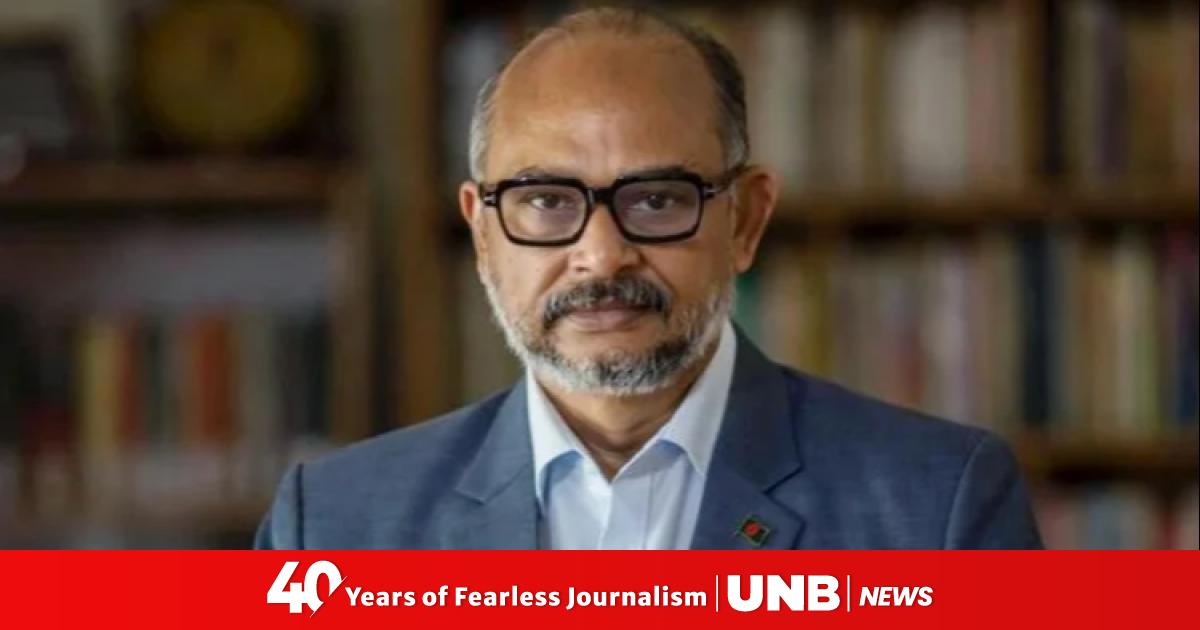
Prime Minister’s Economic and Planning Adviser Prof Dr Rashed Al Mahmud Titumir has said that in an age where false information and misinformation spread rapidly through digital platforms, the most effective defence is not censorship but critical thinking and research-based knowledge practices. “There is no alternative to critical thinking and research-based knowledge practices in combating false information and misinformation,” he said while speaking as the chief guest at an event organised at Dhaka University (DU) today to confer the Dean’s Awards on teachers and students. The ceremony, held on the university campus, brought together educators, administrators and award-winning students from different faculties to honour academic excellence and contributions to knowledge. Prof Titumir, an economist and high-level government adviser, used the occasion to deliver a broader message about the purpose of higher education in Bangladesh and the role that public universities must play in preparing citizens to navigate an increasingly complex world.
Addressing the award recipients directly, Prof Titumir said that students at Dhaka University must not merely follow conventional knowledge. Instead, they must ask questions, assess issues through reason and contribute to creating new knowledge. He argued that the era of passive learning, where students reproduce information from textbooks and lectures, cannot respond to the challenges of the twenty-first century. In an information environment crowded with rumours, manipulated media and unverified claims, the capacity to think independently is not a luxury; it is a necessity. He said the primary responsibility of a public university is to develop a sense of citizenship, skills and innovative capabilities. This vision of education goes beyond the narrow pursuit of grades and certificates. It imagines the university as a place where young people learn how to think, not what to think, and where they are trained to serve society with intellectual honesty and moral integrity.
Prof Titumir also made a clear distinction between a university that merely teaches and one that creates knowledge. He said Dhaka University should be developed not merely as a “teaching university” but as an institution that generates new ideas, theories and solutions. This is a significant statement, as it calls upon Bangladesh’s oldest and most prestigious university to redefine its institutional identity. For decades, universities in Bangladesh have struggled with limited research facilities, heavy teaching loads, outdated curricula and insufficient funding for scholarship. Prof Titumir’s remarks highlight the urgent need to shift from a culture of transmitting established wisdom to a culture of producing original knowledge. A knowledge-creating university does not only prepare students for existing jobs; it equips them to imagine new possibilities, solve unresolved problems and contribute to national development. This is particularly important for a country like Bangladesh, which aspires to move beyond the status of a lower-middle-income nation and to compete in the global economy where innovation and intellectual capital matter most.
The Prime Minister’s adviser urged the Dean’s Award-winning students to generate new ideas and theories through research and to increase Bangladesh’s contribution to the global pool of knowledge. He said that research is not a side activity or an optional add-on to academic life; it is the core of a true university. Through research, students and teachers can address pressing problems in fields such as public health, climate change, agriculture, economic development, social justice and technology. He also stressed that Dhaka University should take the lead in expanding science and mathematics education, developing practical skills and ensuring research-based education. In a world increasingly driven by digital technologies and artificial intelligence, Bangladeshi graduates need strong foundations in science, technology, engineering and mathematics. But Prof Titumir’s call is not limited to the sciences. He appeared to suggest that all disciplines, from social sciences to humanities, must embrace a spirit of enquiry and rigorous methodology. The goal is not simply to produce researchers for academic journals, but to create a society that values evidence, reason and truth.
Prof Titumir further warned that higher education should not be confined to obtaining certificates. He said students must be equipped with genuine knowledge and skills. This is a pointed critique of a system where degrees are often treated as ends in themselves, rather than as evidence of ability and understanding. In Bangladesh, as in many countries, the pressure to earn credentials can push students toward rote memorisation and examination-focused study. Such a system may produce degree holders, but it does not necessarily produce thinkers, innovators or responsible citizens. In the context of misinformation, the danger is even greater: people who have never been trained to evaluate sources, detect bias or weigh evidence may easily fall victim to false narratives. Prof Titumir’s emphasis on genuine knowledge and skills connects education to the quality of public discourse. If universities cannot teach students to think critically, then society as a whole will struggle to distinguish fact from fiction and truth from propaganda.
Finally, Prof Titumir spoke about the governance of public universities. He said that while maintaining academic freedom and autonomy at public universities is essential, ensuring good governance, accountability and public interest is equally essential. This is a balanced and important message. Public universities in Bangladesh are largely funded by taxpayers’ money, and therefore they have a responsibility to serve the public good. Academic freedom should not mean a lack of transparency or an exemption from ethical standards. It should protect scholars from political interference and allow them to pursue knowledge freely. But in exchange, universities must demonstrate that they are using public resources effectively and in ways that benefit society. Prof Titumir’s speech, therefore, was not merely a ceremonial address at an awards ceremony. It was a call for a new educational philosophy in Bangladesh—one that values critical thinking, research, creativity and social responsibility. As the award-winning teachers and students returned to their classrooms and laboratories, they carried with them a challenge: to create knowledge that is not only academically sound but also meaningful for the nation and the world. In a time of misinformation, disinformation and unprecedented global uncertainty, Prof Titumir’s message offers a clear road map: the way forward lies in minds trained to question, reason and discover.


