



Indonesia Launches Rapid Response Playbook to Combat Health Hoaxes
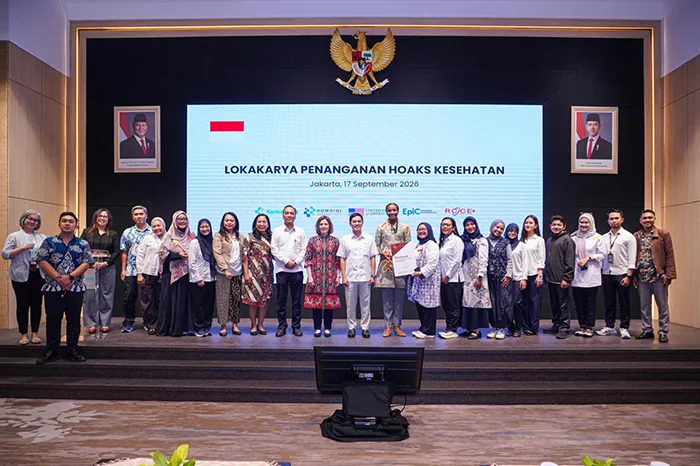
Jakarta, IO – The Ministry of Health has officially launched the Rapid Response Playbook for Health Hoax Handling, a new framework designed to counter the escalating spread of health misinformation that has increasingly influenced public decisions about medical care. Deputy Health Minister Professor Dante S. Harbuwono introduced the playbook at the National Health Hoax Handling Workshop on Thursday (17/9/2026), emphasizing that traditional methods of responding to disinformation are no longer enough. “Kemenkes continues to strengthen its hoax management system—from reforming regulations and governance to enhancing cross-sector coordination, developing an integrated hoax-handling channel, and compiling the Rapid Response Playbook,” he said. The Deputy Minister explained that the playbook turns what were previously sporadic, ad-hoc reactions into a structured, formal system for tackling health misinformation. In practice, this means faster identification of false narratives, clearer assignment of responsibilities, and a more coordinated response among government agencies, health workers, digital platforms, and community leaders. The launch comes amid growing alarm over the volume of health hoaxes circulating online and the tangible damage they have caused in communities across Indonesia. The Ministry believes that without a rapid and systematic response, hoaxes will continue to erode public trust in health institutions, discourage preventive care, and put vulnerable groups such as children and pregnant women at greater risk. The new playbook is intended to be a living document, updated as new misinformation tactics emerge, and it will guide officers in ministries, local health offices, and community health centers on how to react within hours rather than days. It also complements existing legal and digital measures, ensuring that fact-checking and public education are integrated into every stage of outbreak response and health program implementation. By formalizing the response mechanism, the Ministry is signaling that health misinformation is a public health emergency in its own right and must be treated with the same urgency as a disease outbreak.
The urgency of the new framework is underscored by recent public health setbacks directly linked to misinformation. Between 2025 and 2026, the Ministry recorded measles outbreaks across several regions, resulting in the deaths of 72 children. During the same period, polio—which causes Acute Flaccid Paralysis, a severe condition characterized by rapid onset of muscle weakness or paralysis and mainly affecting children—reemerged in Papua, West Java, Central Java, and East Java. Health officials attribute these outbreaks to a widespread loss of community immunity, allowing the viruses to spread rapidly among children and cause severe illness, permanent disability, or death. Data from Kemenkes’ Immunization Directorate show a consecutive decline in national immunization coverage, from 95 percent in 2023 to 87 percent in 2024 and further to 80 percent in 2025. To maintain herd immunity, at least 90 to 95 percent coverage must be sustained in every district and city. The drop has been fueled in large part by health hoaxes targeting immunizations, tuberculosis treatment, breastfeeding, dietary supplements, and vitamin programs. These hoaxes have convinced many parents to skip or delay vaccinations, leaving children unprotected against preventable diseases and undermining decades of progress in Indonesia’s immunization program. The resurgence of measles and polio is a stark reminder that vaccine-preventable diseases do not disappear simply because they have not been seen for years; when coverage falls below the critical threshold, outbreaks follow. Health workers in affected areas have reported facing suspicion and hostility from parents who have been influenced by false claims circulating on social media and messaging applications. Some families have even hidden their children’s vaccination status or refused to bring them to health facilities for treatment. This has forced health authorities to conduct intensive outreach, going door to door to rebuild trust and explain the benefits of immunization. The Rapid Response Playbook is intended to support these efforts by giving health workers clear guidance on how to address misinformation in the field, how to communicate with skeptical families, and how to coordinate with local leaders and religious figures who can help amplify accurate information.
Health hoaxes are not merely harmless rumors; they cause people to make wrong decisions and take dangerous actions. The Communications and Digital Ministry (Komdigi) has identified health as one of the categories with the highest volume of misinformation. Between August 2018 and September this year, 2,622 health hoaxes were flagged across various digital platforms, with immunization issues topping the list. Kemenkes spokesperson Aji Muhawarman stressed that the impact of disinformation goes far beyond shaping public perception. “First, in our view, hoaxes do not merely influence opinions; they cause people to make wrong decisions and take harmful actions. Second, hoaxes can lead to illness, disability, and even death. That is why we must take health hoaxes seriously,” he said. The statement reflects a growing consensus among health authorities that misinformation must be treated with the same urgency as disease outbreaks themselves. False claims about vaccine side effects, miracle cures, and the dangers of medical treatments have been linked to vaccine refusals, delayed care-seeking, and the resurgence of diseases that had been nearly eliminated. In several cases, families have chosen traditional or unverified treatments over proven medical care, with fatal consequences. The Ministry therefore sees the new playbook not as a publicity tool but as a life-saving intervention. The data from Komdigi shows that health hoaxes are not spread evenly; they often spike during disease outbreaks, national immunization campaigns, and moments of public anxiety. This pattern suggests that hoax producers exploit uncertainty to push agendas that range from promoting alternative remedies to undermining government health programs. By tracking these trends, Kemenkes hopes to anticipate misinformation before it spreads and respond with preemptive public communication. The playbook includes protocols for monitoring online conversations, identifying emerging hoaxes, and coordinating with social media companies to remove or label false content. It also emphasizes the importance of providing accurate information to journalists and community leaders so that they can serve as credible voices in the fight against misinformation.
The Ministry’s new anti-hoax architecture includes several integrated components. Kemenkes is upgrading regulations and governance, intensifying cross-sector coordination, and incorporating a dedicated reporting channel into Halo Kemenkes, the ministry’s public hotline and complaint service. The Rapid Response Playbook itself maps out cross-functional roles across ministries and agencies, detailing task allocations, expected deliverables, timelines, and standard operating procedures. It was developed together with Komdigi and the Risk Communication and Community Engagement (RCCE) Working Group, which have helped establish an integrated infrastructure and strategy to respond to false narratives swiftly and decisively. A key element is a microsite that will function both upstream and downstream: members of the public can report suspected hoaxes, while a dedicated menu on the Kemenkes website will host the latest verified articles and content. This two-way flow is intended to shorten the distance between the public and official fact-checkers, allowing misinformation to be identified early and countered before it spreads further. The microsite also gives journalists, health workers, and local officials a reliable reference they can use to debunk false claims in their communities. By consolidating all hoax-related information in one place, the Ministry hopes to eliminate confusion and ensure that every response is based on the most current scientific evidence. The playbook also outlines when and how the Ministry should issue public statements, hold press conferences, or collaborate with influencers and medical professionals to deliver accurate messages. It recognizes that different audiences require different communication strategies; a message that works for urban mothers may not be effective for rural farmers or religious communities. Therefore, the response protocols include guidance on tailoring language, tone, and delivery channels to reach the most vulnerable populations. The Ministry has also established a network of spokespersons who can speak with authority on health issues and counter false narratives in real time. These spokespersons are trained to avoid technical jargon, respond to questions empathetically, and admit uncertainty when more evidence is needed. By building a trusted and visible presence in public discourse, Kemenkes aims to become the first source that Indonesians turn to when they encounter confusing or alarming health information.
Beyond structural measures, Kemenkes is emphasizing the importance of clear, empathetic, and easily understandable health communication. The Ministry has noted that protecting the public requires more than just offering medical services such as free health screenings, treatment, or vaccinations; people must also receive accurate information in a form they trust and can act on. Health messages that are technical, alarmist, or culturally insensitive are likely to be ignored or rejected, creating a vacuum that hoaxes can fill. To address this, the Ministry is training health workers and communicators to engage with communities respectfully, listen to their concerns, and provide evidence-based explanations without stigmatizing or dismissing them. This approach is especially important for immunization campaigns, where parental fears must be acknowledged and addressed rather than simply countered with facts. Health workers are being encouraged to ask open-ended questions, understand why families refuse vaccination, and provide personalized counseling that addresses specific misconceptions. For example, a parent who believes vaccines cause infertility may need a different explanation than a parent who is concerned about halal ingredients. The playbook includes case studies and communication tips to help health workers handle such conversations with patience and cultural sensitivity. The Ministry also urged the public to verify incoming health claims, rely on scientific evidence, and consult official government channels to confirm facts before sharing information. In an age when one misleading post can reach millions within hours, media literacy and community engagement are essential complements to the Rapid Response Playbook. Schools, universities, religious organizations, and community groups all have a role in teaching people how to identify reliable health information and avoid spreading rumors. The Ministry plans to work with educational institutions to integrate digital health literacy into curricula and public campaigns. It will also engage with local media outlets to ensure that accurate health reporting is accessible in languages and formats that ordinary people understand. By strengthening the information ecosystem, Kemenkes hopes to create an environment where hoaxes are quickly recognized, rejected, and reported rather than shared and believed.
With the launch of the Rapid Response Playbook, Kemenkes aims to streamline its anti-disinformation framework for faster, data-driven interventions. The initiative is expected to disrupt the spread of health misinformation while safeguarding the public from the dangers of misinformed health choices. The Ministry acknowledges, however, that no single playbook can solve the problem overnight. Sustained commitment from all levels of government, cooperation with digital platforms, and active participation from civil society and community leaders will be required to reverse the tide of health hoaxes. The playbook will be tested and refined through real-world use, and its effectiveness will depend on whether health officers, communicators, and the public embrace its protocols. At its core, the initiative is a recognition that accurate health information is a fundamental part of healthcare. As Indonesia works to recover immunization coverage, control outbreaks, and build a healthier future, the fight against misinformation will remain a top priority. The Ministry’s message is clear: every citizen has a role in stopping hoaxes, and every hoax stopped can mean a child protected, a life saved, and a healthier nation. The success of the Rapid Response Playbook will ultimately be measured not by the number of documents distributed or workshops held, but by its impact on public behavior and health outcomes. If immunization coverage rises, if outbreak responses become faster and more effective, and if Indonesians become more critical consumers of health information, then the new framework will have achieved its purpose. Kemenkes has committed to regular monitoring and evaluation, with adjustments made as new challenges emerge. In the end, the fight against health hoaxes is not just about correcting falsehoods; it is about building a society that values truth, trusts science, and protects the health of all its members. (est)