


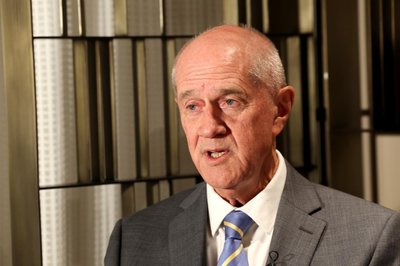
South Africa’s Ambassador to the United States, Roelf Meyer, has called for a renewed commitment to dialogue and honest communication as the most effective way to repair the deteriorating diplomatic relationship between Pretoria and Washington. In remarks reflecting growing concern over the trajectory of bilateral ties, Meyer argued that much of the current strain stems not from fundamental disagreements over policy, but from widespread misinformation about South Africa’s domestic efforts to overcome the legacy of apartheid. He singled out claims that the South African government is supporting violence against minority groups, including the repeated accusation of so-called genocide, as particularly damaging and untrue. “There’s a lot of misrepresentation about that, as if there is government-initiated violence taking place, so-called genocide and things like that,” Meyer said. “We all know it’s not true, but that is the narrative that is being broadcast by some, and we have to address that and find ways to bring the real story across.” His comments come at a time when the two countries are navigating their most tense period in years, marked by unilateral action from the United States and an emphatic insistence from South Africa that it will not abandon its constitutional and social obligations. The ambassador’s call for better communication is not simply a diplomatic nicety; it is an acknowledgment that the gap in perception between the two capitals has grown wide enough to fuel concrete measures which, in turn, risk reinforcing mutual mistrust. Meyer, who has deep experience in South Africa’s own negotiated transition from apartheid, understands better than most that hostile narratives can become entrenched if they are not countered effectively. His appeal for dialogue is therefore both an opening gesture and a warning about the direction in which the relationship is heading. He cautioned that without a coordinated effort to correct the record, the relationship could continue to spiral downward, harming not only diplomatic interests but also trade, investment and people-to-people ties. He stressed that the primary responsibility for conveying the country’s true story rests with South Africa itself, and that government officials must be willing to engage with international media and political leaders who may be hostile to the government’s transformative agenda.
At the heart of the current standoff is a recent United States decision to impose visa restrictions on South Africans whom Washington deems responsible or complicit in policies promoting race-based discrimination, inciting imminent violence against racial or ethnic minorities, or enabling expropriation without compensation. The announcement did not identify any individuals who would be affected, creating an atmosphere of uncertainty within South African official circles and among those whose work touches on land reform and social justice. The restrictions were widely interpreted as a direct response to legislation adopted by South Africa’s Parliament, particularly the Expropriation Act, which allows the government to acquire land without compensation in certain public-interest cases. The US action followed months of verbal attacks by President Donald Trump on South Africa’s land reform programme and employment equity laws, which are designed to address the deep economic disparities that remain more than three decades after the end of white minority rule. For many South Africans, the visa restrictions represent a foreign government imposing its interpretation on a sovereign state’s attempt to rectify historical injustice. For supporters of the measures, they are a necessary response to policies they believe target a particular racial group. Although the US State Department did not explain how the visa restrictions would be implemented or which officials might be barred from entering the country, observers noted that the move was unprecedented in recent memory. It placed South Africa in a select group of nations subjected to such measures over internal social policies. The lack of specificity also made it difficult for Pretoria to know what actions could ease the situation, or whether the restrictions were intended primarily as a symbolic rebuke. Legal experts argued that the US criteria were framed so broadly that they could apply to almost any official involved in the expropriation process, from local councillors to national ministers. Some worried that the restrictions could extend to judges who rule on land cases or to activists who campaign for land reform. The ambiguity, Meyer suggested, makes dialogue more difficult because South Africa cannot respond effectively to charges that are vague and unsubstantiated. Trump has a history of asserting, without evidence, that South Africa is confiscating white-owned farms and committing what some right-wing commentators call “white genocide.” During his first term, he requested an investigation into farm seizures, and the issue became a rallying point for conservative groups in the United States. South Africa’s government repeatedly denied the allegations, pointing to official statistics showing that property rights are protected by the Constitution and that expropriation, when it occurs, follows a rigorous legal process. Nevertheless, the narrative persisted and now appears to have influenced formal US policy.
Meyer’s references to misinformation and “so-called genocide” speak to a broader campaign that has sought to depict South Africa as a place of racial conflict where the rights of minority communities, especially white farmers, are under systematic attack. This narrative gained international traction through social media and has been amplified by certain political groups in the United States with ties to conservative and nationalist movements. The accusation of “white genocide” has been repeatedly debunked by academic researchers and fact-checking organisations. Statistics show that farm murders, while tragic and a serious concern, have not increased in the way activists often claim, and the murder rate across all racial groups remains a far broader crisis. South African officials have argued that the focus on farm murders is a misdirection, designed to obscure the fact that black South Africans are overwhelmingly the victims of violent crime. The government has also noted that land reform is a constitutional imperative, not a plan to dispossess any group arbitrarily. Meyer’s insistence that “we all know it’s not true” is therefore an attempt to shift the conversation back to evidence and reality, rather than allowing sensational allegations to determine foreign policy. The message has been slow to take hold in Washington, however, where conservative media figures and some Republican lawmakers have repeatedly featured South Africa’s land debate as an example of racial injustice against whites. A number of American politicians have visited South Africa and returned with highly selective accounts, often guided by local groups that oppose the government’s reform agenda. These visits produced dramatic footage and emotional testimony but little context about South Africa’s history of land dispossession under colonialism and apartheid. Meyer and other South African diplomats have tried to counter by organising briefings with journalists and think tanks, but the sheer scale of the misinformation is overwhelming. They argue that the US visa restrictions are only the latest manifestation of a persistent campaign to portray the country as a failed state. This campaign, they say, is dangerous not only because it damages the country’s reputation, but because it distracts from real challenges such as inequality, unemployment and crime, and it encourages Washington to adopt policies that punish ordinary South Africans.
South Africa’s Minister of International Relations and Cooperation, Ronald Lamola, responded to the US visa restrictions with a firm statement of principle. He said South Africa would continue to pursue racial redress despite the punitive measures, and he rejected claims that government policies are discriminatory or violent. Lamola called for constructive diplomatic engagement between Pretoria and Washington, suggesting that the two countries should not allow partisan politics in the United States to dictate the terms of their relationship. His response was notable for its restraint; there was no talk of retaliation or reciprocal sanctions. Instead, the minister sought to frame the issue as one of mutual respect and understanding. South Africa will not be deterred from its constitutional obligations, he said, in comments that echoed President Cyril Ramaphosa’s earlier assurances that land reform would be implemented lawfully, transparently and without undermining property rights. The government’s position is that the visa restrictions are not only unjustified but also counterproductive, because they impede the kind of people-to-people contact and dialogue that Meyer argues is essential. Lamola’s call for engagement was echoed by other South African officials, who pointed out that the country remains an important strategic partner for the United States in Africa. South Africa is the continent’s most industrialised economy and a key voice on continental security, trade and climate issues. Punishing Pretoria, critics inside the country argued, undermines the broader American interest in African stability and economic growth. At the same time, Lamola was careful not to inflame the situation further. His language avoided direct attacks on President Trump or on the US Congress, perhaps reflecting a calculation that a more aggressive response would only reinforce the narrative that South Africa is hostile to American concerns. Instead, he expressed a continuing willingness to talk while drawing a firm red line: South Africa cannot accept a relationship based on false premises or one that requires it to abandon its commitment to redress. Lamola also stressed that South Africa’s approach to land reform is grounded in the Constitution and in extensive public consultation, not in arbitrary seizure of property. The minister promised that the government would continue to explain its policies to international audiences, despite the difficulties of being heard above the noise.
These diplomatic tensions do not exist in a vacuum. The relationship between South Africa and the United States has been subjected to a series of shocks since Donald Trump returned to the White House. Beyond the visa restrictions, Washington has threatened to review trade preferences, suspended some foreign assistance, and voiced open support for political actors in South Africa who oppose the current government. The administration has also expressed displeasure at South Africa’s independent foreign policy, including its position on the war in Ukraine and its strengthening ties with Russia and China. For many South Africans, the increasing pressure from Washington feels like punishment for the country’s refusal to subordinate its foreign and domestic policies to the whims of the United States. At the same time, there are genuine concerns within the American establishment that South Africa is drifting away from the democratic values it embraced after 1994. Land reform, while necessary, has become a flashpoint in the United States because it is presented by critics as an attack on property rights and racial harmony. Meyer and Lamola argue that this presentation is false and that the perceptions have yet to be corrected. Economically, the stakes are high. The United States is one of South Africa’s largest trading partners, and the African Growth and Opportunity Act, or AGOA, provides preferential access to the American market for South African exporters. AGOA is scheduled for review, and US lawmakers have already introduced bills calling for South Africa’s suspension, citing land policy and the country’s ties to Russia. South African officials have lobbied intensively to keep the trade benefits, arguing that withdrawing them would damage African economies and undermine US influence on the continent. The visa restrictions, while symbolically significant, may be only the first step in a broader campaign. Meyer’s emphasis on dialogue is therefore not merely about restoring warm feelings; it is an urgent attempt to prevent further costly escalation. His challenge is that the political dynamic in Washington rewards toughness on South Africa, at least among certain segments of the Republican base. The more narratives of “white genocide” and “land seizures” are repeated, the harder it becomes for moderate voices in the United States to resist calls for punitive action. Despite the rhetoric, official channels remain open, and both governments have indicated at various points that they do not seek a complete rupture.
In the end, Meyer’s message is one of cautious optimism: relationships between countries can withstand disagreements if communication remains open and if both sides are willing to separate facts from fiction. He did not ask the United States to abandon its concerns or to cease scrutiny of South Africa’s policies. Instead, he asked for a better understanding of the context, a willingness to listen to South Africa’s own explanations, and an acknowledgment that the country is still grappling with the consequences of centuries of colonialism and apartheid. The ambassador’s use of the word “dialogue” was deliberate. In South Africa’s own political history, dialogue was the mechanism that made a negotiated transition possible in the early 1990s. The country that once seemed destined for a racial civil war found a way forward through communication, compromise and a shared recognition that continued conflict would destroy everyone. Meyer, who participated in those negotiations, appears to be applying the same philosophy to the current standoff with Washington. Whether that approach can succeed in the highly polarised atmosphere of contemporary American politics remains an open question. But he argues that there is no realistic alternative. South Africa’s strategy, according to diplomats, is to combine firmness on principle with flexibility on engagement. That means continuing to implement land reform and laws addressing equity while ensuring that all expropriations are transparent and subject to judicial review. It also means using every available platform, from embassies to multilateral institutions, to repeat the basic facts: that South Africa’s Constitution guarantees property rights; that expropriation without compensation is an exception, not a blanket policy; and that the government has no policy of violence against any group. For the United States, the next step is not necessarily to withdraw the visa restrictions, but to engage in a genuine process of consultation before judging a sovereign nation. Unless that happens, the relationship is likely to remain on a downward path, with consequences reaching far beyond the two countries. As Meyer said, the real story needs to be told. The question is whether Washington is willing to listen. The coming months will reveal whether talk of dialogue can be translated into a more stable partnership, or whether the forces of misinformation will continue to set the agenda.