


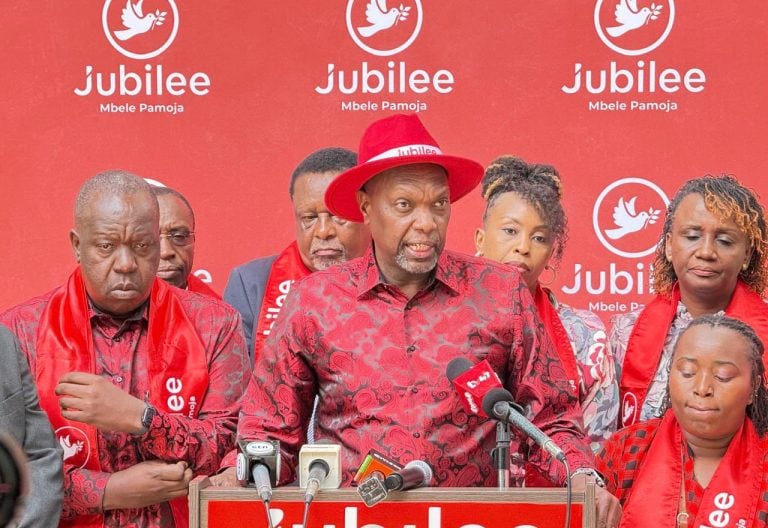
Headline: Kioni Hails Court Ruling on Retired Presidents, Declares Uhuru Firmly in Charge of Jubilee
Jubilee Party Secretary-General Jeremiah Kioni has officially backed retired President Uhuru Kenyatta in the wake of a High Court ruling that struck down a legal provision barring former presidents from active political participation. In a strongly worded statement posted on his X account on Monday, September 21, 2026, Kioni described the ruling as a significant victory for democracy, constitutionalism and the Bill of Rights, and insisted that the Constitution does not retire a citizen from exercising fundamental political rights simply because they once occupied the highest office in the land. The case was determined by Justice Bahati Mwamuye of the Kiambu High Court, who declared that Section 6(1) of the impugned law—to the extent that it imposed a disability on a retired president from holding office in a political party after six months from leaving office—was inconsistent with Article 38 of the Constitution. Article 38 guarantees every citizen the right to make political choices, including the right to join, participate and campaign for a political party. The judge further held that the restriction could have a chilling effect on political participation. Leaving the presidency, he said, does not extinguish a person’s citizenship or constitutional political rights. The transition from serving as president to becoming a retired president ends the exercise of presidential power but does not terminate the individual’s right to participate in the political life of the country. For Kioni, the decision vindicates the position that a former head of state remains a citizen with full democratic entitlements. His endorsement of Uhuru Kenyatta, the Jubilee Party leader, comes amid intense debate over party succession and transition. The ruling effectively removes a legal obstacle that could have been used to push Uhuru out of active leadership of the party.
At the heart of the High Court judgment is the recognition that political participation is not a privilege granted to citizens by legislative grace but a constitutional right that survives even the highest office. Section 6(1), as interpreted by the court, imposed a time-limited disability on retired presidents, preventing them from holding office in a political party after six months from leaving the presidency. That disability, the judge reasoned, was inconsistent with Article 38 of the Constitution. The provision sought to police the political activity of former presidents in a manner that could discourage them from exercising their rights to association, expression and political engagement. Justice Mwamuye added that the restriction could have a chilling effect on political participation, a standard that courts often use when assessing laws that burden fundamental freedoms. The judgment underscores that the office of the presidency is a temporary trust, not a permanent status that strips a citizen of their political personality. Kioni echoed this reasoning, arguing that no political convenience should be placed above the Constitution. In his view, the decision affirms that the Bill of Rights applies to all Kenyans, regardless of their previous positions. “This is a significant victory for democracy, constitutionalism and the Bill of Rights,” Kioni wrote. He argued that the Constitution does not retire a citizen from exercising fundamental political rights simply because they once held the highest office in the country. The Secretary-General framed the ruling as a step forward for the rule of law, warning that any attempt to read retired presidents out of political life would be an affront to the constitutional order. The judgment also provides a measure of legal clarity for Jubilee Party, which has been navigating internal disputes over who should lead the party in the future. With Uhuru Kenyatta now firmly within his rights to hold a party position and participate in active politics, the party’s internal governance must proceed on the basis of its own constitution and national laws.
Kioni was careful to broaden the significance of the case beyond the fortunes of any individual. He said the ruling was not merely about one person but about protecting political participation as a constitutional right. This framing is important because it shifts the debate from a narrow personality contest to a fundamental question of democratic rights. In a country where retired presidents have traditionally remained influential figures, the decision ensures that their post-presidential years are not treated as a form of political death. The retired President, according to the court, remains a citizen with the same political rights as any other Kenyan. He can support candidates, attend political rallies, campaign, and hold office in a political party. The only thing ended by the presidential transition is the exercise of presidential power. This principle aligns with the broader architecture of the 2010 Constitution, which prioritises the Bill of Rights and limits the imposition of disabilities on citizens. Kioni’s statement suggests that any law that imposes such disabilities will be subjected to strict scrutiny. He also appeared to pre-empt arguments that a retired president should somehow remain above the partisan fray. In a democracy, no one is forced to be neutral because they once held office. Uhuru Kenyatta, as the leader of Jubilee, is entitled to be fully involved in the party’s activities, including its organisation, electoral preparations, and policy direction. Kioni’s declaration that Uhuru remains in charge of Jubilee is therefore not merely a political slogan but a direct application of the High Court’s reasoning. If the retired President cannot be barred from holding a party office, then his continued leadership of Jubilee cannot be challenged on the basis of the now-invalidated statutory restriction. Rather, any leadership dispute must be resolved through the party constitution and the Constitution of Kenya, not through manufactured crises or social media campaigns.
In what appeared to be a response to growing internal discord, Kioni warned against what he termed a manufactured succession crisis. He condemned efforts by some individuals to malign others, manufacture divisions, and spread defamatory claims in the ongoing debate over party succession and transition. “Political disagreements should never be an excuse for defamation, intimidation or the deliberate creation of false narratives,” Kioni said. The Secretary-General called for an end to what he described as “politics of malice, misinformation and manufactured divisions.” His remarks reflect anxieties within Jubilee about the party’s direction after its electoral setbacks and the complex relationship between Uhuru Kenyatta and other political actors. Since leaving office, Uhuru has continued to play a significant role in Jubilee, attending party delegates meetings and maintaining a visible presence in the party’s internal affairs. However, there have been internal voices pushing for a generational shift or a change in leadership, creating a delicate balance of power. Kioni’s statement seeks to draw a clear line: succession and transition must be handled democratically and lawfully, not through character assassination or coercive tactics. By invoking the Constitution and the party constitution, he is signalling that no individual ambition can override institutional rules. He also appeared to warn party members against being swayed by online narratives designed to create the impression that Uhuru’s leadership is already ending. In the age of social media, political campaigns can be won or lost through perception management, and Kioni’s insistence on facts and democratic principles is a counter-move against those who would use digital platforms to destabilise the party. The Secretary-General’s language was firm and unequivocal: political competition is acceptable, but it must not degenerate into a war of lies and intimidation. His call to focus on the democratic principles governing political parties is intended to remind all Jubilee members that the party has structures and procedures for resolving disputes.
Kioni further declared that Uhuru remains firmly in charge of the Jubilee Party, saying his leadership, influence and political participation cannot be wished away through social media campaigns or attempts to create what he termed a succession crisis. “Let there be no ambiguity: President Uhuru Kenyatta remains firmly in charge of the Jubilee Party,” Kioni said. This unequivocal statement is notable because it comes from the party Secretary-General, the official custodian of the party’s administrative and legal affairs. It leaves little room for alternative interpretations. Kioni maintained that Jubilee’s affairs are governed by its party constitution, the Constitution of Kenya and the law, rather than by individuals pursuing personal ambitions. In other words, the party is not a vehicle for personal projects; it is an institution subject to rules. Any attempt to oust or sideline Uhuru outside those rules would be unconstitutional and unlawful. Kioni’s remarks also serve as a reminder that political leadership is not determined by hashtags, tweets or press statements. While social media can shape public opinion, it cannot substitute for the formal procedures through which parties choose their leaders. The High Court’s ruling reinforces this point by striking down a law that would have imposed an arbitrary disability on Uhuru solely because he is a retired president. The Jubilee Party leader’s political rights are protected, and he can lawfully continue to lead the party for as long as the party’s constitution allows. Kioni did not specify when succession would happen, but his statement implies that the timing and process must be governed by the party’s internal democracy. The debate over who will lead Jubilee into the next election cycle is legitimate, but it must be conducted without defaming the current leader or attempting to manufacture false crises. For now, Kioni’s message is simple: the party has a leader, the leader has constitutional rights, and no amount of online noise can change that.
The High Court’s decision has broader implications for Kenya’s political landscape. By striking down Section 6(1) to the extent that it restricted retired presidents from holding party office, the court affirmed that the Bill of Rights protects all citizens, including former heads of state. The ruling may also influence how Parliament drafts laws in the future, reminding legislators that they cannot abridge fundamental rights simply because a person has previously held high office. Kioni welcomed the ruling, saying no political convenience should be placed above the Constitution. He described the decision as a victory for democracy, the Bill of Rights and the right of Kenyans, including retired presidents, to participate in the political life of the country. The Secretary-General’s language was emphatic, suggesting that the party will not tolerate any attempts to use legal or extra-legal means to sideline Uhuru. At the same time, he called for unity and discipline within Jubilee, urging members to focus on the democratic principles governing political parties. The coming weeks are likely to test whether the party can channel its internal energy into constructive debates rather than destructive infighting. For Jubilee, the ruling removes one major cloud of uncertainty: the question of whether Uhuru could legally continue as party leader. That question has now been answered in the affirmative. The remaining questions—about succession timing, leadership style, electoral strategy and coalition politics—will have to be resolved through the party’s internal mechanisms. Kioni’s statement makes it clear that the party’s leadership is determined to follow the rule of law and to resist any narrative that treats political disagreement as a justification for defamation or intimidation. In a wider sense, the case reinforces the principle that the presidency is not a status that dehumanises a person or removes them from civic life. A retired president is simply a citizen who once carried the ultimate public trust. That trust may carry great moral weight, but it does not carry a constitutional disability. By affirming Uhuru’s right to political participation, the High Court has strengthened the democratic fabric of the nation.