



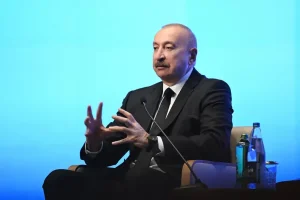





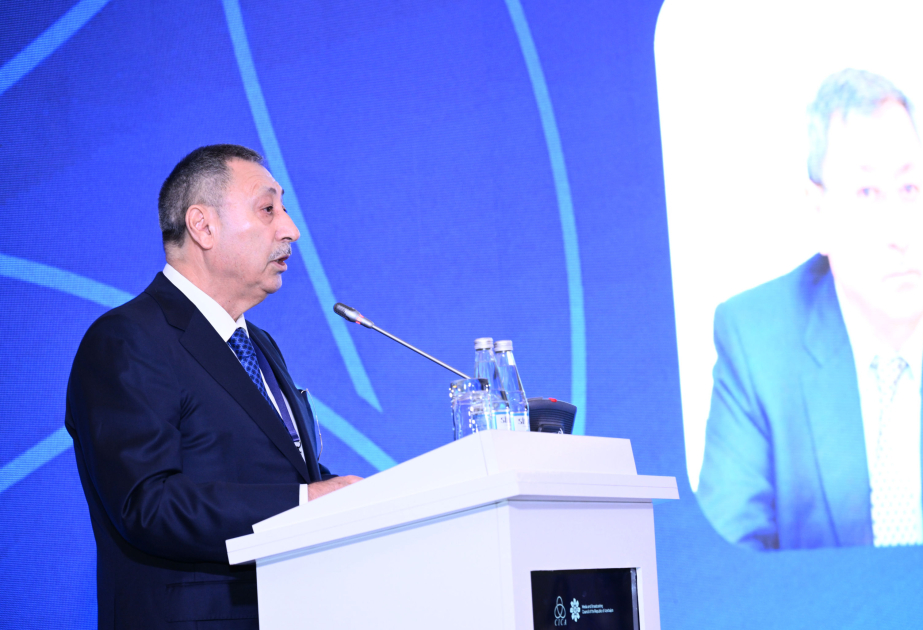
Baku, October 1, AZERTAC – The Conference on Interaction and Confidence Building Measures in Asia (CICA) Media Forum opened in Baku today under the title “Building Trust through Media in a Polarized World,” bringing together media professionals, policymakers, and international experts to confront one of the defining challenges of the modern era: the weaponization of information. In a keynote address read to the forum, Khalaf Khalafov, Representative of the President of Azerbaijan on Special Assignments, delivered a powerful call for objective, responsible, and professional journalism as a counterweight to the growing tide of disinformation and hate speech that increasingly shape global politics. Khalafov framed the event not merely as a professional gathering but as a necessary intervention in an international relations system where information has become both a tool of confrontation and a potential instrument of mutual understanding. His remarks set the tone for a forum that seeks to translate the ideals of trust-building into concrete media practices, while highlighting Azerbaijan’s diplomatic ambition to serve as a bridge between divided perspectives. The forum, held in the Azerbaijani capital, is part of a broader agenda under the country’s CICA chairmanship, and it arrives at a moment when the very concept of shared truth appears under siege.
In his address, Khalafov emphasized that strengthening mutual trust between states and societies, expanding international cooperation, and enhancing joint efforts to address global challenges all require coordinated action in the media sector. He argued that in a polarized world, media cannot remain neutral observers of division; rather, they must actively work to rebuild the connective tissue of informed public debate. The Representative of the President described the expansion of cooperation in the media field as one of the key priorities of Azerbaijan’s chairmanship of CICA, a statement that carries both symbolic and practical weight. By positioning media cooperation at the centre of its multilateral agenda, Azerbaijan is making a clear statement: diplomatic confidence-building cannot be separated from the information environment in which it operates. Khalafov called for the professional exchange of experience within a unified information space, the strengthening of joint efforts to combat disinformation, and the promotion of the principles of responsible journalism. These three pillars, he suggested, are not abstract ideals but necessary responses to a media landscape where falsehoods travel faster than facts and where malicious narratives can undermine decades of diplomatic progress. The call for a “unified information space” is particularly significant in a region where rival broadcasters and digital platforms often amplify national rivalries rather than bridge them, and where the absence of shared standards can turn every reporting lapse into a catalyst for conflict.
Khalafov did not limit his analysis to the media itself. He pointedly placed the challenges facing journalism within a broader context of global security threats that have multiplied and intersected in dangerous ways. He noted that violations of international law, including attacks on the sovereignty and territorial integrity of states, pose serious challenges to global security alongside more traditional concerns such as terrorism, separatism, extremism, and cyber threats. His list of challenges continued with disinformation and risks to food, energy, water, and climate security, an enumeration that reflects the complex, multifront nature of contemporary instability. By linking the media forum to these wider dangers, Khalafov made a crucial argument: disinformation is not an isolated nuisance but a threat multiplier that exacerbates every other crisis. False narratives can inflame separatist conflicts, undermine confidence in energy markets, distort the politics of climate action, and turn cyberattacks into tools of psychological warfare. In such an environment, the role of the journalist becomes akin to that of a public safety official, guarding the integrity of the information ecosystem on which all other forms of security ultimately depend. The forum’s setting in Baku is itself symbolically resonant, as Azerbaijan has direct experience with the consequences of disinformation in the context of its own territorial integrity and post-conflict reconstruction, giving the country’s officials a particular moral authority in advocating for higher standards of truthfulness in international reporting.
The core of Khalafov’s message was a steadfast defense of international law as the key foundation for building a just world order and ensuring lasting peace. In an era characterised by great power rivalry, the erosion of arms control agreements, and the selective invocation of rules-based order, his insistence on international law carries discernible weight. He spoke not of a perfect legal system, but of one that remains indispensable: a set of universally agreed principles that, despite their many violations, provide the only common standard against which state conduct can be judged. International law, in his framing, is also the necessary ground for media ethics. When states violate sovereignty and territorial integrity, they also legitimise the creation of informational bubbles in which such violations are denied or justified. Conversely, when media actors adhere to professional standards and report with impartiality, they reinforce the legal prohibitions against aggression and intervention. Khalafov’s message was therefore a dual one: international law needs responsible media to ensure that facts are respected, and responsible media need international law to protect their ability to operate freely across borders. The symbiotic relationship between legal order and truthful reporting is an idea that runs throughout his speech, and it is one that resonates strongly in a region where conflicts over Nagorno-Karabakh and other frozen and active disputes have repeatedly been worsened by propagandistic media campaigns designed to dehumanise the other side.
Khalafov’s remarks also amounted to a comprehensive definition of what media diplomacy should look like in practical terms. He called on the participants to consider how countries with different political systems, cultural traditions, and levels of economic development can agree on basic standards for content verification, source protection, and factual reporting. This is no small task, because media landscapes vary enormously across the CICA region, from highly regulated state-controlled outlets to chaotic free-for-alls on social media platforms. Yet the forum’s premise is that there does exist a common denominator: the desire to avoid conflict and to manage differences without violence. If media outlets in rival states can at least agree not to manufacture consent for war, not to spread ethnic hatred, and not to publish unverified claims that might trigger a crisis, then a modest but meaningful foundation for trust-building can be laid. Khalafov’s emphasis on “responsible journalism” suggests a professional ethic that transcends particular governments or political ideologies. It is, in essence, an appeal to journalists to recognise that their profession carries public responsibilities, especially in times of heightened tension. The call for “joint efforts to combat disinformation” similarly implies a collaborative, cross-border approach to the problem, perhaps through shared fact-checking networks, joint investigative projects, and training programmes that strengthen the capacity of smaller and more vulnerable media outlets to resist pressures from powerful domestic actors.
The CICA Media Forum in Baku is thus best understood as an attempt to institutionalise a new form of confidence-building that operates through the media rather than only through military-to-military contacts or summit diplomacy. For Azerbaijan, hosting this event under its CICA chairmanship allows the country to project itself as a regional leader not only in energy, transport, or security, but also in the emerging field of informational diplomacy. The forum’s title, “Building Trust through Media in a Polarized World,” encapsulates the ambition: while governments may spend years negotiating agreements, trust is ultimately built and destroyed through narratives. A lie repeated on national television can undo cooperation that took a decade to establish; a carefully reported story based on verified facts can open a path to reconciliation that official channels have failed to find. Khalafov’s address, with its sober recognition of the obstacles and its firm commitment to international law and professional standards, offers a road map of sorts. The road will not be easy. The forces of polarisation are powerful, both within states and between them. Hate speech sells, algorithms amplify outrage, and disinformation campaigns are often cheaper and more effective than tanks. But the forum’s very existence, and the high-level participation it has attracted, indicates a growing awareness that these forces must be countered intentionally and collectively. Whether the lofty principles expressed in Baku can be translated into practical cooperation depends on the willingness of CICA member states to follow through with concrete commitments: funding media literacy programmes, protecting journalists, sharing data on disinformation campaigns, and holding accountable those who incite violence through words. The first step, however, has been taken. A forum has been held, a statement has been made, and the phrase “responsible journalism” has been restored to its proper place in the vocabulary of international diplomacy. As Khalafov made clear, in a polarized world, trust is the scarcest resource, and the media is either its most effective producer or its most efficient destroyer. The choice lies with those who control the cameras, the keyboards, and the broadcast towers. Azerbaijan has made its choice, and it has invited the rest of the CICA region to follow suit. The path to a more stable, just, and peaceful world order begins with a fact, reported honestly, and received in good faith. That simple formula, repeated across borders and cultures, is the ultimate confidence-building measure, and it was given a powerful voice in Baku on this day.


