







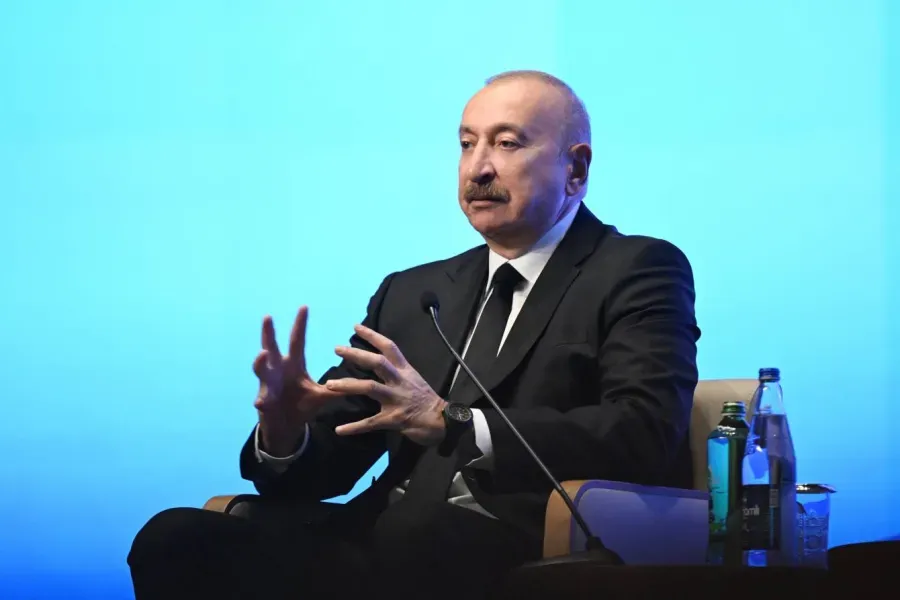
Paragraph 1: The inaugural Media Forum of the Conference on Interaction and Confidence Building Measures in Asia (CICA) opened in Baku on October 1, bringing together media professionals, policymakers and analysts under the theme “Building Trust Through Media in a Polarized World.” The gathering carried particular weight because it sought to define the role of journalism and digital communication in an era of fractured public discourse and declining confidence in institutions. President Ilham Aliyev’s address to the forum was read by his Assistant, Hikmat Hajiyev, and its central message was unmistakable: the future of trust depends on media literacy and the responsible use of new technologies. The President described the widespread dissemination of disinformation and fake content generated by artificial intelligence as direct threats to public trust, and he argued that these threats cannot be countered by governments alone. The address offered a broad answer to the question of who should build a reliable information environment: government agencies, media organizations, digital platforms, journalists, researchers and civil society all share responsibility. Significantly, the address placed the reader at the very end of this chain, suggesting that an informed audience is not a passive consumer of news but an active guardian of information integrity. By framing media literacy as a core component of societal resilience, the President’s message turned what is often seen as an individual skill into a collective security concern. The forum itself, as a CICA initiative, also signalled a regional commitment to addressing information manipulation, a phenomenon that crosses borders and threatens the stability of the entire Asian continent. In a polarized world, the Baku forum proposed, trust cannot be decreed from above; it must be built piece by piece, starting with the relationship between a newsroom and its audience. That relationship, in turn, is only as strong as the habits of verification and critical thinking that readers bring to their screens. The Azerbaijani leadership’s emphasis on the reader as a “strong link” in the information chain therefore represented a subtle but important conceptual shift: instead of treating ordinary people as victims of misinformation, the address treated them as essential participants in the defence of truth.
Paragraph 2: The urgency of the message is supported by comparative international research that has tracked societal resilience to disinformation for years. The Open Society Institute, based in Sofia, has been measuring European societies’ resilience to disinformation since 2017, and in its 2026 index four countries share first place: Denmark, Finland, Ireland and the Netherlands, each scoring 71 points. The index is based on a straightforward formula, with the largest share of the score coming from reading skills acquired at school and the quality of the media environment. In other words, the report suggests that informed readers are shaped in the classroom long before they encounter their first viral fake news item. Countries closer to Azerbaijan’s region are positioned toward the bottom of the list, which indicates that the challenge is not evenly distributed and that educational infrastructure is a decisive factor. Finland has topped the list since the index began, and its approach is particularly instructive. There, media literacy education begins in kindergarten and is considered part of the country’s overall defence strategy, a recognition that information warfare is as real as conventional military threats. Leo Pekkala, director of the National Audiovisual Institute, urges teachers to incorporate information-verification exercises into every lesson, whether they teach physics or mathematics. This approach treats critical thinking not as a separate subject but as a cross-cutting competency that must be practiced constantly. The Finnish model demonstrates that resilience to disinformation is not a matter of innate caution; it is a learned behaviour reinforced over many years. The fact that Finland consistently tops the Sofia index is therefore not an accident but the product of deliberate policy choices. For Azerbaijan, the comparison offers both a warning and a roadmap: the gap in resilience between top-ranked countries and those closer to the region is not permanent, but closing it requires patience, sustained investment in education, and a willingness to treat media literacy as part of national security. The Sofia index also underscores the importance of a healthy media environment, meaning that efforts to improve journalism standards and editorial accountability are inseparable from efforts to teach readers how to evaluate what they see. A literate audience cannot flourish if the media landscape is dominated by unverified rumours and clickbait, just as a high-quality media system cannot thrive if its audience lacks the tools to distinguish reliable reporting from propaganda.
Paragraph 3: Additional evidence from the Reuters Institute at the University of Oxford shows that the crisis of trust is real and measurable. According to its 2026 report, trust in news across 48 countries has fallen to 37%, its lowest level since 2015. Trust in news encountered on social media stands at only 22%, while trust in responses from AI chatbots is even lower at 20%. The proportion of people concerned about distinguishing real from fake content online has risen to 62%. These figures paint a portrait of a deeply anxious information environment. Yet there is a paradox embedded in the data: people trust social media less, but they increasingly turn to it for news. For the first time, social media and video platforms have overtaken television and news websites as sources of news, with 54% of respondents relying on them. This means that the platforms people distrust most are precisely the platforms where they receive most of their information. The disconnect between behaviour and belief is not irrational; it reflects the convenience, speed and algorithmic appeal of social media, as well as the declining reach of traditional newsrooms. But it also creates a dangerous gap. If audiences no longer trust the sources they use, they may become cynical and disengaged, or they may fall back on their own biases, accepting only information that confirms what they already believe. Media literacy, the Baku forum argued, is the skill that can help bridge this gap. It does not require abandoning social media; rather, it requires teaching people to navigate these platforms with the same caution they would apply to any unverified source. The Reuters Institute data also highlights the particular challenge of artificial intelligence. With trust in AI chatbots at only 20%, the public is understandably wary of machine-generated content, yet AI is increasingly used to produce news summaries, social media posts and even entire articles. The President’s address explicitly identified fake content generated by AI as a direct threat to public trust, and this concern is backed by the data. The question is no longer whether disinformation exists, but whether societies can build the immune systems necessary to resist it. The decline of trust in traditional news media, combined with the rise of AI-generated content, creates a perfect storm in which the audience’s ability to verify information becomes the last line of defence.
Paragraph 4: In Azerbaijan, media literacy already has an institutional and legal framework, although its results are not yet systematically measured. The charter of the Media Development Agency and the presentation document of the newly established Media and Broadcasting Council identify media literacy as a separate responsibility. This is a significant step, because it moves the issue from the realm of good intentions to the realm of institutional obligation. The Media Development Agency has announced that it is studying international practices and developing a unified domestic strategy targeting specific groups, which suggests that the authorities are aware of the need for a structured approach rather than a series of one-off campaigns. Media Literacy Week is held every December, and last year the week concluded on December 22 with a conference titled “Digitalization, Artificial Intelligence and Media Literacy.” The event included discussions about open lessons and awareness sessions for schoolchildren, reflecting an effort to reach younger audiences where their habits are still being formed. The agency’s Media Literacy platform and the “MEDİA Volunteers” programme seek to instil information-verification habits among young people, using a combination of digital tools and peer-to-peer engagement. These initiatives are commendable, but they face a fundamental problem: Azerbaijan is not included in the Sofia index or the Reuters Institute report, and the country has no regular national indicator for measuring media literacy. It is difficult to manage results that are not measured. Without a baseline, policymakers cannot know whether the programmes are working, whether the target groups are being reached, or whether the gap between Azerbaijan and leading countries is narrowing or widening. The absence of reliable data also makes it harder for international partners to assess progress and for civil society to hold institutions accountable. The institutional framework, in other words, is a necessary but not sufficient condition for success. What is missing is a feedback loop that connects policy decisions to measurable outcomes. The establishment of the Media and Broadcasting Council and the Media Development Agency provides the structural foundation, but the next step must be the creation of indicators that can track trust, verification habits and resilience to disinformation over time.
Paragraph 5: The Finnish example shows that results take years to emerge, but it also shows that concrete steps can be taken along the way. The authors of the Sofia report consider education the most reliable, albeit long-term, approach to building resilience. For Azerbaijan, several practical measures are available. First, there is no need to wait for media literacy to become a separate school subject. It can be integrated into Azerbaijani language, history and computer science lessons. The Finnish model works in precisely this way: every teacher teaches students to question the source of the information they encounter, regardless of the subject. A history teacher can ask students to compare primary sources; a language teacher can analyse the rhetoric of a viral headline; a computer science teacher can show how algorithms decide what appears in a social media feed. This integration does not require a new curriculum, only a new pedagogical mindset. Second, a baseline national survey is needed. An annual survey measuring trust in news, concerns about fake news and information-verification habits would make it possible to evaluate the Media Development Agency’s projects using measurable data. Such a survey would also create a public conversation about the issue, normalising the idea that media literacy is a skill worth cultivating. Third, the President’s address identified digital platforms as partners. Making verified information in Azerbaijani more visible and removing fake accounts promptly could serve as key measures of this partnership. Social media companies often respond to pressure from regulators and civil society, but they also respond to concrete requests from state institutions. A formal partnership agreement with platforms, specifying commitments on content moderation and the promotion of authoritative sources, would give the Azerbaijani authorities a mechanism to hold them accountable. Fourth, ordinary readers can be equipped with simple tools. Four questions are enough to establish a daily habit: Who published this news, and are their name and contact details available? When was the news published? Could old footage be presented as a recent event? Is the headline designed to make me angry or afraid? Has the same information been confirmed by a second reliable source? These questions are not complicated, but they are powerful because they slow down the reflex to share. They turn the reader from a passive receiver into an active verifier. None of these steps requires a massive budget or a long legislative process; they require political will and institutional coordination.
Paragraph 6: The CICA Media Forum sent a signal from Baku that resonates far beyond Azerbaijan: in a polarized world, trust begins in the newsroom and is reinforced on the reader’s phone. This formulation captures the two-sided nature of the challenge. On the production side, journalists and media organizations must uphold standards of accuracy, transparency and accountability. On the consumption side, readers must develop the habit of questioning what they see, especially when it comes to emotionally charged headlines, unverified videos and AI-generated content. The forum’s theme, “Building Trust Through Media in a Polarized World,” was not an abstract slogan but a call to action. Trust, after all, is not a commodity that can be imported or imposed; it is built through daily practice. The Azerbaijani government’s recognition of media literacy as a strategic priority, combined with the institutional framework already in place, suggests that the country is moving in the right direction. But the road ahead is long, and the absence of measurable indicators remains a weakness. The Sofia index and the Reuters Institute report are useful benchmarks, but they do not include Azerbaijan; the country therefore needs its own national data to guide policy. The Finnish experience demonstrates that success is possible, but only with sustained effort over a generation. The integration of media literacy into the school system, the establishment of a national baseline survey, and a more formal partnership with digital platforms are three achievable goals that could transform the current framework from a set of promising initiatives into a coherent national strategy. The CICA Media Forum itself was a contribution to this effort, because it brought the issue to the centre of a regional agenda and gave it a platform. The final message of the forum, echoed by President Aliyev’s address, was that information integrity is not merely a technical issue or a matter of professional ethics; it is a foundation of social trust, and without trust, no society can function effectively in a polarized world. As Azerbaijan continues to build its media literacy ecosystem, the world will be watching whether this early promise matures into measurable results. The responsibility, as the President made clear, belongs to everyone: governments, media, platforms, teachers and, above all, readers themselves.


