


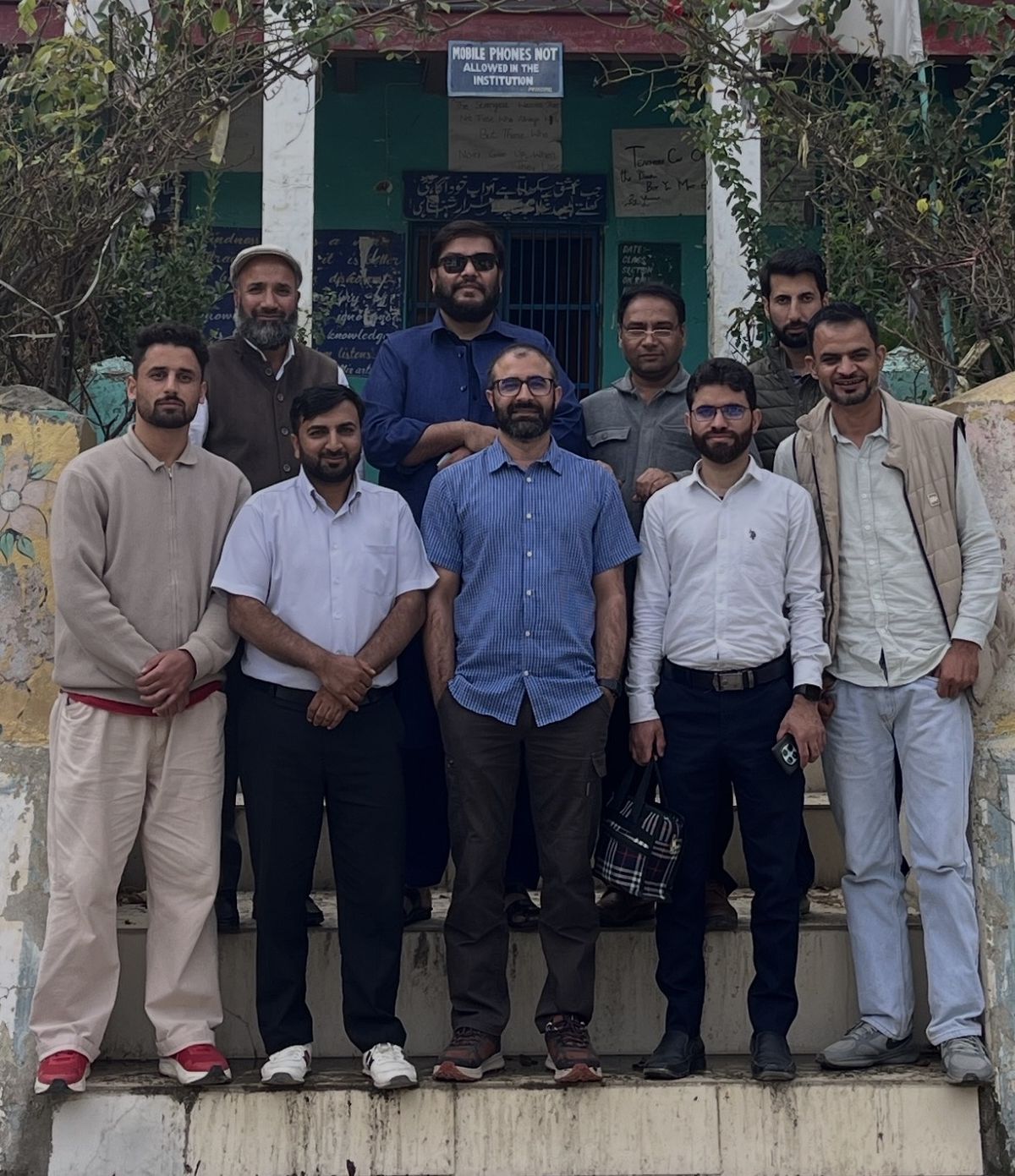
Srinagar, March 29: A global debate over the erosion of truth in the digital age found an unlikely but deeply fitting setting on Monday in Kalaroos, a remote hamlet in north Kashmir’s Kupwara district, where students gathered to confront a problem that reaches them through the very same handheld screens used by people thousands of miles away: how to know when information can be trusted. The occasion was International Right to Information Day, and the Jammu and Kashmir RTI Movement, in collaboration with the Civic Research and Development Foundation, chose Government Higher Secondary School Kalaroos as the venue for an awareness programme that translated the abstract international discourse on information disorder into something far more practical and urgent — checking a source, seeking an official record, and asking an authority for facts. This year’s global theme, “Upholding Information Integrity in the Digital Age: The role of access to Information in addressing Information Disorder,” provided the conceptual framework, but the conversation in Kalaroos was never merely academic. It was about the lived reality of students in a region where information flows unevenly, where official decisions are made far away, and where a single phone can bring together verified announcements, viral rumours, and outright falsehoods in one undifferentiated stream. By taking the global conversation to a school in one of the valley’s most remote areas, the organisers underscored a crucial point: misinformation is not a problem confined to metropolitan newsrooms or national capitals; it is a daily challenge for every citizen, especially those with the fewest alternative channels of verification.
Dr. Raja Muzaffar Bhat, chairman of the J&K RTI Movement, told the students that the Right to Information Act offers a structured way through the confusion created by false or unverified information. The law, he explained, gives citizens a formal route to seek information from public authorities, transforming a claim circulating on social media into a question that an official record can help answer. Instead of relying on forwarded messages or unverified posts, a citizen can use the RTI route to demand documentary evidence, official responses, and accountable replies from public institutions. This, he argued, is the practical value of the law in the digital age. “We deliberately chose to reach out to students at Kalaroos Kupwara which is one of the remote areas of the Kashmir valley,” Bhat said. “It was great to interact with the students on this important day.” His choice of venue was strategic, not incidental, and it reflected a growing concern among civil society actors that digital misinformation tends to thrive precisely where institutional access is weakest and where citizens lack the media literacy to distinguish between fact and fiction. Bhat also called on the government to establish dedicated official social media accounts for public offices at the district and block levels, arguing that such accounts could provide citizens with verified updates directly from authorities on the digital platforms they already use. The suggestion points to a fundamental structural problem in the digital information environment: people often receive information before they know its source, and an official channel, even one that only posts routine updates, can give citizens a reliable reference point against which to check what they see elsewhere. In the absence of such official anchors, rumour and fact are left to compete on equal terms, and the consequences are felt most acutely in communities far from centres of authority.
Dr. Umar Saif, a scientist and director of research at Orchid University, focused on the other side of that equation: the citizen receiving the information. Addressing the students directly, he urged them to develop critical thinking, verify sources, and actively seek credible information rather than passively consuming whatever appears on their feeds. Rapid digital communication, he said, has made source-checking increasingly important, and in an environment where messages can be screenshotted, cropped, edited, and reshared within seconds, the ability to pause and question is not merely a useful skill — it is a survival mechanism for democratic citizenship. Saif’s message was not simply about distrusting everything online; it was about building a disciplined habit of verification, of asking who produced a piece of information, why it was produced, and whether it can be confirmed through an independent or official channel. His remarks resonated with the broader theme of the day, which links access to information with the fight against misinformation. In a digital ecosystem powered by algorithms that reward engagement over accuracy, falsehoods often travel faster and reach farther than the truth. For students in a place like Kalaroos, whose access to mainstream fact-checking platforms may be limited, the first line of defence is their own critical judgment, sharpened through education and reinforced by awareness of their legal rights. The scientist’s intervention made clear that no amount of official transparency can fully substitute for an informed and questioning public.
The discussion, however, moved beyond the problem of misinformation to the larger question of civic participation. Senior members of the J&K RTI Movement, including Sajad Rasool and Shahid ul Islam, interacted with the students and explained the mechanisms through which ordinary citizens can seek information and answers from public institutions. They detailed the steps involved in filing an RTI application, the timelines within which authorities must respond, and the appeals process available when information is denied or withheld. In doing so, they sought to demystify a law that many citizens still regard as inaccessible or intimidating, and to demonstrate that transparency is not a favour granted by the state but a right exercised by the people. The setting gave the discussion a particular relevance. Kalaroos lies far from the centres where government decisions are made, and official information often reaches the area late, incompletely, or through intermediaries. At the same time, digital platforms have collapsed distances in unexpected ways, bringing official announcements, rumours, and unverified claims into the same phone screen. This convergence of isolation and hyper-connectivity creates a unique vulnerability: communities can be simultaneously information-rich in volume and information-poor in quality. By teaching students how to use RTI, the movement aims to equip them with a tool that works offline as well as online, a formal legal mechanism that cuts through the noise and compels an authoritative answer. It is a reminder that access to information is not only about the freedom to browse the internet, but about the power to demand accountability from the institutions that shape public life.
Zahoor Hamdani, principal of Government Higher Secondary School Kalaroos, thanked the speakers for explaining the RTI Act and the importance of transparency in governance, while Peerzada Mashooq, a teacher at the school, conducted the programme. Their involvement reflected the broader educational potential of the event, which was not confined to the students who attended but also had implications for the teaching staff and the wider community. When a school in a remote area becomes the venue for a discussion on information rights, it sends a signal that the issue is not peripheral but central to the kind of society that is being built. The presence of educators and civil society activists in the same room underscored the need for collaboration between formal education and civil society in promoting digital literacy. The school setting was also significant because young people are among the most active users of digital platforms in Kashmir, and they are also among the most exposed to misinformation, disinformation, and malinformation. By reaching them early, the RTI Movement hopes to create a generation of citizens who understand that information is a public good, that access to official records is a legal right, and that the health of a democracy depends on the ability of its citizens to ask difficult questions and receive truthful answers. The event was a small but meaningful step toward that goal, one that linked the global theme of the day to the local realities of a particular community.
International RTI Day thus brought a global debate into a remote Kashmir classroom, where the lesson was simple: check the source, seek the record, and ask for the facts. In an age of deepfakes, algorithmically amplified rumours, and state-sponsored disinformation campaigns, the simple act of verification has become a political act, and the Right to Information Act has emerged as a powerful counterweight to the forces of information disorder. The event in Kalaroos was not merely a commemoration but a demonstration — a demonstration that the fight for truth begins not in newsrooms or courthouses alone, but in classrooms, where young citizens learn to question, to demand evidence, and to hold power to account. It also served as an appeal to the government to recognise its role in fostering information integrity by providing official digital channels, supporting transparency initiatives, and protecting the right to information from erosion. The organisers left Kalaroos with a renewed sense of purpose, but they also left behind a challenge to the students: to carry the lessons of the day beyond the school gates, into their families, their villages, and their digital networks. The battle against misinformation will not be won in a single event or a single law, but in thousands of small acts of verification, performed daily by citizens who refuse to accept falsehood as inevitable. If the students of Kalaroos have learned anything from this International RTI Day, it is that the truth is not always easy to find, but the tools to seek it are within their reach — and the responsibility to use them is theirs.