









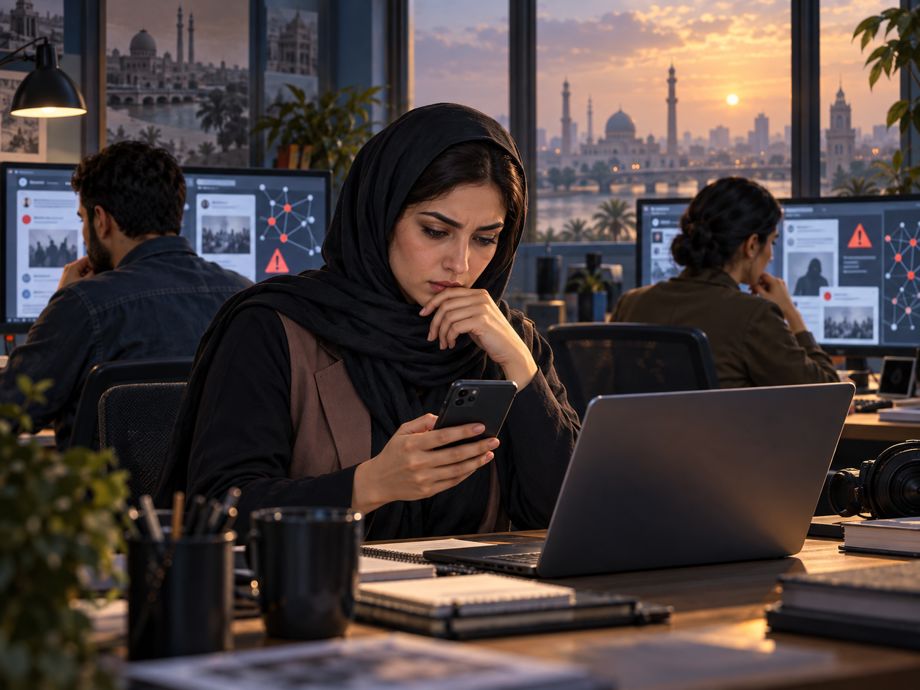
BAGHDAD — The regional war involving Iran has spilled into Iraq’s digital spaces, bringing a surge of hate speech, misleading information and targeted harassment that is putting journalists and other public voices under growing pressure. After the conflict escalated in late February, Iraqi media organizations, academics and civil society groups mobilized to track harmful posts and examine how regional tensions were being used to deepen divisions inside the country. The organizations belong to a coalition supported by UNESCO through its European Union-funded Social Media 4 Peace project, which has operated in Iraq since 2025. Their work addresses a difficult and urgent challenge: responding to online abuse and manipulation with measures that respect freedom of expression and people’s access to information. In Iraq, where social media is often a primary arena for political debate, the collision between war-related propaganda and long-simmering domestic conflicts has created a volatile environment. Users face coordinated smear campaigns, sectarian incitement, threats of physical harm and the rapid circulation of false narratives that blur the line between real events and manufactured outrage. The monitoring coalition was formed to document these patterns systematically, rather than relying on anecdote or impression. Its members come from different parts of Iraq, including the Kurdistan Region, and bring a range of expertise in journalism, data analysis, gender-based violence and media monitoring. Their aim is not to restrict what Iraqis can say. It is to help the public understand what is being done to manipulate them, to support those who are attacked for doing their jobs, and to give policymakers and platforms the evidence they need to craft responses that are both effective and rights-respecting. In a country still emerging from decades of conflict, the stakes are high. If digital spaces become uninhabitable for independent voices, the consequences will be felt far beyond the internet, weakening the possibility of informed citizen participation and accountable governance.
Between 5 and 29 March 2026, five organizations led the monitoring effort: ANAT for Media Development; the Iraqi Digital Reporting Platform for Female Journalists; Journalists Home in the Kurdistan Region of Iraq; the Iraqi Centre for Strategic Analytics; and the Media Monitoring Centre. The team reviewed thousands of social media posts and closely analysed 713 cases of harmful content, drawn primarily from Facebook. The monitoring period was deliberately chosen to capture the immediate aftermath of the late-February escalation, when tensions were high and digital activity was intensifying. Researchers combined manual observation with keyword searches and reports from affected users, giving people experiencing online harm a direct way to contribute evidence. A dedicated reporting platform was integrated into the coalition’s website, helping the team investigate patterns of disinformation, hate speech, threats and attacks against journalists during a period of rapidly escalating tensions. This method was important because automated tools alone can miss context, irony, dialect and the subtle ways in which harmful narratives are adapted for local audiences. The 713 cases are not a comprehensive total of all harmful content in Iraq during those 25 days; they are a closely examined sample that reveals the nature of online abuse and the techniques used to spread it. Facebook, which has the largest user base in the country, proved to be the main battlefield, though the researchers also observed content moving across other platforms and messaging applications. The inclusion of direct reports from affected users was particularly valuable, because it captured experiences that keyword searches might not surface, such as targeted threats sent through private channels or coordinated harassment that referenced local events. By integrating these reports with open-source monitoring, the coalition was able to identify patterns that might otherwise appear as isolated incidents.
The findings paint a concerning picture. The monitoring identified an intensification of hate speech, incitement and accusations of treason, alongside a shift in how the war was discussed. Online narratives increasingly used the regional conflict to mobilize domestic actors around disputes over weapons, the role of the United States, the influence of armed groups and Iraq’s political future, drawing religious themes and historical memory into those arguments. What began as coverage of a regional confrontation quickly became a way of framing old domestic grievances and settling scores. Posts that appeared to comment on the war were often, in reality, coded attacks on political opponents, competing factions or critics of particular armed groups. The language of patriotism and betrayal was heavily deployed, with accusations of treason used as a weapon to silence dissent and discredit independent voices. The monitors also observed repeated wording across accounts, closely synchronized posts and the recycling of videos, allegations and hashtags, all of which suggested that some campaigns involved organized or partly organized activity. The researchers did not establish proof of centralized control, a distinction that matters when assessing who might be directing these narratives. A campaign can be coordinated without a single command center, and the absence of direct evidence linking posts to specific officials or institutions does not mean that the activity is spontaneous. The finding indicates that Iraq’s digital spaces were doing more than reflecting regional events; they were bringing those events into domestic struggles over power, identity and public opinion. War narratives were being used as weapons in disputes that are fundamentally about Iraq’s future direction, including the presence of foreign forces, the authority of the state and the role of non-state actors in Iraqi politics. In this environment, fact and fiction become entangled, and people are pushed toward increasingly polarized positions.
The coalition called for more responsive, real-time monitoring and practical protection mechanisms as journalists, analysts and content creators faced increased targeting. Journalists in Iraq already work under difficult conditions, covering corruption, protests, armed conflict and the competing interests of regional powers. When they become targets of coordinated digital attacks, the impact can extend beyond reputational damage. Threats of violence, doxxing and the deliberate circulation of false accusations can force reporters to self-censor, leave their jobs or even flee their homes. The monitoring found that women were disproportionately affected by digital violence, highlighting the need for interventions that directly address technology-facilitated gender-based violence and the particular forms of harassment women encounter online. Female journalists, activists and public figures are often subjected to sexualized abuse, attempts to damage their credibility, and threats that invoke their families and personal lives. The emotional and psychological toll is severe, and the chilling effect on women’s participation in public life is one of the most troubling consequences of the current online environment. The coalition emphasized that responses must be practical and timely, not merely legal or rhetorical. Real-time monitoring can help identify emerging threats before they escalate, and practical protection mechanisms can include digital security training, emergency financial support, mental health assistance, and clear protocols for reporting abuse to platforms and security forces. The growing volume of disinformation and AI-generated content has also made stronger, more widely available verification capacity a priority. Deepfakes, manipulated images, fabricated quotes and automated accounts can be used to spread false narratives faster than traditional fact-checking can keep up. Journalists and civil society organizations need tools and skills to verify content quickly and to explain to the public why certain material is false.
Audience behaviour also plays a part in spreading harmful material. The monitors found that emotional reactions helped posts reach more people, because social media algorithms tend to amplify content that generates anger, fear or outrage. When users react strongly to a false or inciting post, they contribute, often unintentionally, to its spread. This makes media and information literacy essential to helping users assess what they read, watch and share. In an environment where misinformation is weaponized, the ability to pause, verify sources and consider context is a form of resilience. UNESCO has said it plans to expand media and information literacy initiatives, safety training for journalists and content creators, and support for fact-checking through Social Media 4 Peace. These activities are designed to strengthen the capacity of Iraqi media professionals to navigate a hostile digital landscape while also equipping ordinary citizens with the critical thinking skills needed to resist manipulation. The response to online harm cannot rely solely on content removal or platform regulation, especially when the people producing harmful content are skilled at adapting their messages to evade detection. Education and awareness are long-term investments that can reduce the demand for sensational and false information. If users understand how algorithms work, why certain posts are promoted and how coordinated campaigns operate, they are less likely to become tools for those campaigns. The coalition’s approach is therefore not simply defensive. It aims to build a more informed public that can engage with digital media in ways that strengthen democratic debate rather than undermine it.
Local partners contribute knowledge of Iraq’s communities, political tensions and cultural context, helping ground this work in people’s lived experiences. The coalition’s broader purpose is to build an evidence-based, human rights-centred response to online harm, connecting Iraq with similar project initiatives in Indonesia, Kenya, Bosnia and Herzegovina, Colombia, South Africa and Kyrgyzstan. These countries face different circumstances, but they share common challenges: the spread of disinformation, the targeting of journalists, the manipulation of social media by political actors and the difficulty of protecting freedom of expression while addressing harmful content. By sharing methodologies, lessons learned and practical tools, the organizations involved can avoid reinventing approaches that have already been tested elsewhere. The Iraqi coalition’s emphasis on evidence is particularly important. Rather than making broad claims about online harm based on impression or anecdote, the monitoring process produces data that can be used to guide policy, inform platform companies and support advocacy efforts. A human rights-centred approach means that responses must be designed to protect the vulnerable without giving governments an excuse to crack down on legitimate criticism. This is a delicate balance, and it is one that the coalition takes seriously. The involvement of Iraqi civil society organizations and media watchdogs is essential because they understand the local context. They know which actors are likely to benefit from certain narratives, how religious and historical references can be used to mobilize audiences, and what kinds of protection are most practical in different parts of the country. The work is ongoing, and the situation on the ground can change rapidly. But the monitoring effort has already demonstrated that there are Iraqi organizations willing and able to document digital harm, support affected individuals and advocate for a healthier online environment. As the regional conflict continues to evolve, so too will the digital battlefield. The challenge for Iraq, and for the international partners supporting this work, is to remain vigilant without losing sight of the fundamental rights and values that open societies depend on.


