








Nepal Police Strategically Mobilized to Preserve Peace, Curb Crime: IGP Karki
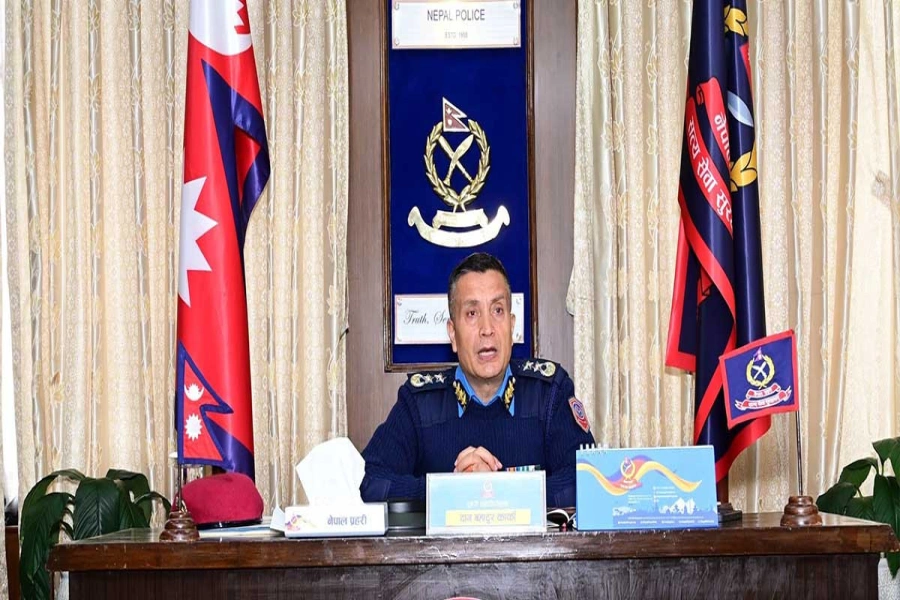
Kathmandu, August 12 – Inspector General of Nepal Police Dan Bahadur Karki has affirmed that the police organization is strategically deployed across all seven provinces to safeguard peace, public order, and security while simultaneously cracking down on criminal networks that threaten the country’s social fabric. In an exclusive and detailed interaction with the state-owned national news agency RSS, IGP Karki stated that the overall law-and-order situation in Nepal is currently normal and under control, even though a small segment of criminal-minded individuals continues to engage in acts that attempt to disturb the prevailing security arrangement. The IGP’s remarks carry considerable weight in Nepal’s security discourse, arriving at a time when the country is undergoing significant political transitions, urban expansion, and digital transformation, all of which present both unconventional challenges and new responsibilities for the law enforcement apparatus. Karki’s leadership of Nepal Police comes after decades of distinguished service, and his assessment of the ground-level situation is grounded in daily operational briefings, intelligence reports, and field observations. He made it clear that the police force is not only reactive but strategically proactive, with deployments—personnel, technology, and intelligence resources—aligned with a national plan that anticipates threats before they materialize. The announcement underscores the institution’s commitment to constitutional duties, in which peace is not merely the absence of conflict but the presence of justice, mutual tolerance, and a functioning social order. With civic life expanding into economic hubs, border towns, rural municipalities, and metropolitan centers, the IGP’s message was framed as a reassurance to citizens, investors, and international stakeholders that Nepal’s internal security remains stable and professionally managed. Moreover, his remarks subtly reinforced the doctrine that law enforcement in a democratic society balances assertive crime control with uncompromising respect for citizen rights, a philosophy woven through all branches of police work, from street-level patrol to cyber investigation.
Expounding on the strategic rationale behind police mobilization, IGP Karki stressed that the force operates with a dual mandate: to preserve harmonious relations among the ethnically, linguistically, and culturally diverse population of Nepal, and to sternly address those elements that exploit any disruption, crisis, or protest movement to further their criminal objectives. “Talking to state-owned RSS, IGP Karki said the police are operating strategically to control criminal activities, fundamentally keeping in mind the need to maintain good relations and harmony among citizens while controlling elements that try to take advantage of disturbances to peace and security,” the statement underscored. In concrete terms, this strategy translates into intelligence-driven policing, where specialized units—including the Metropolitan Police Crime Division and provincial crime investigation bureaus—continuously map criminal syndicates engaged in organised crime, drug trafficking, kidnapping, extortion, and financial fraud. Police authorities have also prioritized community policing initiatives, recognizing that the most effective preventive force is a cooperative public that trusts the police and shares actionable information. In high-density urban neighborhoods, stations have been instructed not only to respond to crimes but to engage with citizens through routine consultation, civic forums, and school safety programs. Simultaneously, border security remains a critical concern, with Nepal police forces coordinating closely with customs and immigration departments to combat cross-border smuggling, human trafficking, and movement of illicit goods. The IGP emphasized that the strategy is inherently citizen-centric, meant to minimize inconvenience to daily social and economic activity while maximizing the deterrent effect against criminal behavior. He also highlighted that internal directives require officers to apply the law with impartiality, observe procedural fairness, undergo continuous training on human rights standards, and avoid blanket or indiscriminate operations that could erode public confidence. In economically fragile communities, crime prevention policies have been linked to broader social welfare frameworks, acknowledging that unemployment, inequality, and lack of opportunity often serve as the breeding grounds for delinquency. Thus, Nepal Police sees itself not as an occupying force but as a public service institution, one that facilitates courts, protects vulnerable groups, and helps strengthen the rule of law as an essential pillar of the Republic’s federal democratic architecture.
Addressing a growing non-traditional security threat, the IGP conceded that modern peace is not only contested on the streets but also in the digital sphere, where misinformation, disinformation, deepfake content, and hate speech can dangerously polarize public opinion and incite violence. According to Karki, Nepal Police remains “equally alert” to the capacity of social media platforms to disrupt cordial relations among citizens, and has therefore deployed trained personnel for proactive digital surveillance and online vigilance. Nepal is experiencing an internet boom, with more than 14 million internet users and a similarly high number of active social media accounts. Platforms like Facebook, TikTok, and X have become arenas for political confrontation, ethnic targeting, gender-based harassment, and virulent fake news, all of which can spill over into physical conflict in seconds. The IGP’s acknowledgement signals a broader institutional shift: the police are now firmly recognizing that criminality in cyberspace is a core law-enforcement priority, not a marginal concern. To this end, the Cyber Bureau of Nepal Police has intensified its operations to detect, investigate, and prosecute offenders engaged in digital crimes including unauthorized data access, identity theft, cyberstalking, and the production of manipulated videos that damage reputations or ignite sectarian tensions. The police have also strengthened their capacity to work with internet service providers, telecommunications companies, and the Ministry of Communications and Information Technology to trace the origin of malicious content and secure digital evidence in a legally admissible manner. Beyond enforcement, the police apparatus is investing in capacity building for its officers—training on digital forensics, password cracking recovery, financial cybercrime, and encrypted communication interception—while coordinating with international organizations and regional partners to keep pace with the rapidly changing techniques of online criminal entities. Public awareness campaigns have been launched to help citizens recognize and report fake news, teaching digital literacy skills that empower individuals to avoid falling prey to disinformation networks. The purpose, the IGP noted, is to create a resilient digital ecosystem where freedom of expression flourishes, but where the law acts decisively against speech that endangers public safety, social harmony, or national security. This digital alertness is now an integral part of the police’s comprehensive security architecture, and the IGP’s statement signals that any attempt to disturb peace through viral manipulation will be met with serious legal consequences under the Electronic Transactions Act and other relevant statutes.
A crucial pillar of Nepal’s security stability, according to IGP Karki, is the seamless collaboration, coordination, and unity of purpose among the various security institutions that share the mandate to protect the country. He detailed that “there is regular contact and coordination among the Nepali Army, Nepal Police, Armed Police Force, National Investigation Department, and concerned ministries, including the Ministry of Home Affairs, when it comes to maintaining law and order and peace in society. In special situations, we discuss matters among all agencies and develop security strategies accordingly. Overall, coordinated deployment of all mechanisms has been key to maintaining normal security arrangements.” This inter-agency coordination operates on multiple vertical and horizontal layers under Nepal’s federal constitutional framework. At the apex, the National Security Council—chaired by the Prime Minister and attended by key ministers, the Army Chief, the IGP, and the leadership of other security bodies—periodically reviews the strategic security environment. At the operational level, the Ministry of Home Affairs choreographs the integrated deployment of plainclothes and uniformed personnel. District Administration Offices run daily meetings that bring together Chiefs of Police, Armed Police, Army units deployed for security, and intelligence officers to share information in real time, allowing for swift joint responses to emergencies such as armed violence, riots, and natural disasters. The Nepali Army, which normally remains in the barracks, is mobilized for major crises and for election security, disaster rescue operations, and border protection when directed, while the Armed Police Force enables rapid intervention against armed outfits, hostile mobs, and tactical impasses. The National Investigation Department’s counterintelligence work complements these efforts by thwarting espionage and internal subversion. In the newly federalized system, coordination also extends to provincial governments and local municipalities, which have their own jurisdiction over some administrative functions and can influence community relations, dispute resolution, and small-scale policing partnerships. The IGP emphasized that in special situations, such as the conduct of general elections, high-profile international summits, or major festivals, the agencies devise unified security strategies, establish joint command centers, and deploy personnel from multiple forces side-by-side, ensuring no gap, duplication of effort, or miscommunication. This integrated approach, he proudly noted, has proven its worth repeatedly in maintaining normal security arrangements and has been widely appreciated during major events in recent years, including global summits and peace process support missions where all branches of security seamlessly synchronized their operations.
Looking to the road ahead, the IGP committed that Nepal Police will continue conducting operations in close coordination with all security mechanisms, fulfilling not just a narrow mandate of crime suppression but the broader vision reflected in the Prime Minister’s guidance. According to Karki, that guidance is purposeful and people-first: all state mechanisms—including police—should strengthen peace and security and, in the same breath, offer relief, empathy, and accessible public services to the everyday citizen. This forward-looking philosophy is transforming the Nepal Police into a more service-oriented institution with clear benchmarks set for district units, province headquarters, and specialized departments. Future operations will emphasize prevention, early intervention, and the consolidation of the community-police partnership model, where beat officers are known personally in their sectors and local civil society groups act as interlocutors between residents and law enforcement. The police leadership is also prioritizing the enhancement of forensic labs, cyber crime units, and fast-tracked investigation teams to expedite case disposal and reduce the backlog in courts. A women and children protection directorate has been expanded to provide psychological counselling and legal support to victims of gender-based violence, domestic abuse, and child exploitation. Additionally, in line with digital era demands, the Nepal Police has started expanding e-policing services that allow citizens to file complaints online, track case status, and access victim compensation mechanisms—dramatically improving transparency and reducing instances of bribery or bureaucratic harassment. The IGP’s roadmap includes continuing contributions to United Nations peacekeeping missions, where Nepali police officers have earned global recognition for their professionalism, discipline, and skills in conflict zones, thus enhancing Nepal’s international standing. Domestically, the force plans to intensify its fight against financial crimes, money laundering, and cyber-enabled fraud that prey on the public’s trust in institutions and emerging banking technologies. Karki also reiterated a zero-tolerance policy against any police personnel involved in corruption, human rights violations, or misuse of firearms, stressing that internal accountability mechanisms will be applied without exception. This emphasis on institutional integrity is critical to sustaining public confidence since a police force that respects the law is the most credible deterrent against those who challenge it. The police force, he concluded, is dedicated to ensuring that Nepal’s major thoroughfares, marketplaces, pilgrimage sites, and city neighborhoods continue to function with a sense of calm and normalcy, while also being prepared to surge resources toward any hotspot at a moment’s notice, always adhering to the principles of the Constitution and the high standards of professional law enforcement.
In sum, IGP Karki’s detailed statement to the state news agency serves as a broad reassurance to the nation that Nepal’s internal security environment is not only stable but is being proactively fortified on multiple fronts—kinetic, digital, and institutional. While Nepal faces persistent tests from organized crime, substance abuse, social conflicts, and a troubling wave of online misinformation, the IGP is projecting confidence that these challenges are manageable through integrated strategy, modernized capabilities, and, most importantly, the moral strength of a disciplined and people-oriented police force. The police’s strategic mobilization, as described, aligns with the government’s overall policy to protect life and property, safeguard fundamental rights, and ensure that the fruits of democracy are enjoyed without fear. The normalcy Karki referenced is not hypothetical; it underpins the daily life of citizens, the smooth operation of economic activities, and the enabling environment for tourism and foreign investment. In a country that has overcome a conflict-ridden past and continues to evolve its federal institutions, every step that reinforces public faith in the law enforcement system is an investment in the republic’s future. Citizens will now look for tangible evidence of this strategic approach in the form of lower crime rates, more effective investigations, fewer instances of police impunity, and a noticeable improvement in the delivery of safety and justice. As Nepal navigates the complex security realities of the twenty-first century—from cyber threats to cross-border crime—the IGP’s words remind all stakeholders that peace is a collective endeavor. The police alone cannot build a harmonious society; it requires the concerted participation of civil society, parents, schools, media, and every citizen who chooses dialogue over confrontation and lawfulness over expediency. With the leadership’s clear vision, sustained political support, and the continued resilience of its officers, Nepal Police stands ready to serve as an unwavering guardian of the country’s peace, unity, and development. The coming months will demonstrate whether that promise becomes visible in the everyday sense of security experienced by citizens across Nepal. For now, the institution has signaled its readiness to answer that call, reaffirming the timeless principle that sustainable peace is the bedrock of national progress.


