


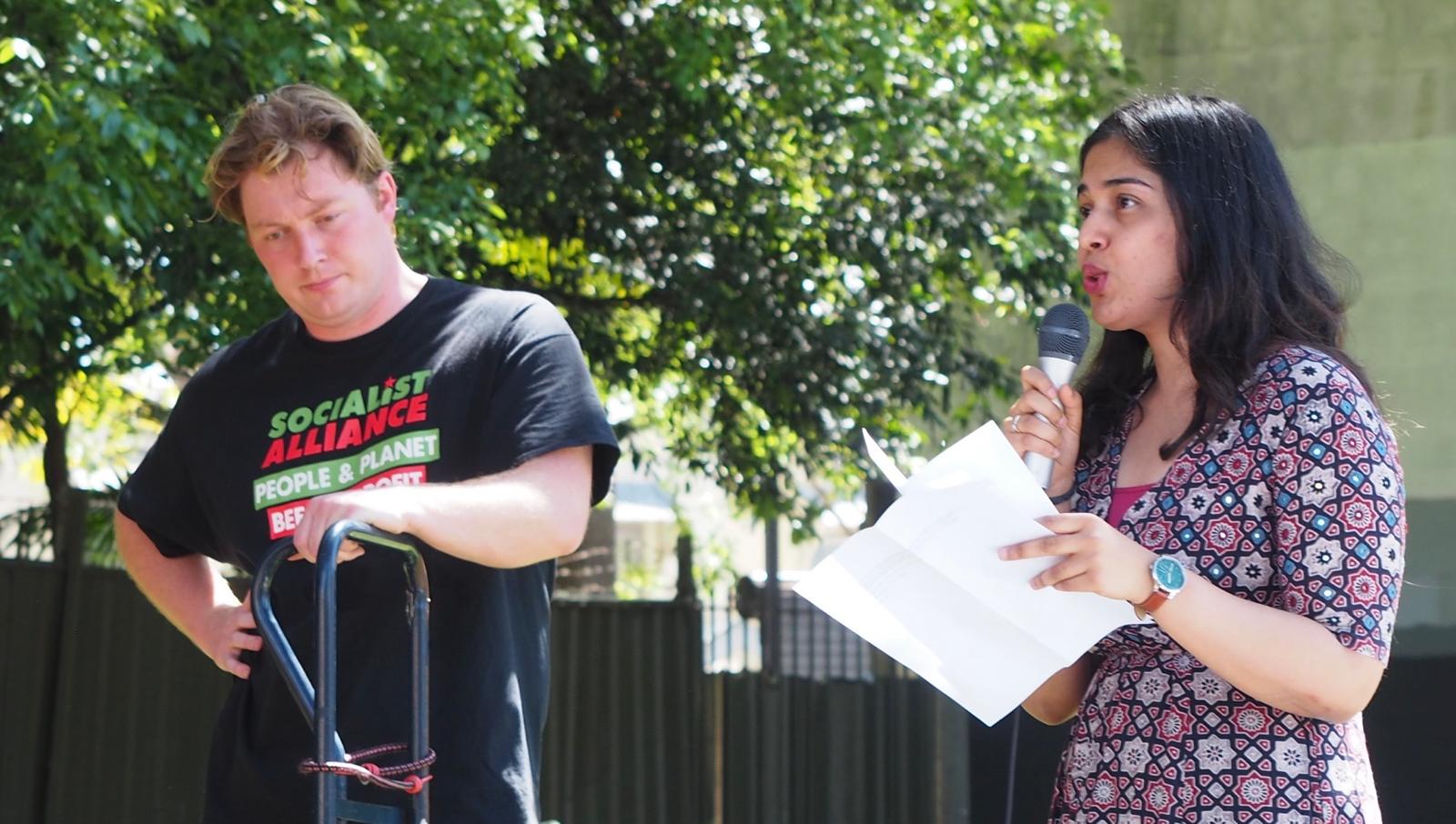
Hindus for Human Rights Representative Addresses Unite Against Racism Rally, Calls for Solidarity Across Communities
GLEBE, GADIGAL COUNTRY – Ishita Chakrabarty, representing Hindus for Human Rights, delivered a powerful address at a Unite Against Racism rally on September 26, urging Australians to confront racism in all its forms—from far-right politics to internal discrimination within migrant communities. Speaking on Gadigal Country, Chakrabarty opened with a message of solidarity for immigrants who have overcome monumental barriers including escalating visa costs, demanding return ticket requirements, intrusive bank statement and medical report submissions, and intense questioning about their motivations. She extended her words equally to those who have lived in Australia for generations yet are still told to “go back where you came from,” and to First Nations peoples whose sacred relationship to the land “can never be severed by the operation of an unjust, extractive and foreign imposed law.” The speech called for unity among all who believe in “an inclusive, egalitarian and multicultural Australia,” setting the tone for a wide-ranging critique of racism that spans both overt violence and insidious systemic failures.
Coming from Bengal, India, Chakrabarty spoke from a position of deep personal knowledge about the destructive power of hatred and bigotry. “I know all too well what hate, bigotry and the belief of the superiority of some over the other looks like, and how the destruction of the very fabric of society is tantamount to the destruction of the human within us,” she told the assembled crowd. She framed her advocacy as an act of love for both her home country and her appreciation for Australia, arguing that the fight against racism must be joined across all fronts—whether against the “far right politics of One Nation” or the “Hindutva ideology that considers Dalits, Muslims, Christians and other minorities inferior and less than human.” Drawing on current realities in India, she detailed how Muslims are being “lynched, evicted, legally stripped of their citizenship through complicit state institutions,” Christians are being hounded with prayer services stopped mid-worship on allegations of forced conversions, and Dalits and caste minorities remain trapped in systems of humiliation where upper castes take offense at a Dalit man “daring” to attend his own wedding on horseback. As someone bearing a majoritarian identity, Chakrabarty expressed an even greater compulsion to speak not only about racism emanating from distant political entities but also the hatred transpiring within South Asian communities themselves.
Chakrabarty turned her attention to the often-unspoken internal exclusions that persist within migrant communities, including in Australia, where identities, beliefs, and practices travel alongside communities. She described how such discrimination manifests through seemingly casual acts—questioning one’s food preferences, tasking an Indian student whose surname reveals their caste identity with menial household chores, and casual bullying perpetuated through closed social groups and marriage alliances. Hindus for Human Rights, she noted, has worked “hard and successfully” to have caste discrimination included as a form of racism in city councils and universities. But she also exposed the dangerous weaponisation of the “model minority” narrative, explaining how the same hatred used against some is twisted to justify the far right’s positioning as “not against all immigrants—only the ‘bad ones’ who refuse to ‘assimilate,’ for example, the hijab- or turban-wearing student of Indian origin.” She cited One Nation leader Pauline Hanson’s repeated characterisation of Indians as “good, hardworking migrants,” and pointed to platforms showing Hanson attending Diwali festivals “being warmly received by diasporic Indians” represented through associations like the Hindu Council of Australia, or posing with an Indian migrant-run shop owner in Townsville while eating fish and chips—all of which legitimises the exclusion of fellow community members.
The speech catalogued the stark realities of overt racism that persist in Australia. Chakrabarty recalled the February attack on 22-year-old Harmanpreet Singh in Corio, who was called “a dog” and physically assaulted, leaving him with a broken nose. She referenced the abuse directed at 26-year-old Nayonika in Sydney’s CBD, who was called a “curry muncher,” “smelly Indian,” and a “Mrs. 7/11 driver.” She highlighted the digital attacks where “desk warriors feel confident to call Greens Senator Mehreen Faruqi ‘a filthy Australian hating racist pig.'” But racism, she argued, also operates through more subtle mechanisms—the daily micro-aggressions of people staring you down on the road, and the constant anxieties expressed through questions like “So, you will return to India, right?”—a question, she revealed, that she has been asked “before I even had the chance to introduce myself.” The problem, she asserted, also lies in the state’s failure to provide adequate protection and remedy. She criticised the failure to stop hateful rallies such as the March for Australia from proceeding while law enforcement seeks orders to halt pro-Palestine rallies on “public safety” grounds, and noted that the state often resorts to mere “condemnations” after events rather than interventions before them. She also flagged a lack of data monitoring regarding whether incidents increase following such marches, citing responses from Victoria Police, New South Wales Police, and Queensland Police services to ABC media inquiries on the matter.
Turning to the framing of immigrants as a burden on Australian society, Chakrabarty systematically dismantled myths around housing, cost of living, crime, and migration rates. She argued that it is not migration but “bad policies” that create housing shortages—”decades of tax settings that reward buying property over building it and consecutive governments that under-fund social housing.” While the Australian Housing and Urban Research Institute indicates a need for 1.2 million new homes by 2029 to meet demand, Australia is falling behind by roughly half that rate, a shortfall she described as “purely state apathy.” Addressing crime statistics, she cited the Australian Institute of Criminology, which has consistently found that migrants and refugees are underrepresented in crime statistics relative to their share of the population. A 2023 University of Melbourne study further showed that migrants have higher rates of civic and political participation, including tax contributions, than the national average. “It’s a different matter though when fear needs only to be evoked—not proved,” she said, noting how much easier it is to blame the “other” than to ask and deliver on real questions like taxing billionaires or holding accountable a trillion-dollar AI company whose system accessed sensitive personal information like Medicare data. She also referenced the Australian Human Rights Commission’s receipt of 144 complaints alleging racial hatred in 2024-25, calling these figures “only a very conservative estimate” since immigrants are often told to stay quiet and “put up with the abuse and walk away.”
Chakrabarty concluded with a call to collective and individual action. She advocated for unified opposition to “Donald Trump-style deportation laws and excessive police powers,” investment in community cohesion infrastructures, housing reforms, and accountability for “those who incite hatred, dehumanise, or degrade others.” Individually, she urged Australians to speak up whenever witnessing acts of racism and to offer support to those being victimised. Her final words carried a special message for fellow Indians and South Asians tempted by the “model minority” status, warning that “our identities are mere constructs, fit to be used or disposed of, as and when those holding political power please.” She invoked the ethos of Vasudhaiva Kutumbakam—”the world is one family”—and called on all present to “stand shoulder to shoulder with your neighbours, familiar and unfamiliar.” Her speech ended with a vision of unity that bridges the distances of geography, culture, and experience: a reminder that the fight against racism requires not only confronting hatred from without but also interrogating the exclusions within, and that genuine solidarity demands recognising the world as one family.