







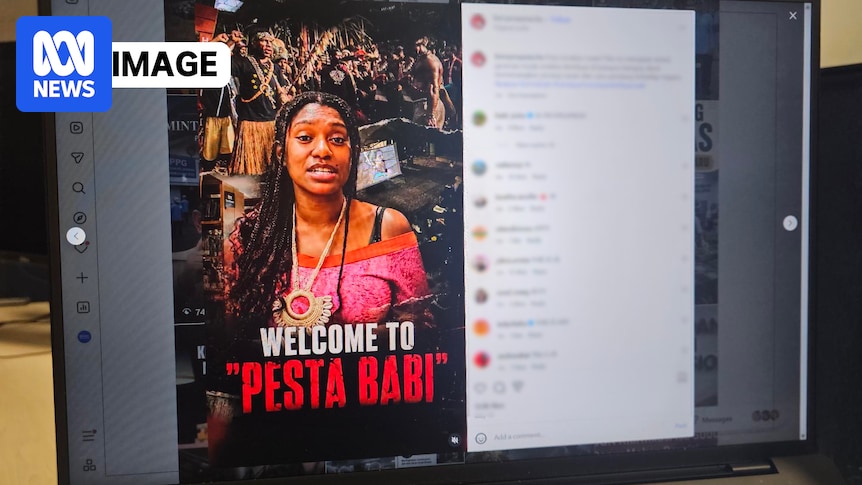
The landscape of political dissent regarding West Papua has reached a volatile new frontier as prominent activists face a wave of sophisticated digital attacks. Koteka Wenda, daughter of United Liberation Movement for West Papua leader Benny Wenda, recently discovered an AI-generated video of herself circulating online, in which she appeared to denounce a critical documentary titled Pig Feast (Pesta Babi). The film, which highlights mass deforestation, land exploitation, and the involvement of multinational corporations in the region, has become a focal point of intense debate. For Wenda, the experience was deeply personal, describing the synthetic replication of her likeness as a “sinister” violation that threatens to mislead her supporters and undermine the liberation movement.
This trend of using AI to discredit critics is increasingly being viewed as a contemporary iteration of long-standing state repression. Sydney-based activist Veronica Koman has been targeted multiple times, including by a deepfake depicting her engaging in sexual acts, as well as altered footage designed to project a false pro-government stance. Both activists suggest that the resources and coordination required for such high-quality deceptive content point toward state actors. Beyond mere defamation, these tactics serve to confuse the public, creating a chaotic information environment where supporters find it difficult to distinguish between genuine activist voices and state-sponsored digital fabrications.
Human rights organizations are sounding the alarm on the broader implications of these campaigns. A recent report by Amnesty International, titled Building up Imaginary Enemies, documents how Indonesian authorities are increasingly utilizing disinformation as a political weapon to consolidate power and silence dissent. Agnès Callmar, the organization’s secretary general, noted that online disinformation has become a key tactic used to justify repression while tech platforms fail to enforce safeguards. This development fits into a historical pattern of state suppression of information in West Papua, which has been ongoing since the 1960s, ranging from restrictive media access to the active cultivation of “bots” to shape public opinion.
Academic experts argue that while the medium has shifted to the digital realm, the fundamental strategy remains rooted in authoritarian control. Dr. Ken Setiawan from the University of Melbourne characterizes these interventions as “old wine in a new bottle,” noting that while the technology is modern, the persistent involvement of security forces in targeting human rights defenders is well-documented. By flooding social media with “slanted or untrue content,” these disinformation campaigns aim to manufacture a narrative that favors government projects and national strategic interests, effectively rewriting the public’s perception of the West Papuan conflict in real time.
For activists on the ground, this represents a new manifestation of “digital colonization.” Koteka Wenda suggests that the appropriation of their voices is an attempt to once again silence a people who have struggled for over 60 years to gain international attention. By manipulating their digital identities, critics of the state are not only being marginalized but actively repurposed to validate the very systems they seek to dismantle. This psychological warfare adds a layer of complexity to the already arduous task of advocating for Indigenous rights and territorial sovereignty in a space where the truth is increasingly obscured by synthetic media.
Despite these significant challenges, activists remain resilient, emphasizing the necessity of digital literacy and skepticism among the younger generation. Koman and Wenda assert that while the technology poses a severe threat to their credibility, the fundamental truths regarding the conditions in West Papua remain unchanged. They advocate for a more disciplined approach to digital engagement to maintain the integrity of their messaging. As the struggle over the future of West Papua continues, the digital arena has essentially become the most recent battleground, where the preservation of one’s own likeness and voice is as critical as the political cause itself.


