








Here is a news article summarizing the proceedings of the conference:
The Frontline of Perception: Deputy Prime Minister Sikorski Warns of Russia’s Multi-Billion Dollar Cognitive War
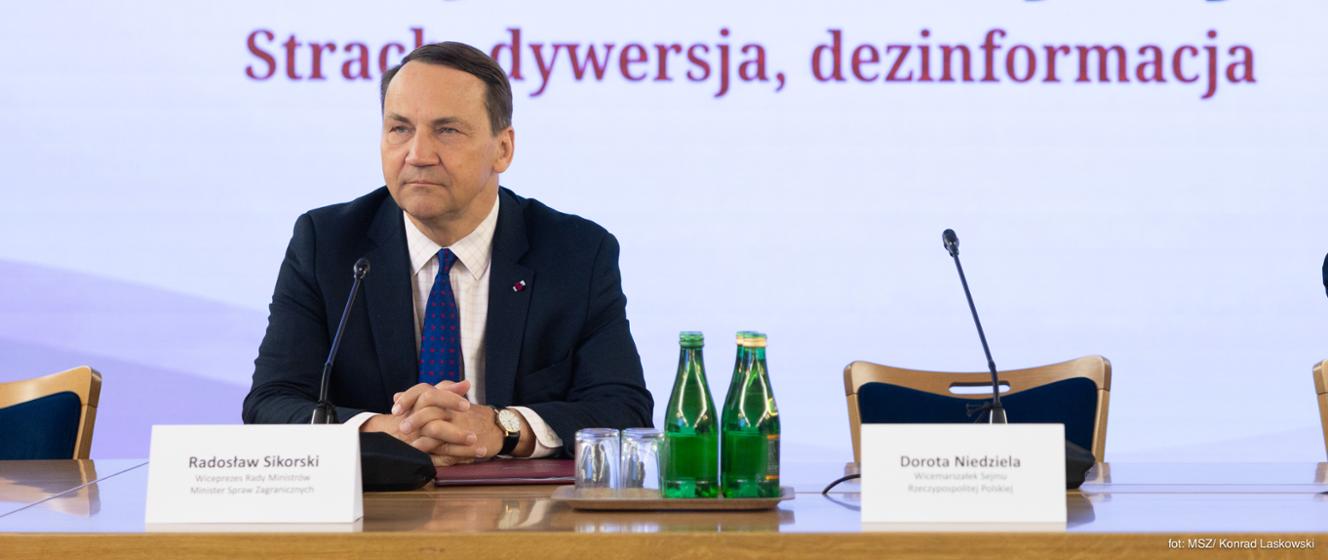
On June 8, 2026, the Polish Sejm became the epicenter of a critical dialogue regarding national security, hosting the conference titled “The War for Minds: Fear, Subversion, Disinformation.” Held under the honorary patronage of Deputy Speaker of the Sejm Dorota Niedziela, the event convened top government officials, leading academics, and experts in information security to address the intensifying challenges of hybrid threats. Deputy Prime Minister and Minister of Foreign Affairs Radosław Sikorski opened the proceedings with a keynote address titled “Europe in the Shadow of War,” setting a grave tone for the discussions that followed regarding the state’s resilience against external manipulation.
In his address, Minister Sikorski characterized the current geopolitical climate as an era where the battlefield transcends physical geography, manifesting as a “full-scale cognitive war.” According to the Foreign Minister, the Kremlin views these operations as an existential struggle against the Western world and its strategic alliances. By targeting the psychological foundations of Poland and its neighbors, Russia aims to dismantle the pillars of regional stability and prosperity. Sikorski emphasized that this is not merely a fringe activity but a core component of Russian military and state doctrine, calculated to sow deep-seated confusion and erode the democratic resilience of sovereign nations.
The scale of this operation is staggering, as evidenced by the financial figures presented by the Minister. Sikorski revealed that in 2025 alone, Russia poured a record-breaking $1.4 billion into its global propaganda machine—a monthly expenditure of approximately $118 million, or half a billion zlotys. Since the inception of the full-scale invasion of Ukraine, the total investment in this sophisticated disinformation apparatus has reached $6 billion. This massive mobilization of capital highlights Russia’s commitment to a long-term strategy of destabilization, designed to weaken the collective will of Western populations to resist foreign aggression.
Technological advancement has significantly lowered the barriers to entry for these malicious actors. Minister Sikorski highlighted that the proliferation of artificial intelligence has rendered disinformation operations faster, cheaper, and more difficult to detect than at any point in history. He argued that the speed of technological evolution is currently outpacing the legislative frameworks of democratic states, creating a dangerous vacuum. To combat this, the Minister issued a call to action for policymakers to modernize legal systems, ensuring that they can provide robust responses to the full spectrum of contemporary digital threats without compromising the democratic values they aim to protect.
A central theme of the conference was the vulnerability of social media platforms and the importance of digital literacy among the youth. Minister Sikorski identified the younger generation as both a primary target for disinformation and a vital participant in the defense of truth. He advocated for deeper collaboration between the state and young citizens, pointing to the Ministry of Foreign Affairs’ “Youth Resilience Council” as a prototype for future engagement. By fostering such initiatives, the government hopes to build a cognitive shield, equipping the next generation with the critical thinking skills necessary to navigate and resist the barrage of state-sponsored falsehoods.
Ultimately, the “War for Minds” conference served as a stark reminder that modern warfare is increasingly fought in the digital arena. Minister Sikorski’s closing remarks emphasized that passive observation is no longer a viable strategy; a cohesive, multifaceted, and proactive approach is required to secure the information space. Through legislative reform, increased public-private cooperation, and the sustained empowerment of younger demographics, Poland remains committed to thwarting efforts to compromise its national security. As the threat of disinformation continues to evolve, the consensus at the Sejm was clear: democratic nations must treat cognitive resilience with the same level of urgency as their territorial and conventional defenses.


