


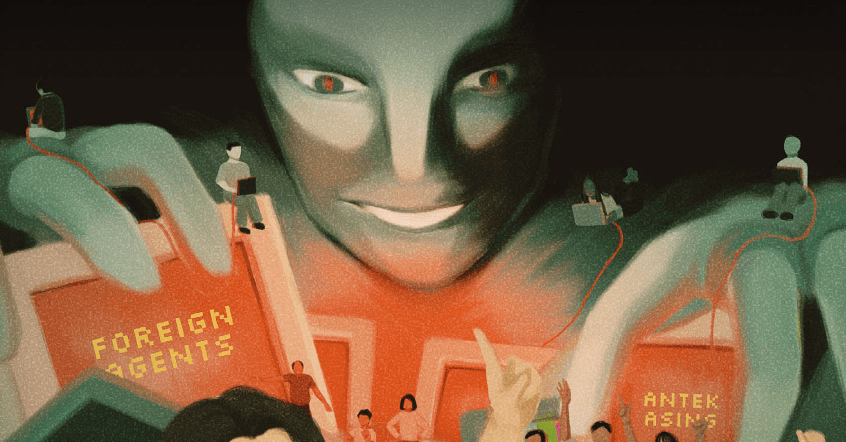
In the eighteen months since President Prabowo Subianto assumed office in October 2024, Indonesia’s digital landscape has been profoundly reshaped by a systematic campaign of state-sponsored information warfare. The administration has frequently deployed stigmatizing mis- and disinformation to discredit political dissent, marking a departure toward authoritarian tactics that prioritize regime protection over democratic deliberation. Central to this strategy is the rebranding of legitimate civil society advocacy as the work of nefarious “foreign agents.” By framing activists, NGOs, and independent journalists as conduits for external interference, state officials have effectively delegitimized critique, shifting the narrative away from pressing socio-economic concerns toward fabricated national security threats.
The mechanics of this state-led offensive rely on the cultivation of “imaginary enemies,” a diversionary tactic designed to neutralize criticism regarding government policy. Whenever the administration faces scrutiny—whether it concerns economic mismanagement, human rights abuses, or political corruption—state-aligned actors have moved to characterize the friction not as a product of genuine domestic grievances, but as a deliberate provocation by hidden foreign interests. This rhetorical pivot serves two purposes: it appeals to populist nationalism to rally the state’s base, and it provides a convenient justification for the state to abandon its duty to address the substantive content of the protests, portraying the protesters instead as subversive fifth columnists.
The repercussions of this discourse extend far beyond the digital realm, as the report, “Building Up Imaginary Enemies,” highlights an alarming synergy between online vitriol and offline intimidation. The online stigmatization campaigns act as a form of “digital dog-whistling,” identifying specific civil society actors as targets for harassment. Once labeled as agents of foreign powers, these individuals are frequently subjected to doxxing, physical surveillance, and direct threats of violence in their real-world interactions. This bridge between online disinformation and offline harm illustrates how state actors use the digital space to facilitate an environment where civic space is characterized by escalating danger rather than open debate.
A core consequence of this state-orchestrated campaign is the deep “chilling effect” it has cast over Indonesian civil society. The constant threat of being branded an enemy of the state has forced many non-governmental organizations and activists to engage in self-censorship, limiting the scope of their advocacy to avoid becoming targets of coordinated misinformation campaigns. The fear of institutional retaliation, combined with the reputational damage caused by being labeled a “foreign agent,” has stalled critical oversight of the Prabowo administration, arguably undermining the very foundations of Indonesia’s democratic accountability. The psychological toll on those speaking truth to power cannot be overstated, as the digital environment has become a crucible of intimidation.
The investigation further interrogates the complicity of social media platforms, which have become the primary vehicles for this state-weaponized disinformation. Despite policies ostensibly designed to curtail the spread of harmful content, the major platforms have largely failed to mitigate the specific danger posed by state-aligned actors using “foreign agent” narratives to silence dissent. By failing to consistently enforce community standards or recognize the nuances of state-sponsored systemic harassment, these tech companies have inadvertently provided the infrastructure necessary for the government to suppress political opposition. Their inaction or slow response to the rapid dissemination of state-endorsed smears has allowed the toxicity to reach mass audiences with minimal friction.
In summary, the early years of the Prabowo administration demonstrate a calculated effort to institutionalize the delegitimization of critics through the misuse of information. The transition toward utilizing “foreign agent” allegations as a tool of repression signifies a precarious period for human rights and individual liberties in Indonesia. To preserve the integrity of Indonesia’s democratic framework, it is essential that both the international community and domestic institutions demand accountability for the use of state resources in perpetuating disinformation. As long as these digital frontiers are utilized as conduits for unchecked state power, the safety of civil society actors will remain in jeopardy, and the vibrancy of Indonesian democracy will continue to wither under the weight of an adversarial, manufactured reality.