


Strengthening Local-Language Fact-Checking: A Vital Pillar for Nigeria’s Electoral Integrity
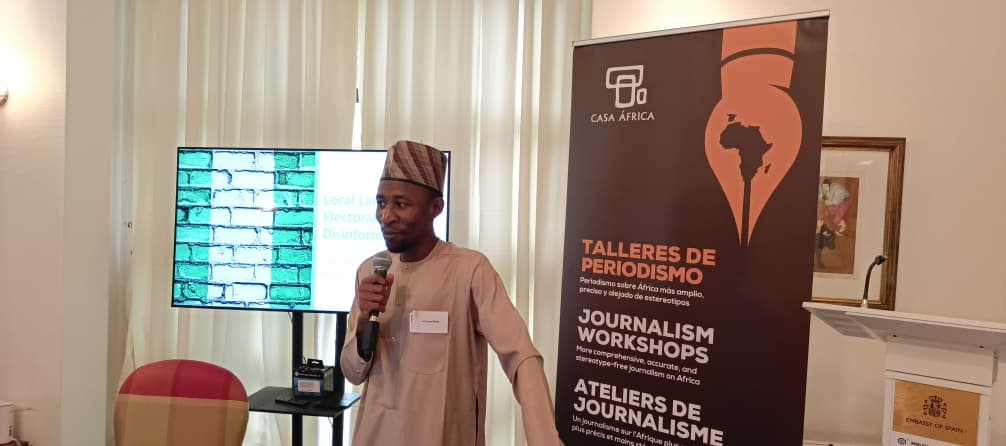
Alhassan Bala, the publisher of Alkalanci (The Arbiter)—Nigeria’s pioneer Hausa-language fact-checking and media literacy organization—has issued a clarion call for the professionalization of indigenous-language fact-checking. Speaking at a specialized training workshop in Abuja focused on Electoral Disinformation, Bala argued that the current reliance on English-language verification is a significant vulnerability. By shifting focus toward local-language capacity building, media organizations can more effectively combat the spread of electoral disinformation and better protect the sanctity of the democratic process from manipulative narratives.
The training program, organized by the Embassy of Spain in partnership with Casa África and the Centre for Journalism Innovation and Development (CJID), gathered prominent journalists to confront the accelerating threat of false information. As elections remain high-stakes events, experts emphasized that disinformation campaigns are becoming increasingly sophisticated, often weaponizing the cultural trust inherent in community-based communication. Bala noted that because citizens often process information and think in their mother tongues, disinformation spread in these languages carries a unique “perceived credibility” that English-language content lacks.
A critical point raised during the event was the systemic “detection gap” inherent in current digital moderation strategies. Bala pointed out that while social media companies heavily leverage Artificial Intelligence (AI) and trust and safety teams to curb harmful content, these tools are predominantly trained on English datasets. This technological bias creates a blind spot for Nigerian local languages, allowing false narratives to circulate unchecked across various platforms. Furthermore, because these messages often originate from familiar community voices in broadcast or audio formats—which are notoriously difficult to archive, search, and verify compared to text—they effectively evade traditional oversight.
The expert highlighted that the disparity in resources is a major hurdle; there are significantly fewer fact-checkers trained to work in indigenous Nigerian languages than there are in English. This imbalance leaves the majority of the population, particularly those in rural or semi-urban areas who rely on native-language broadcast media and communal networks, at the mercy of unchecked falsehoods. When disinformation is allowed to flourish in these local spheres, the inevitable consequence is the erosion of public trust in democratic institutions and the distortion of informed electoral participation.
Echoing the urgency of these concerns, Eva Barta Martin, the Cultural Adviser at the Spanish Embassy in Nigeria, reaffirmed the international commitment to supporting independent journalism in the region. She emphasized that access to credible, verifiable information is a fundamental building block for democratic development. In her remarks, Martin stressed that the challenge of digital disinformation requires a robust, collaborative front. Success depends not only on individual journalists but on a stronger synergy between media practitioners, civil society organizations, and international stakeholders to harden the information ecosystem against malice.
Ultimately, the workshop served as a blueprint for the future of Nigerian fact-checking. The consensus among participants was that combating disinformation is no longer just a technical requirement for newsrooms; it is a necessity for the preservation of Nigeria’s democracy. By investing in linguistic diversity within media organizations and cultivating a stronger fact-checking culture across the country’s 250-plus languages, stakeholders aim to build a more resilient citizenry capable of filtering fact from fiction, ensuring that voters cast their ballots based on truth rather than manufactured deception.