


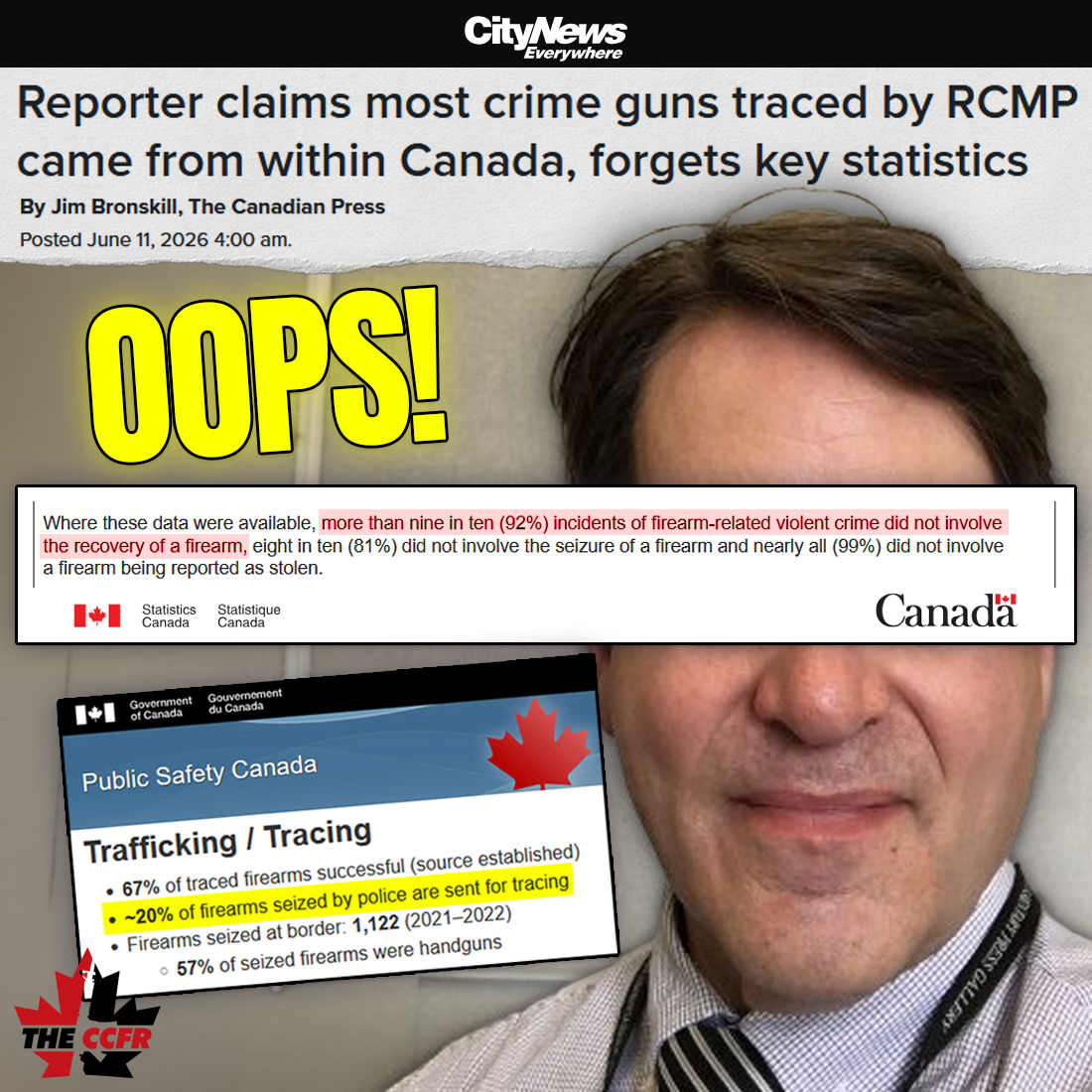
A recent report by Canadian Press journalist Jim Bronskill has ignited a firestorm of controversy among firearms policy critics, centering on the claim that 71% of traced RCMP crime guns are domestically sourced. The report, which suggests a significant internal origin for illegal firearms, has been met with skepticism by industry observers who argue the narrative contradicts long-standing law enforcement data and statistical realities. By failing to provide the full context of how these figures are derived, critics argue the report misleads the public regarding the true nature of criminal gun sourcing in Canada.
The primary point of contention lies in the limited scope of the data itself. According to a 2023 Statistics Canada report on firearms and violent crime, more than 92% of incidents involving a firearm do not involve the recovery of a weapon by police. Furthermore, data released by Public Safety Canada as recently as March 2025 indicates that fewer than 20% of seized firearms are ever submitted for formal tracing. When these figures are reconciled, the percentage of total crime guns that are actually traced is remarkably small, calling into question the validity of extrapolating national trends from such a narrow sample size.
Statistically, if only 8% of crime guns are recovered, and of those, only 20% are traced, the 71% “domestic” figure applies to a mere 1.6% of the total estimated crime guns in circulation. Consequently, the actual portion of crime guns proven to be domestically sourced from legal owners or shops is estimated to be roughly 1.1%. Even this figure is considered inflated by critics, as the RCMP’s tracing category includes “ghost guns”—illegally manufactured or 3D-printed weapons—which account for 67% of that internal subset, alongside replicas, airsoft guns, and BB guns.
When these non-firearm items and ghost guns are stripped away, the percentage of crime guns originating from the legal domestic supply—via theft or diversion—drops to less than 1%. Critics of the Bronskill report point out that this crucial context was entirely omitted, as was the fact that the data excludes Canada’s two most populous provinces, Ontario and Quebec. This omission has led to accusations that the narrative was intentionally crafted to support specific political posturing regarding current federal gun-control legislation, rather than to inform the public with comprehensive data.
The timing of the story has also drawn intense scrutiny, appearing in the press one day after the federal government announced an extension to the amnesty period for its controversial “buyback” or “gun grab” program. Many in the firearms community believe this juxtaposition is not coincidental but rather a coordinated effort to frame the amnesty extension as a necessary response to a domestic gun crisis. They argue that by relying on skewed data, the narrative avoids the uncomfortable reality that current Liberal gun bills, bans, and handgun freezes do little to address the root sources of illicit firearms.
Ultimately, observers are calling for a shift in policy, suggesting that if the government redirected the capital currently allocated for the gun confiscation program into law enforcement, it could increase recovery and tracing rates. By investing in better forensics and more robust tracing labs, Canada could move away from these statistically thin narratives and toward a data-driven approach that addresses the actual flow of illegal weapons. Until then, critics warn that the public should view reporting on domestic gun sourcing with extreme caution, as the current numbers appear designed to serve a political objective rather than public safety.