








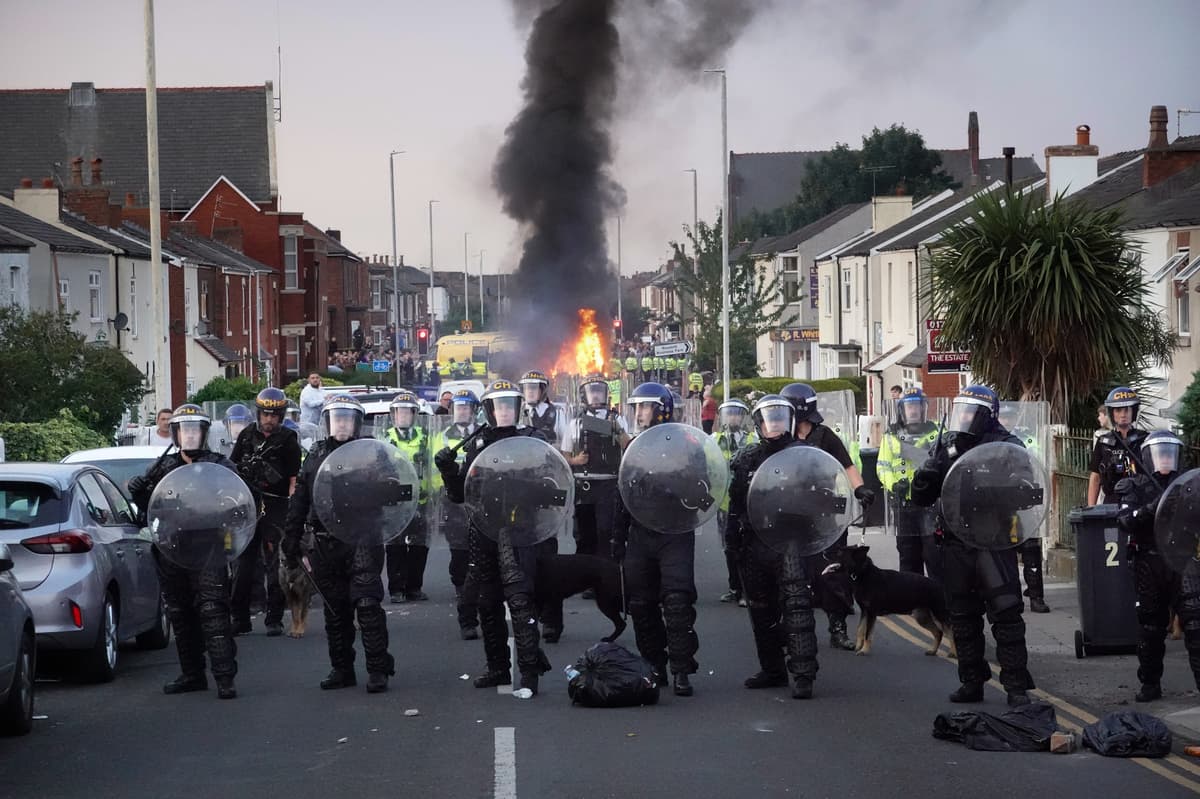
The violent disorder that erupted in Southport following the July 2024 stabbings has unmasked a sophisticated, multi-layered threat to British social cohesion. Beyond the immediate chaos on the streets, intelligence analysts have identified a disturbing trend: the weaponization of domestic grievances by foreign actors. Investigations suggest that the rapidly spreading misinformation regarding the identity and motivations of the suspect was not merely the product of domestic far-right opportunism, but was heavily amplified—if not directly facilitated—by external actors, including elements tied to the Kremlin.
Writing for the Royal United Services Institute (RUSI), intelligence analyst Joe Morley-Davies of Janes highlighted how Russia has shifted its strategy to obscure its fingerprints. Moscow is increasingly “outsourcing and franchising” its influence campaigns to a network of witting and unwitting proxies. By leveraging these intermediaries to inject inflammatory narratives into the British social media ecosystem, the Kremlin successfully creates a veneer of grassroots authenticity, making it difficult for the public to distinguish between genuine local concern and orchestrated foreign subversion.
The transition from foreign policy agitation to domestic destabilization has been stark. Following the 2024 general election, social media accounts previously fixated on undermining UK support for Ukraine seamlessly pivoted to attacking the newly installed Labour government. By deploying divisive hashtags such as #twotierkier and #twotierpolicing, these networks stoked narratives of institutional bias and national decline. Morley-Davies notes that these specific linguistic patterns bear the “tell-tale signs of Kremlin interference,” framing the internal division of the UK as a critical theatre in Vladimir Putin’s broader “existential struggle” against Western stability.
The effects of this digital interference are now manifesting physically in communities far from Whitehall. Recent reports from Glasgow, where racist attacks against members of the public have been linked to fabricated social media claims, demonstrate that the disruption is ongoing. Concerns have escalated further regarding a planned protest in the city concerning a local care home expansion. False allegations, circulating online, baselessly claim the facility is intended to house asylum seekers, turning a mundane planning matter into a potential flashpoint for organized violence and community hostility.
The moral culpability of those participating in these disturbances is two-fold. Those who consume and act upon digital falsehoods are effectively functioning as “dupes,” manipulated by bad-faith actors to serve agendas they often do not understand. Those who translate this misinformation into physical violence, however, must be classified as thugs, undermining the rule of law. Yet, if the source of these inciting lies is confirmed to be an orchestrated Russian disinformation campaign, the dynamic changes from a domestic policing issue to one of national security. Citizens unknowingly acting as conduits for hostile state propaganda are, in effect, serving the interests of an adversary.
As the geopolitical climate grows increasingly tense—with some experts warning of the potential for direct conflict between the UK and Russia by 2030—the domestic tolerance for such foreign-influenced destabilization is rapidly evaporating. If this period of social unrest is eventually proven to be a proxy maneuver by the Kremlin, the legal and social response may be severe. Policymakers and the public alike are beginning to view these digital influence campaigns not as organic societal friction, but as a deliberate and dangerous form of informational warfare that threatens the very fabric of the nation.


