









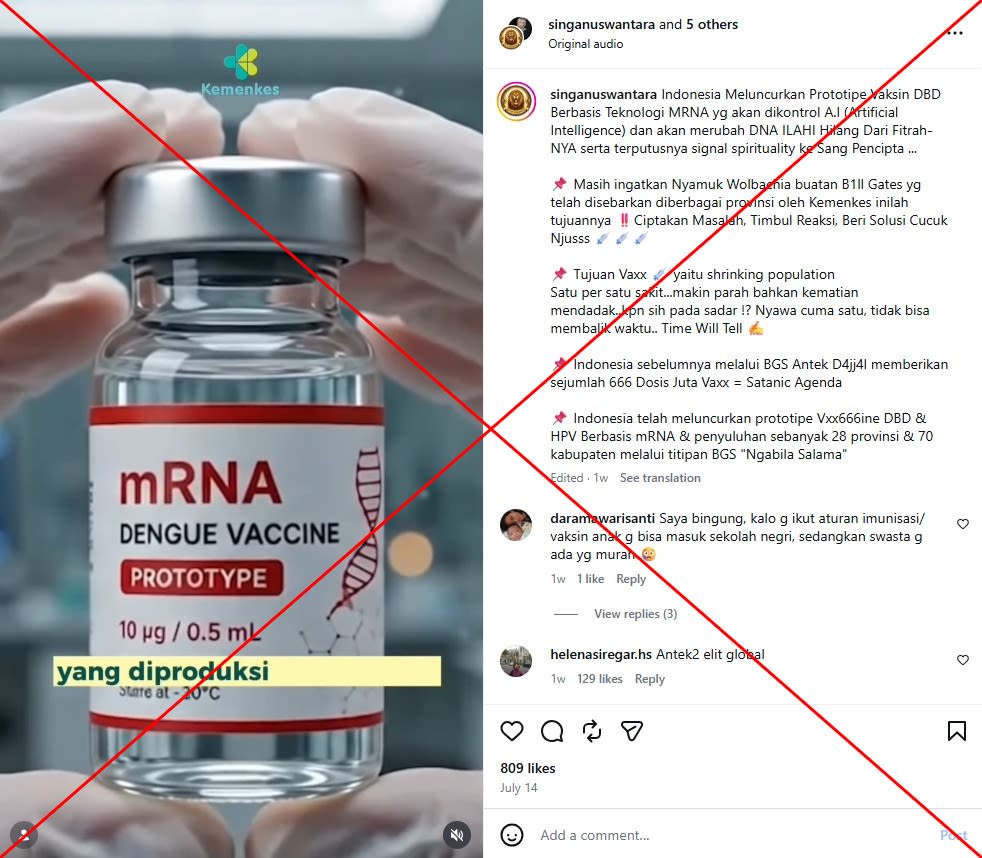
In a recent development, the University of Indonesia and Tsinghua University successfully created an mRNA-based dengue vaccine prototype, representing a significant potential advancement in combating a disease that causes up to 400 million infections annually. Despite the scientific promise of this innovation, the announcement triggered a wave of misinformation on social media platforms like Instagram and Facebook. Baseless claims have resurfaced, erroneously alleging that the vaccine is designed to alter human DNA, suppress spirituality, and facilitate “population shrinking” through artificial intelligence-controlled mechanisms.
Medical experts and the Indonesian Health Ministry have categorically rejected these conspiracy theories, reaffirming that mRNA technology does not possess the capability to modify human genetics. Scientists explained that mRNA vaccines work by delivering temporary instructions to cells to produce a protein that triggers an immune response; the molecule then naturally breaks down and exits the body. Crucially, mRNA lacks the specialized enzymes necessary to integrate itself into the human genome, making the biological claims circulating online scientifically impossible.
The assertion that the vaccine is “controlled by AI” has also been debunked as a fundamental misunderstanding of pharmaceutical research. The Indonesian Health Ministry clarified that while artificial intelligence is being utilized as a sophisticated tool during the design phase—specifically to predict potential future viral mutations—it is not a physical component of the vaccine itself. Experts emphasized that a vaccine consists solely of biological molecules such as lipids and mRNA, which contain no hardware, software, or communication capabilities to monitor or influence recipients.
This misinformation effort has leveraged clips of known public figures and echoes earlier debunked narratives, such as those regarding the release of Wolbachia-infected mosquitoes to combat dengue. By conflating the legitimate use of computational modeling with malicious intent, these viral posts aim to foster distrust in public health initiatives. Indonesian authorities reiterated that the dengue prototype is still in its infancy and must pass rigorous preclinical and clinical trials, as well as strict safety evaluations, before any consideration for public use.
The scientific community maintains that mRNA vaccines are generally safer than traditional methods because they do not require the use of live pathogens, which can sometimes pose risks. By instructing the body to create proteins that mimic a pathogen, the immune system develops a “memory” of the virus without the need for exposure to the actual disease. Researchers point out that mRNA is a common, essential molecule found in every human cell, meaning the platform is a natural, efficient way to teach the body how to defend itself against serious health threats.
Ultimately, the goal of the Indonesian research team remains the reduction of the massive disease burden caused by dengue fever, which affects nearly half the global population. By utilizing mRNA technology, scientists hope to scale production more effectively than with traditional vaccines. As development continues, health officials urge the public to rely on verified information from medical experts rather than social media conspiracies that distort the role of technology in modern medicine to manufacture fear and distrust.


