



The messaging app Line has become a primary conduit for political disinformation in Taiwan, where its encrypted, peer-to-peer nature allows misinformation to spread unchecked within closed social circles. A recent study by National Taiwan University’s John Chung-En Liu and Lee Chia-Fen identifies that this content is frequently weaponized to undermine trust in Taiwan’s energy infrastructure and policy. By categorizing this data, researchers revealed four recurring themes: “renewable delayism,” the manufacturing of distrust in power stability, the strategic use of “nuclear distraction,” and misleading claims regarding climate action. These narratives are designed not just to confuse the public, but to serve specific political objectives that align with pro-China interests.
The mechanics of this disinformation campaign frequently rely on easily debunked falsehoods to erode public confidence. For example, persistent rumors regarding tiered electricity rates—falsely claiming that costs fluctuate drastically throughout the day—force state utility Taipower to waste significant resources on public clarification. Furthermore, propaganda often conflates systemic issues of local governance, such as corruption and organized crime activity in the solar energy sector, with policy failure. By framing genuine administrative hurdles as evidence of inherent flaws in renewable programs, these campaigns create a climate of skepticism that hinders the government’s transition toward green energy.
Research into the 2024 Taiwanese election indicates that energy policy has become a powerful proxy for broader geopolitical alignments. A study by a Dartmouth College-led team found that belief in skepticism toward the United States is more strongly correlated with views on energy policy than with traditional cross-strait issues. This suggests that energy has evolved into an “alternate geopolitical issue,” allowing external actors to frame the debate in a way that separates Taiwan from its democratic allies. By exploiting these fractures, the disinformation campaigns effectively turn energy policy into a tool for challenging Taiwan’s democratic standing.
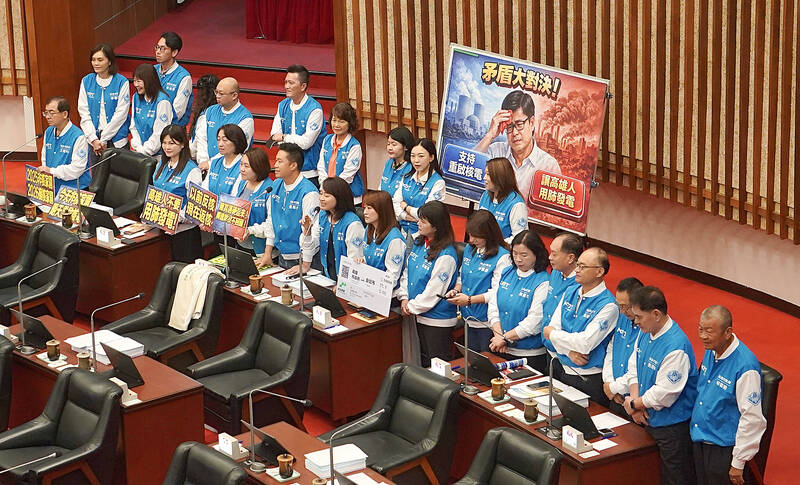
The “nuclear distraction” theme serves as a tactical centerpiece, particularly for the opposition Kuomintang (KMT). While the KMT frequently presents itself as an ardent proponent of nuclear energy, its legislative history tells a different story. The party has historically blocked efforts to extend the lifespans of nuclear plants and failed to secure storage sites when it held power. By pushing for performative referendums and centering nuclear power as the “only” solution, the party creates a smoke screen. This strategy effectively distracts the public from the reality that the KMT’s legislative actions frequently stifle both nuclear development and the necessary expansion of renewable energy.
The reality of the KMT’s energy stance appears to be a preference for the status quo: continued reliance on fossil fuels. Despite their pro-nuclear rhetoric, the party’s actions—such as recent legislative attempts to restrict solar energy projects—suggest a calculated opposition to renewable alternatives. Observers note that this hostility toward renewables, paired with a lack of substantive support for nuclear infrastructure, indicates that the party’s business interests and long-standing ties to the traditional energy establishment may be dictating its strategy. This preference for fossil fuels benefits established industrial allies but leaves the island’s energy policy stagnant.
Ultimately, these disinformation efforts have significant security implications for Taiwan. By stalling the development of indigenous renewable energy sources, the KMT and its aligned actors may be inadvertently strengthening Taiwan’s dependence on imported fossil fuels, a vulnerability that would make the island significantly easier to isolate during a potential blockade. The persistent use of nuclear issues to obscure this broader policy agenda creates a dangerous barrier to energy independence. As Michael Turton notes, the misalignment between the KMT’s stated positions and its actual legislative habits suggests that energy policy is being used as a pawn to maintain traditional power structures at the expense of national resilience.