








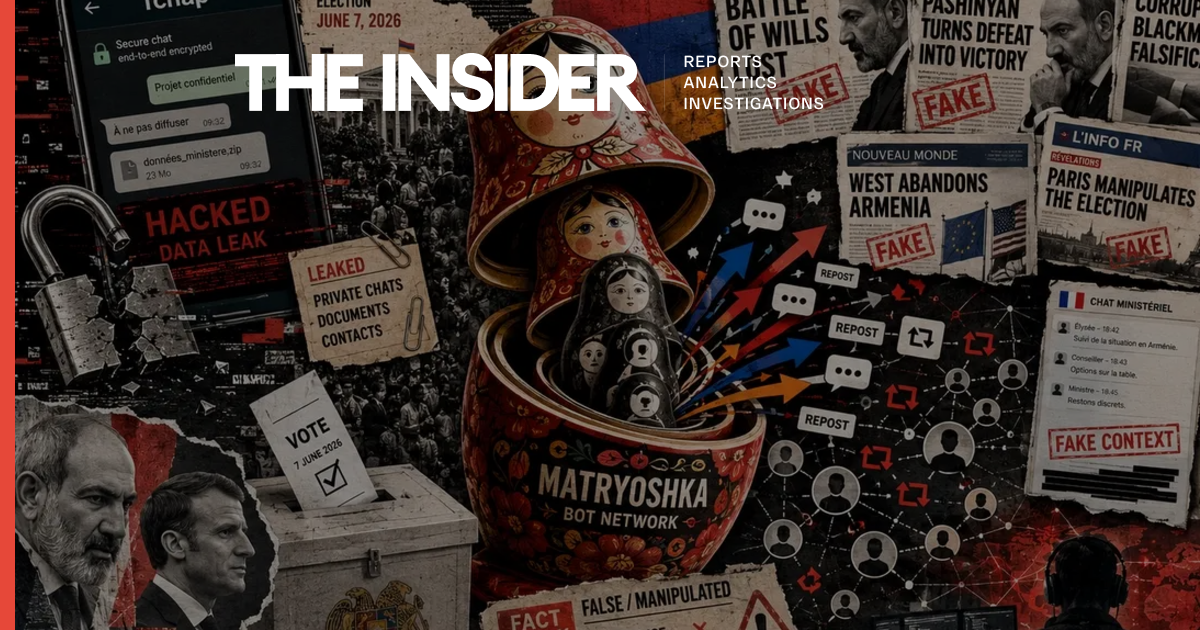
Following the conclusion of Armenia’s parliamentary elections on June 7, a sophisticated Russian-linked disinformation network known as “Matryoshka” has unleashed a coordinated digital assault aimed at destabilizing the regional political landscape. Researchers from the Antibot4Navalny project, who monitor pro-Russian network activity, identified this campaign as a highly calculated effort to manipulate public perception by framing the election results as a fraudulent failure. By leveraging a genuine security breach of the French government’s Tchap messaging app, the network has successfully manufactured a series of “leaks” designed to implicate European leaders in illicit interference and colonial-style exploitation of Armenia.
The centerpiece of the campaign involves high-quality, deceptive videos that mimic the branding of reputable Western media outlets, including Le Figaro, Libération, France 24, and Spiegel TV. In these fabricated clips, the bots feature real journalists and public figures, such as Alexis Brézet and Fritz Scharpf, who are falsely quoted as confirming that the French government used “manipulation technologies” to rig the vote in favor of Prime Minister Nikol Pashinyan. One particularly inflammatory narrative alleges that France funneled millions of euros into Armenian and Moldovan elections, while another disturbing fabrication uses a fake Bellingcat report to falsely accuse a French diplomat’s son of heinous crimes as part of a state-sanctioned cover-up.
To further amplify the illusion of consensus, the Matryoshka operation has flooded social media platforms like X, Telegram, and Bluesky with forged screenshots of international news outlets. Front pages from newspapers such as Le Parisien and La Croix highlight headlines claiming Pashinyan’s party suffered a “failure” and was marred by blackmail, despite the objective reality that his Civil Contract party secured a clear parliamentary majority with 49.85% of the vote. These digital artifacts are designed to create a sense of internal European panic, suggesting that officials like Emmanuel Macron are “furious” over the alleged corruption and the failure to secure a constitutional super-majority.
While the disinformation campaign is built on a foundation of lies, it utilizes a kernel of truth regarding a cybersecurity incident. France’s national cybersecurity agency, ANSSI, confirmed that a Tchap account was indeed compromised on June 7, resulting in the theft of approximately 13.5 gigabytes of data. However, French authorities have clarified that the breach was limited to public messaging rooms, and no evidence exists to suggest that private, encrypted conversations related to Armenia were leaked or that any electoral fraud occurred. The Matryoshka network has effectively weaponized this genuine security incident, layering it with layers of fabricated correspondence to obscure the origin of their propaganda.
The Matryoshka operation—named for the Russian nesting doll to reflect its layered, deceptive infrastructure—relies on a vast network of hundreds of bot accounts masquerading as individual citizens, think tanks, and independent observers. By mimicking local speech patterns and simultaneously launching content across multiple platforms, the campaign aims to generate an “artificial information noise” that makes verification nearly impossible for the average user. Their strategy is not merely to promote a specific viewpoint, but to overwhelm the digital space with conflicting evidence, ultimately undermining the credibility of democratic processes and Western diplomatic influence within the Caucasus region.
For international observers and the Armenian public, the Matryoshka campaign serves as a stark reminder of the evolving nature of hybrid warfare. By co-opting the logos and identities of trusted journalistic institutions, the network attempts to bypass the critical faculties of the audience. As research continues to uncover the backend mechanisms of these automated bot farms, transparency from independent investigative outlets remains essential. By documenting these links and exposing the “Matryoshka” methodology, researchers are providing the necessary information to help the public discern between the reality of Armenia’s electoral process and the manufactured instability pushed by external bad actors.


