


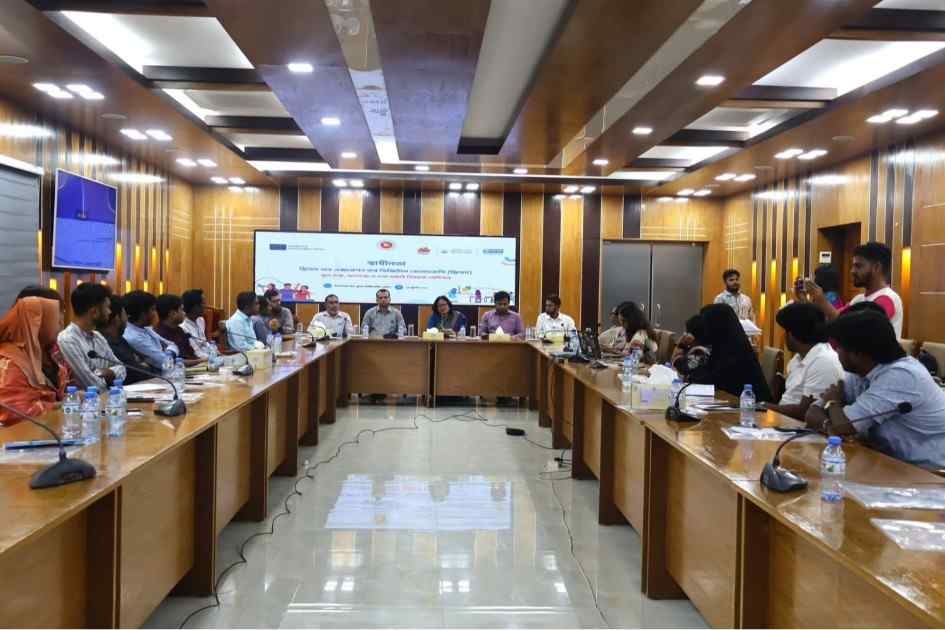
Seminar in Khulna Emphasizes Collective Responsibility in Tackling Digital Misinformation and Harassment
A coalition of government officials, journalists, and activists recently convened at the Khulna Circuit House to address the escalating challenges of the digital age, specifically focusing on the rampant spread of misinformation and the rise of online harassment. Held under the European Union-funded “Swadhinata: Freedom of Expression for Digital Democracy” (FREEDOM) project, the seminar served as a platform to foster a more secure and responsible digital environment. Organized by Badabon Sangho in collaboration with the Manusher Jonno Foundation, the event underscored that safeguarding digital democracy requires a unified effort between public institutions and the citizenry to curb the misuse of online platforms.
The event, which drew a diverse group of stakeholders including the District Magistrate and representatives from the police and ICT departments, highlighted that digital risks have grown into a critical public concern. Hure Jannat, the Deputy Commissioner and District Magistrate of Khulna, who served as the Chief Guest, emphasized that while the government is actively working to implement safety regulations, state intervention is merely one component of the solution. She stressed that the responsibility rests heavily on individuals to practice digital hygiene, specifically by verifying information before engagement and refraining from propagating unverified or harmful content that can cause widespread social damage.
A significant portion of the discourse was dedicated to the heightened vulnerability of women in digital spaces, who frequently bear the brunt of online harassment. Participants identified that women in rural communities are particularly at risk, often lacking the tools or knowledge to navigate cyber threats. To bridge this gap, the seminar proposed implementing “uthan boithok” (courtyard meetings) to provide rural women with essential knowledge about online safety, the mechanics of misinformation, and the formal mechanisms available for seeking redress. By decentralizing awareness, stakeholders hope to protect vulnerable demographics from the increasingly sophisticated threats emerging online.
Journalistic integrity also took center stage, with attendees stressing that media professionals hold a profound ethical responsibility to act as gatekeepers of truth. Journalists were urged to move beyond speed and prioritize rigorous fact-checking, consulting multiple reliable sources, and questioning the origins of trending reports before publication. The session featured practical training segments where participants learned to utilize modern digital tools—such as reverse image searches and techniques for identifying AI-generated content—to debunk misleading narratives. These skills are seen as vital in an era where digital deception can influence public opinion with dangerous speed.
The seminar further addressed the legal and administrative pathways for addressing cyber-related complaints. Officials provided clarity on the procedures for filing an “Online GD” (General Diary) and explained how various government units coordinate to handle digital crimes. Furthermore, there was a strong consensus on the need to involve educational institutions in this safety initiative. Attendees recommended integrating discussions about online risks into parent-teacher meetings, ensuring that guardians are equipped to guide children and young people through the potential pitfalls of social media and the internet, thereby fostering a safer digital culture from the ground up.
As the FREEDOM project continues its implementation, the Khulna seminar stands as a model for regional engagement in digital literacy. Led by Plan International Bangladesh and executed by the Manusher Jonno Foundation alongside local partners like Badabon Sangho, the initiative is working to weave digital safety into the fabric of local communities. By combining government oversight with grassroot-level advocacy, the project aims to cultivate a more resilient digital society, where freedom of expression is upheld alongside the critical responsibilities of truth, verification, and mutual respect in the virtual domain.