


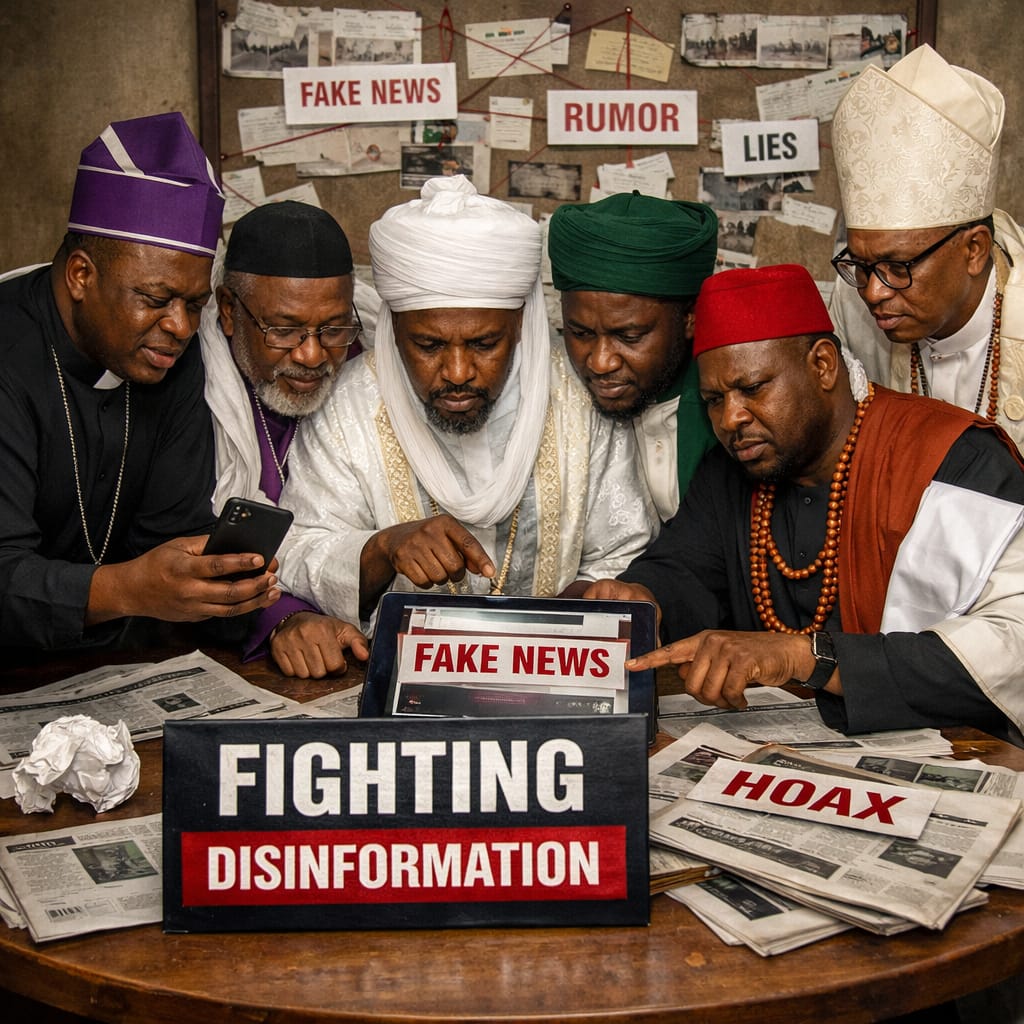
The “Kano Model,” a pioneering initiative that positions religious and traditional leaders as the primary defense against the tide of digital misinformation, has officially moved from a localized experiment to a significant regional movement. Originally conceptualized to leverage the immense social capital of Nigeria’s spiritual authorities, the model was most recently showcased in Abuja on June 24–25, 2026. Convened by the Hausa-language verification platform Alkalanci and supported by the MacArthur Foundation, the event marked the largest training session to date, uniting Islamic scholars and clerics from across Northern Nigeria—and neighboring Niger—to formalize their role as ethical “firewalls” against digital manipulation.
The urgency of this initiative is underscored by a volatile socio-political climate as Nigeria approaches the 2027 general elections. With the rise of advanced artificial intelligence, bad actors now have the capability to deploy “deepfakes,” cloned voices, and fabricated videos to incite unrest or discredit political processes. This evolution has transformed disinformation from a mere media nuisance into a critical national security threat. By training over 120 clerics across six cities, Alkalanci is proactively equipping community leaders with the tools to identify synthetic content before it can be used to destabilize the nation or influence the democratic process.
What distinguishes the Kano Model from top-down government interventions is its profound moral framework. During the Abuja sessions, internal institutional heavyweights, such as the Nigerian Supreme Council for Islamic Affairs (NSCIA) and Jama’atu Nasril Islam (JNI), anchored the necessity of fact-checking in religious scripture. By framing verification as a divine mandate—citing the Quranic instruction in Surah Al-Hujurat to verify information before action—the program transcends secular policy. This approach strikes at the heart of the “trust deficit,” as citizens are far more likely to heed the counsel of their spiritual mentors, whose influence in daily life and community governance remains unparalleled by state or tech-sector rhetoric.
The initiative’s power is further amplified by the direct endorsement of Nigeria’s traditional institutions, including the Sultanate of Sokoto and the various Emirates. When religious and traditional leaders collectively urge their congregants to pause and verify viral claims, they create a social buffer that no algorithm can replicate. As these leaders maintain their roles as arbiters of truth, they have been cautioned by organizations like the JNI to remain strictly apolitical. By resisting partisan traps, these clerics serve as a stabilizing force, effectively neutralizing the ability of politicians to weaponize religious platforms for campaign agendas or inflammatory rhetoric.
The scope of this model is increasingly vital given the geopolitical volatility of the wider Sahel region. In nations like Mali, Burkina Faso, and Niger, foreign-backed disinformation has become a weapon of war, used to fuel coups and erode regional stability. By exporting the Alkalanci training into these areas—such as in Maradi—the program bypasses the traditional barriers of state-run media, embedding its verification protocols directly into the bedrock of local communities. This strategy denies foreign propagandists the leverage they usually gain by exploiting the gaps in local information ecosystems, proving that the most effective firewall against external subversion is the trusted local voice speaking a local language.
Ultimately, the growth of the Kano Model signals a shift in how society must approach the crisis of truth in the modern age. It demonstrates that the responsibility to fight disinformation cannot be left solely to tech companies, journalists, or state regulators; it requires a deep, grassroots commitment to individual and community discernment. As the network of these “warriors for truth” continues to expand across faith lines and geographic boundaries, it serves as a powerful reminder that Africa’s most enduring defense against the digital age lies not in technology, but in the strength of its ancient, trusted institutions.