








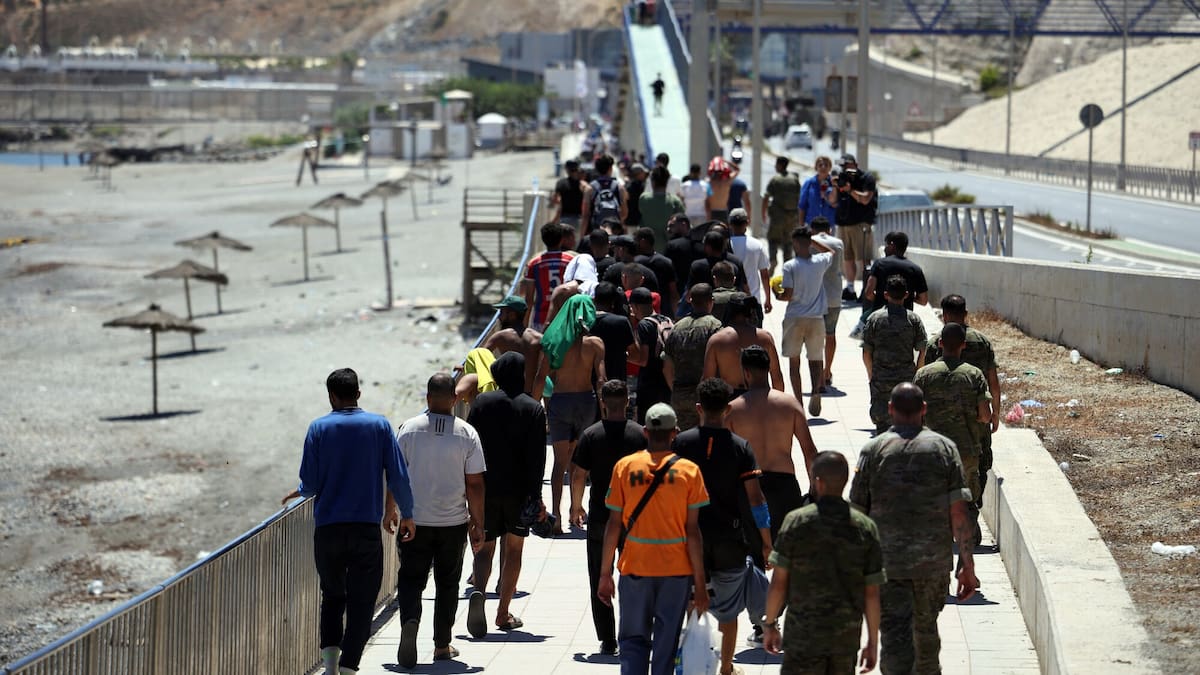
An investigation conducted by the technology firm Golden Owl has concluded with a “high degree of confidence” that the recent migrant surge at the Spanish enclave of Ceuta was not a spontaneous occurrence, but rather a deliberately organized operation. Security and social media expert Marcelino Madrigal corroborated these findings, noting that the crisis was preceded by clear digital indicators. According to investigations, the chaos was fueled by a coordinated barrage of rumors, messages, and social media activity circulating primarily on Facebook and WhatsApp, though experts have yet to identify the specific actors responsible for igniting the campaign.
The political fallout was immediate, as Spanish Prime Minister Pedro Sanchez formally attributed the surge to the activities of organized human trafficking gangs. His administration has notably navigated the diplomatic minefield with caution, studiously avoiding public criticism of Morocco, a country with which Spain maintains a fragile and essential bilateral relationship. Instead, government officials have pointed toward a deliberate disinformation campaign that exploited a recent Supreme Court ruling regarding the treatment of irregular migrants who arrive by sea.
The catalyst for the misinformation appears to be a specific Instagram post that surfaced just one day after the Supreme Court delivered its ruling. The post falsely claimed that the court had effectively opened the border to irregular migrants by banning immediate returns. Mohamed Benaissa, president of the Northern Observatory for Human Rights, observed that these misleading claims were amplified by suspicious, unidentifiable accounts with minimal prior activity. He suggests this pattern indicates the potential deployment of mass-diffusion algorithms designed to manipulate public perception and spark an exodus.
Legal experts have worked to clarify the reality of the court’s decision, noting that it has been fundamentally misrepresented. Lawyers Antonio Benitez Ostos and Antonio Jesus Perez explained that the ruling did not signify an “open border,” but rather established that migrants intercepted on the high seas—rather than those breaching physical land infrastructure—are entitled to a specific legal procedure. While human rights lawyer Laura Maria Medina Ferreras emphasized that these procedures provide necessary basic guarantees, the Spanish government has already begun responding by installing floating barriers in the water, which may provide a legal basis for future border containment.
This incident is not an isolated event; social media platforms have increasingly become battlegrounds for encouraging irregular migration. Authorities recall a strikingly similar scenario in 2024, which resulted in the prosecution of over 150 individuals in Morocco. The recurrence of these tactics suggests that coordinated digital influence campaigns have become a standard, albeit dangerous, tool for human smugglers and political agitators looking to bypass border security through the mobilization of large crowds.
Looking toward the future, experts like Madrigal warn that the instability is far from over, as new online posts are already calling for another mass arrival attempt in August. He has leveled sharp criticism at social media platforms for their failure to monitor, rebut, or remove content that incites such dangerous events. Madrigal cautioned that without stricter oversight and more responsive algorithmic moderation, these “digital triggers” for human migration crises are likely to become a recurring phenomenon not just in Ceuta, but in vulnerable border regions across the globe.


