









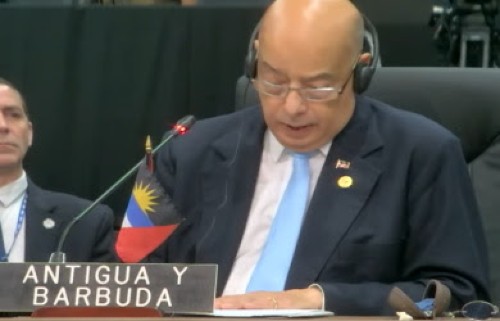
The government of Antigua and Barbuda has officially challenged a piece of legislation introduced in the U.S. House of Representatives, arguing that the bill contains significant factual inaccuracies and relies on outdated information. The legislation, titled the “Third World Immigration Moratorium Act,” was tabled by Representative Nancy Mace of South Carolina and seeks to impose broad immigration restrictions on 40 nations. Among these countries, Antigua and Barbuda was singled out, a classification that the Caribbean nation’s leadership argues is both unfounded and offensive given its status as a stable democratic partner of the United States.
Sir Ronald Sanders, Antigua and Barbuda’s Ambassador to the United States, spearheaded the diplomatic pushback by sending a formal letter to Representative Mace, with copies provided to several high-ranking members of Congress. While acknowledging that sovereign nations hold the inherent right to set their own immigration policies, Ambassador Sanders insisted that such measures must be grounded in “accurate information and objective facts.” He explicitly pointed out that the government of Prime Minister Gaston Browne has previously alerted Washington to errors in Presidential Proclamation 10998—a document that appears to have informed the basis of the new restrictive legislation.
A primary point of contention involves the U.S. government’s description of Antigua and Barbuda’s Citizenship by Investment (CBI) programme. The Proclamation incorrectly claims that the nation’s citizenship scheme operates “without residency,” a charge that Ambassador Sanders firmly rejected. He countered that the programme has always maintained a residency requirement and that this detail has been formally communicated to U.S. authorities on multiple occasions. Moreover, the Ambassador highlighted a glaring drafting error in Representative Mace’s bill, which erroneously treats “Antigua” and “Barbuda” as two separate, independent countries, rather than a single sovereign state.
Ambassador Sanders expressed deep concern over the optics of grouping his nation alongside countries currently suffering from prolonged economic collapse, armed conflict, or mass irregular migration. He highlighted that Antigua and Barbuda is, in contrast, a stable parliamentary democracy with an independent judiciary and a robust economy. As an upper-middle-income nation with one of the highest per capita incomes in the Caribbean, the Ambassador emphasized that the country holds a strong record of adherence to the rule of law and enjoys significant trust from the international community.
The diplomatic letter further underscored the mutually beneficial, long-standing relationship between the two nations. Sanders noted that American citizens frequently travel to Antigua and Barbuda without the need for visas, own extensive property and business interests there, and benefit from protected investments. He pointed out that the two countries maintain deep cooperation in areas such as disaster response, law enforcement, tourism, and education. Furthermore, the Ambassador noted that the movement of people between the nations has historically been orderly, with zero instances of Antiguan or Barbudan citizens seeking refugee status in the United States.
In his concluding remarks, Ambassador Sanders highlighted that visa overstays among his nationals remain negligible, hovering at roughly one percent, and noted the country’s consistent cooperation in accepting the return of individuals lawfully removed by U.S. immigration authorities. Given this track record of cooperation and stability, the Ambassador has formally requested that Representative Mace reconsider the inclusion of Antigua and Barbuda in the proposed moratorium. He urged the legislator to ensure that any future measures directed at his country are informed by verified, current data rather than the inaccurate claims that have characterized previous proclamations.


