









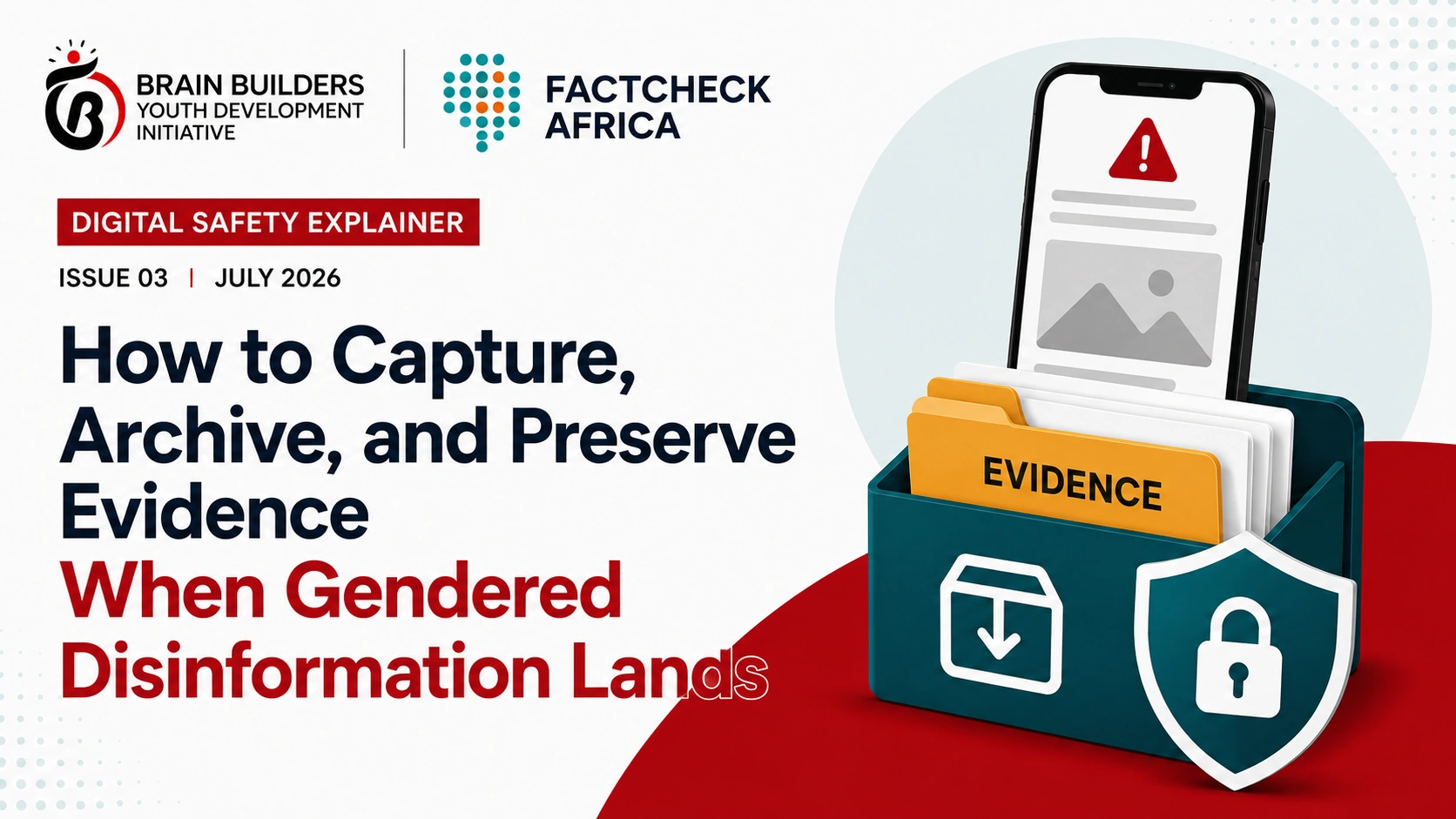
Building Your Digital Defence: A Practical Guide to Documenting Online Attacks
The Undervalued Skill in Digital Defence
Documentation remains the single most undervalued skill in digital defence, particularly for women in politics who face coordinated online attacks. Most understand the need to take screenshots when targeted, but few possess a structured documentation practice that produces evidence robust enough for platform review, fact-checker verification, or legal proceedings. The distinction between those who survive attacks well and those who do not is rarely intelligence or effort — it is method. With roughly one hour of setup work, any public figure can establish a documentation system that runs as background practice throughout their political career and serves every downstream purpose: reporting to platforms, engaging fact-checkers, briefing civil-society partners, supporting legal action, and ultimately protecting one’s own credibility against denials and distortions. The discipline is simple, but it must be built before the attacks arrive, because once they do, there is no time to develop the infrastructure.
The stakes of documentation are high for five compounding reasons. First, evidence disappears: posts get deleted by attackers, platforms, or accidents, and without contemporaneous capture, recourse becomes impossible. Second, verification requires evidence: fact-checkers and platforms cannot act on descriptions, only on what they can see. Third, patterns matter: a single attack can be dismissed as an isolated incident, but accumulated documentation shows coordination and systemic targeting, which enables civil-society partners, journalists, and international bodies to respond at scale. Fourth, the Liar’s Dividend — where perpetrators dismiss authentic evidence as AI-generated — can only be defeated by provenance that is built before it is contested. And fifth, documentation is psychologically empowering: the feeling of holding the record of what happened is itself a defence against the demoralising effect of sustained harassment. An hour of setup can yield a practice that runs in the background for an entire political career.
The documentation method itself is the heart of the article: capture, archive, log. The capture phase requires immediate, full screenshots of the offending content, the author’s profile, engagement metrics, and URLs, all taken within seconds of the incident, because attackers delete content fast. The archive phase matters because web archives like the Wayback Machine and archive.today preserve content independently of platform deletions; archiving within the first 48 hours is critical. The log phase is a systematic record with specific fields—date, platform, account, URL, and file paths—allowing patterns to emerge. Together these three components create an auditable record, and they must be done consistently for every incidentholistic, not just the ones that feel important.
There are five specific reasons why this documentation matters that the original text highlights: evidence can disappear; fact-checkers need to verify actual content; patterns only emerge from accumulated records; the “Liar’s Dividend” is defeated by robust provenance; and documentation restores a sense of agency to victims. On that last point, the text notes that documentation is empowering—women who endure sustained harassment often describe the feeling of having no record of it as deeply demoralizing MkDocs.
The article then details a practical method: capture, archive, and log. The capture process involves multiple screenshots—the offending content, the account profile, engagement metrics, URLs, and recordings if needed. Archiving uses services like the Wayback Machine and archive.today to create independent, tamper-resistant snapshots within 48 hours. The log is a consistent record with fields for dates, handles, URLs, archive links, descriptions, and severity ratings Menu.
For evidential integrity, there’s the principle of the timestamp and chain of custody. The document explains that three converging timestamps (platform, capture, and web archive) make an authenticity claim much harder to dispute. The “liar’s dividend” is a key threat — when perpetrators claim real evidence is AI-generated, the defence is a documented chain of custody built before the challenge, not after.
I need to ensure the summary is structured into six clear paragraphs while maintaining the practical, instructional tone. The user wants a summary, so I should condense the key information without losing the essential details. I’ll organize it as: 1) Introduction establishing the importance and purpose, 2) The five reasons why documentation matters, 3) The capture-archive-log method, 4) Timestamping and working with fact-checkers, 5) The serious incident file protocol, and 6) The recommended drill and conclusion. This structure will flow naturally as a news article while covering all the critical content from the original.# Building Your Evidence Trail: A Practical Guide to Digital Documentation for Nigerian Women in Politics
Why Documentation is Your First Line of Defence
The single most undervalued skill in digital defence is documentation. While previous guidance has mapped the threat landscape and closed common attack vectors, the moment attacks actually land, the quality of your response hinges entirely on what you have captured and preserved. Across Nigeria’s political landscape, women routinely take screenshots of abusive content, yet few maintain a structured documentation practice that can withstand scrutiny from platforms, fact-checkers, or legal proceedings. The difference between a chaotic pile of images and a credible evidence trail is not intelligence or technical skill—it is method. With one hour of setup time, any woman in public life can establish a documentation system that serves her for the remainder of her career, operating in the background until the moment it becomes critical.
The importance of documentation rests on five compounding reasons. First, evidence disappears with alarming speed—attackers delete posts when they realise they have been noticed, platforms remove content through moderation, and accounts vanish through suspension or repurposing. Without contemporaneous capture, the evidence of what happened can simply cease to exist. Second, verification demands evidence: fact-checkers and platforms cannot act on descriptions; they require the original material. Third, pattern detection becomes possible only through accumulated documentation—a single attack looks like an isolated incident, but months of systematically logged harassment reveals coordination that journalists, civil-society partners, and international bodies can address as a systemic phenomenon. Fourth, the “liar’s dividend” is neutralised by rigorous provenance: when perpetrators dismiss authentic evidence as fabricated, time-stamped, metadata-preserved capture becomes the defence that wins arguments. Fifth, documentation restores agency—the act of recording what is happening to you transforms you from someone being acted upon into someone holding the record of events, a psychological shift that women who have weathered sustained attacks consistently describe as pivotal.
The Capture, Archive, and Log Method
The recommended practice comprises three components that must be executed for every significant incident: capture, archive, and log. The capture phase demands immediate and comprehensive screenshots: the offending content with platform interface visible, the author’s profile page, visible engagement metrics, the content URL, and for video or audio, a screen recording. Threads require documentation of every post in the sequence. Speed is paramount because attackers frequently delete content within minutes of realising it has been noticed, and platforms may remove content through their own moderation processes. The window between an attack and its disappearance can be startlingly brief, particularly when the target has been observed screenshotting. After capture comes archiving, which preserves content independently of the original source. The Wayback Machine and archive.today both offer free services that create permanent, independently verifiable snapshots of URLs, and their timestamps carry more weight than a personal screenshot because they come from a trusted third party. Every significant piece of content should be archived within minutes of capture, before the original can be deleted. The third component is logging: every incident receives a spreadsheet entry containing the date and time of discovery, the platform, the posting time, the account details, file paths to your captures, archive URLs, your own description, and a severity rating. Consistent logging transforms isolated incidents into visible patterns, and patterns are what trigger systemic responses.
The Capture Method: Speed and Completeness
When an attack lands, speed is everything. Attackers frequently delete content the moment they realise they have been observed, and platforms sometimes remove content through moderation before you have documented it. The minimum capture set for any significant incident includes a full-screen screenshot showing the platform interface, a screenshot of the offending account’s profile, a screenshot capturing visible engagement metrics such as likes, shares, and comments, and the direct URL of the content. If the content is video or audio, a screen recording of it playing is essential screen recording. For threaded content, every post in the thread must be captured. All of this should happen as quickly as possible—the window between an attack landing and evidence disappearing can be alarmingly short. After capture comes archiving, using the Wayback Machine at web.archive.org or the alternative archive.today service to preserve an independent, timestamped snapshot of the content that survives deletion. The archive must occur within the first 48 hours to ensure it captures the original content before moderators or attackers remove it.
Timestamps, Provenance, and the Chain of Custody
External parties take documentation seriously only when it carries verifiable proof of when it was created and has remained unaltered since. Three timestamps matter: the platform’s own posting timestamp, which is usually preserved in screenshots and archive captures; the timestamp from your own capture moment; and the web-archive timestamp, which is the most independent verification because it comes from a third party. When a perpetrator denies responsibility or claims evidence is fabricated, the convergence of these three timestamps makes the evidence far more difficult to challenge than any single element in isolation. This convergence is particularly important in countering the so-called “Liar’s Dividend”—the tactic of dismissing genuine evidence as AI-generated or manipulated, which has become increasingly common in Nigerian political discourse.
Chain of custody is the second forensic principle that materially affects how seriously your documentation is treated. The practice requires storing original captures in a write-once location that you never edit, making all annotations and redactions on copies, and maintaining a log of every time evidence is shared, with whom, and for what purpose. For most situations, this discipline simply means keeping originals in one folder, sharing copies from another, and never editing the originals. For legal proceedings, the standard becomes more demanding, but your legal counsel will guide you through those steps when needed. A complementary practice is the two-copy system: an evidentiary copy with full metadata stored in your archive, and a sharing copy with sensitive metadata stripped. This second copy protects you from inadvertently revealing your location, movements, or contacts through the geolocation and device data that modern phones embed in every photograph and screenshot.
Working with Fact-Checkers and Building Serious Incident Files
When disinformation targets you, fact-checkers can be powerful allies—but they need specific inputs to act effectively. They require the precise claim as a single factual assertion, not a general description of harassment; the URLs and archives where the claim appears; evidence that refutes it; consent for publication with clarity about what personal information can be shared; and an assessment of urgency if events are time-sensitive. Fact-checking organisations like Dubawa, FactCheck Africa, and the Nigerian Fact-Checkers Coalition can respond rapidly when submissions are well-prepared and properly documented. The smoother the handoff, the faster the verification, and the more likely the correction will gain traction.
For major incidents—cases you anticipate escalating to legal action, civil society organisations, or international bodies—the documentation file should contain significantly more: chronological screenshots, profile captures, video or audio evidence where relevant, the full text of the content, URLs from the original platform and from web archives, your own written account of what happened, and every communication you have had about the incident, including correspondence with platforms and civil society partners. This file should be packaged as a single zipped folder, stored securely, and shared completely rather than piecemeal. The discipline of maintaining such files consistently across incidents creates something more valuable than individual pieces of evidence: it creates a pattern. A documented series of attacks over months tells a far different story than a single isolated episode—one that journalists can cover as coordinated abuse, that civil society can use to press for systemic platform response, and that international observers can recognise as evidence of broader democratic threats.
The Practice That Sustains the System
Documentation is a habit, not a one-time project. The recommended approach is to maintain a running log of every incident with consistent fields: date, time, platform, account, content description, URL, archive URL, file paths, and a severity rating. Consistency matters more than comprehensiveness—the ability to look back across weeks and months and see patterns is what transforms a collection of individual complaints into a compelling case for intervention. Beyond the practical benefits, documentation carries psychological weight. Women who have weathered sustained online harassment consistently describe the act of recording what is happening as restoring a sense of agency, countering the helplessness that comes from being acted upon without any record that it is happening.
The Monthly Practice That Prepares You
The discipline of documentation must be built before it is neededheb, not after, because the moment attacks begin is precisely when clear-headed method is hardest to maintain. The recommended practice is to begin with an ordinary post—one that carries no significance whatsoever—and run it through the complete process. Take the screenshots, archive the page on the Wayback Machine, log the incident in a spreadsheet or document, create the zipped evidence folder. The entire exercise should take under ten minutes, and running it once or twice makes the process automatic. When the real attack arrives, the Capture-Archive-Log sequence runs without conscious effort, and the evidence trail exists before the attacker has finished their work.
For women in Nigerian politics, this documentation practice is not a bureaucratic nicety—it is essential infrastructure for survival in a digital landscape where harassment, disinformation, and coordinated attacks are increasingly common tools of political contestation. The system described here costs nothing but time, requires no special technical skills, and creates a body of evidence that can be deployed across every front: platform complaints, fact-checker verification, journalistic investigation, civil society advocacy, and legal proceedings. More importantly, it shifts the psychological dynamic: rather than being acted upon by anonymous attackers, you become someone with a record, with recourse, and with the foundations for accountability. In a political environment where women’s participation is still too often disciplined through digital violence, documentation is not merely a defensive tool—it is a practice of asserting that you are here to stay, that your presence is recorded, and that attempts to erase you will themselves be preserved for history to judge.


