




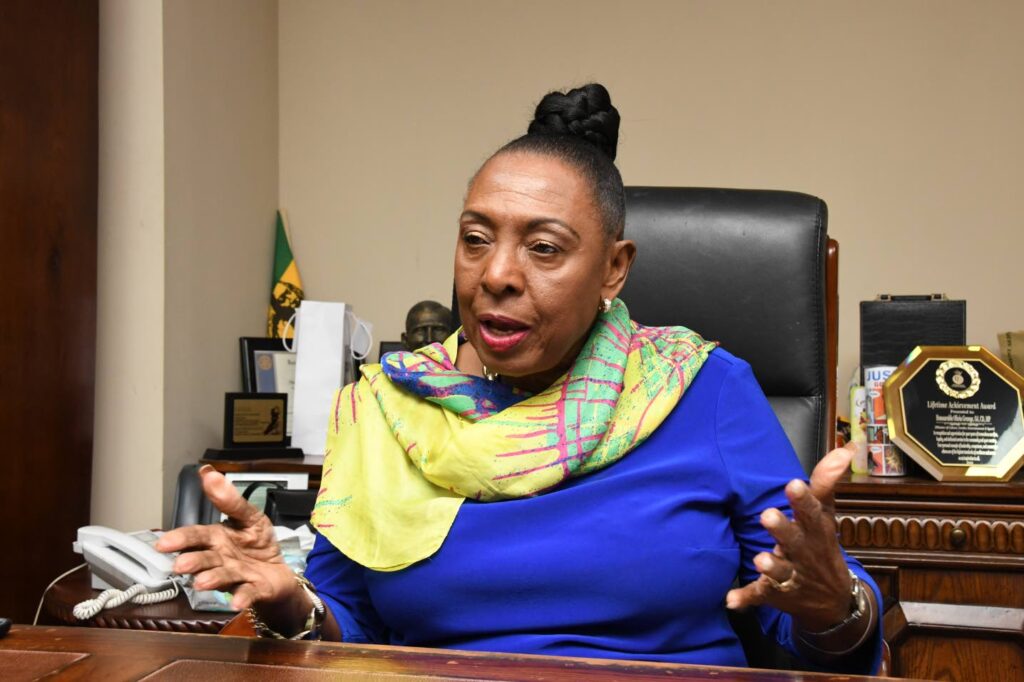
KINGSTON, Jamaica — Minister of Culture, Gender, Entertainment and Sport, Olivia Grange, has moved to correct what she calls misinformation surrounding Jamaica’s reparations petition to King Charles III, explaining that the document was filed through the proper channels and that the process did not require her to hand it directly to the monarch. Speaking on Wednesday at a meeting with members of the Jamaica diaspora at the National Windrush Museum in the United Kingdom, Grange said she wanted to set the record straight after reports and online commentary suggested the petition had not been delivered as formally or as respectably as it should have been. She insisted that the September 7 filing had been smooth and successful, noting that Jamaica’s Governor-General had been in direct contact with the Palace and had received guidance on how the petition should be lodged. “We have followed the process. The process does not involve presenting the document physically to His Majesty,” Grange said. She acknowledged, however, that Jamaica had sought a courtesy call on the King while filing the petition through the requisite channels, but that the Palace replied that the King would be away at Balmoral. That response, she said, in no way meant that the petition was not accepted or properly registered.
Grange’s remarks to the diaspora gathering were as much about legal process as they were about historical and moral necessity. She pushed back against a persistent claim that the reparations petition was somehow weakened because it was not placed directly into the King’s hands. That assumption, she argued, revealed a misunderstanding of British constitutional and royal protocol. The King, as Head of State, receives formal submissions through established channels, and the Palace’s guidance to the Governor-General’s office was an indication that the petition was being treated with the seriousness it warranted. Grange also clarified a key point that has been the source of much confusion: the petition contains no monetary claim. “Contrary to what you might have read in some publications, or seen online, our petition does not include a monetary claim,” she told the audience. Yet she was equally emphatic that this did not mean the demand for justice had been abandoned or diluted. For her, the absence of a specific dollar figure did not undermine the fundamental request for a remedy. “However, we believe there must be, there has to be, some appropriate remedy or remedies for the atrocity of chattel enslavement which our ancestors endured,” she said. Her comment drew a direct line between the horrors of plantation slavery and the continued struggle for recognition, insisting that expressions of regret alone are inadequate. As she put it: “It is not enough to regret the suffering that slavery inflicted on our ancestors and say let’s build a new future.”
The heart of the petition, as described by Grange, is a request that King Charles refer certain points to the Privy Council for determination. The first point is a far-reaching legal question about the very legality of the institution of Transatlantic Chattel Slavery as it was practised in Jamaica under English law. The petition asks whether that brutal system was ever lawful under English law, or whether it was, from the beginning, offensive to the fundamental principles of the common law and indeed to certain express statutory provisions of the Westminster Parliament. This is not merely an academic question. It goes to the root of whether the legal and political systems of the United Kingdom are, or ever were, entitled to legitimise the ownership and treatment of human beings as property. If the Privy Council were to determine that slavery was not lawfully established under English law, the implications could be significant. It would suggest that, in the eyes of the law itself, the mass enslavement of Africans and their descendants in Jamaica was a deliberate perversion of legal order, not a legitimate enterprise protected by statute. Such a finding would shift the ground under centuries of legal reasoning and could open the door to a formal acknowledgement that the state was acting contrary to its own laws when it presided over, regulated, and benefited from the slave trade.
The second determination requested in the petition moves the argument onto the international plane. Grange explained that Jamaica is asking the King to refer a question about whether the forced transportation and chattel enslavement of Africans in Jamaica was a breach of relevant international obligations. These obligations, according to the petition, include those arising out of general principles of law, the peremptory prohibitions of slavery, torture, racial discrimination and crimes against humanity, and obligations derived from other sources of international law. In legal terms, the reference to peremptory prohibitions is particularly powerful. Certain norms of international law are considered so fundamental — jus cogens, in the language of international lawyers — that no state may lawfully derogate from them. Slavery and torture are among the most widely accepted examples of such norms. To ask the Privy Council to examine whether the United Kingdom’s historical practices violated these peremptory norms is to invite a judgment that goes beyond ordinary legal liability. It asks, in effect, whether the very acts of capturing, transporting, selling, and enslaving people were, in the most basic sense of the term, criminal and inhuman, regardless of whatever domestic legislation said at the time. This framing is intentionally global. It connects the experience of Jamaica to the broader evolution of human rights law and to the modern consensus that slavery is an abomination in any form. It also places the reparations question within the context of international law’s increasing willingness to recognise, at least in principle, that the victims of gross human rights abuses are entitled to a remedy.
The third and final determination sought by the petition is perhaps the most consequential of all. Grange said the petition asks whether there is a legal obligation on the part of the United Kingdom to provide a reparatory remedy to the people of Jamaica, as descendants of those subject to these dehumanising practices, and as a community of persons on whom the practices have had an indelible and continuing negative effect. This is the crux of the entire reparations debate. It moves the discussion from historical remorse to legal responsibility and asks a simple but profound question: Does the United Kingdom owe a debt, not merely in moral terms, but in law, to the descendants of the enslaved? The petition’s wording is careful. It does not ask for a symbolic apology alone. It does not ask for cash compensation to be distributed to individuals. Rather, it frames the injury as one suffered by the Jamaican people collectively, and by the community of descendants who continue to experience the effects of slavery in the form of racial inequality, economic underdevelopment, social marginalisation, health disparities, and the legacy of colonialism. It asks the United Kingdom to confront the ways in which the wealth generated by the enslavement of African people contributed to British economic power while systematically excluding the enslaved and their descendants from any share in that prosperity. The continuing effects, as Grange noted, are not a matter of ancient history. They are visible in the structure of Jamaican society, in the distribution of land and resources, in the racial hierarchy that slavery left behind, and in the difficult relationship between the Caribbean and the British crown.
The choice to focus on the Privy Council is itself significant. The Privy Council is one of the oldest parts of the British constitution, and its Judicial Committee was for many years the final court of appeal for much of the British Empire, including Jamaica. That Jamaica would ask the King to send these questions to the very body whose legal oversight once formed part of the imperial machinery is both a historical echo and a deliberate political act. It suggests that Jamaica is not seeking to escape the British legal system’s authority, but rather to hold it to its own highest standards and to demand that it answer for what was done in its name. Grange’s meeting at the National Windrush Museum was also symbolically loaded. The museum commemorates the Caribbean migrants who came to Britain on the Empire Windrush and later ships, and whose labour helped rebuild Britain after the Second World War. The Windrush generation experienced racism, discrimination, and, in recent years, the scandal over their immigration status. That Grange chose to address the diaspora there underscored the fact that the reparations demand is not only about the nineteenth century or the Middle Passage. It is also about the living legacy of that history, the generations that followed, and the continued struggle of people of African descent for full recognition and justice in Britain and across the globe.
Grange’s statement comes at a moment when the conversation around reparatory justice is gaining momentum, particularly within the Caribbean. CARICOM has long revived and formalised the region’s demands for financial and non-financial reparations. Caribbean leaders have increasingly argued that Britain, France, the Netherlands, and other former colonial powers cannot simply acknowledge the wrongs of the past without taking concrete steps to redress them. Jamaica itself has been in a period of constitutional transition, and while the question of becoming a republic has been discussed, the relationship with the British monarchy remains a live and complicated issue. The petition to King Charles is not the first such request made by Caribbean nations, but its framing — lawyerly, precise, and deeply moral — may make it one of the most significant. It leaves the door open for remedies that are not monetary: formal apologies, legal declarations, investments in education and healthcare, cultural restitution, and support for Jamaica’s national development and the repair of institutions still marked by the slave economy. By specifically excluding a monetary claim, Grange may have been signalling that Jamaica is serious about substantive recognition and structural change, not about a payout. In her own words, the point is not merely to regret slavery but to repair its consequences. Whether King Charles will act on the petition, whether the Privy Council will entertain it, or whether the Palace will even respond publicly, remains to be seen. But the petition has already achieved something important: it has placed the legal and moral case for reparations firmly on the table, and it has made clear that Jamaica intends to pursue that case through the highest channels of the very state that once enslaved its people. Grange’s address to the diaspora, and her blunt rejection of misinformation, suggest that the campaign is far from over — and that the Caribbean’s demand for justice will not be satisfied by a simple expression of sorrow or a call to move forward. The past, she made clear, is present. And until it is addressed, it cannot be overcome.