


Wildfire Misinformation in Canada: The Rising Threat of AI-Generated Content During Crisis
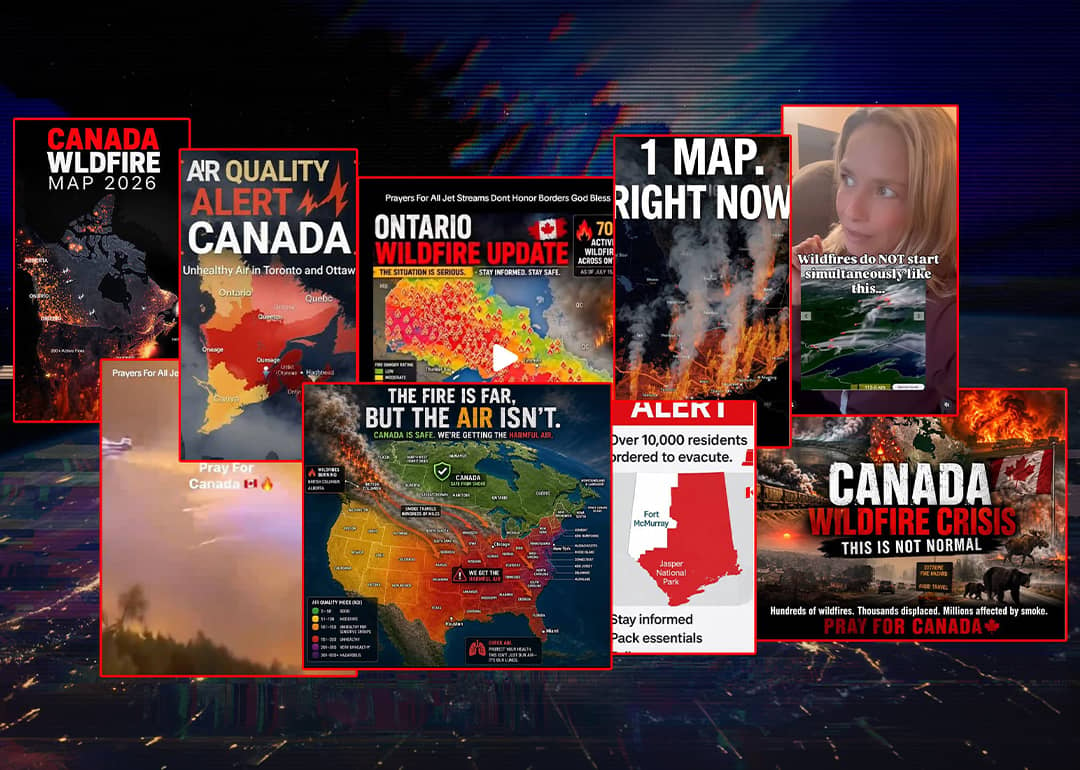
Ontario is currently experiencing one of the most devastating wildfire seasons in recorded history, placing thousands of residents, particularly in the province’s northern regions, at significant risk. The crisis escalated dramatically last month when two Indigenous communities—Namaygoosisagagun First Nation and Whitewater Lake First Nation—were completely destroyed by the flames. This unprecedented scale of destruction has captured global attention, generating a flood of social media activity. However, a troubling pattern has emerged within this digital discourse: a significant portion of these posts contain misinformation, ranging from AI-generated imagery to deliberately crafted falsehoods. These deceptive contents include fabricated maps showing Ontario wildfires with labels for communities that don’t exist anywhere in reality, inaccurate air quality reports, false evacuation alerts, and captions promoting conspiracy theories about everything from 15-minute cities to arson plots. For those paying close attention, clues exist to distinguish authentic information from fabricated content—one viral AI-generated graphic references a nonexistent Ontario government website, while another falsely claims 10,000 Albertans were under evacuation orders in mid-July, accompanied by a map where Jasper National Park absurdly appears to cover most of that province. Some maps contain geographical errors so egregious that Ontario appears on the west coast, Quebec is positioned over the southern United States, and Alberta sits near Alaska, all while featuring an entirely made-up province called “Onjebio” showing catastrophic wildfire conditions.
The challenge of distinguishing fact from fiction continues to intensify, as recent Statistics Canada data reveals that 43% of Canadians now find it increasingly difficult to differentiate between factual information and misinformation online compared to three years ago. This difficulty is even more pronounced among those who express lower trust in traditional news media sources. The relationship between wildfire season and misinformation season has become an unfortunate annual tradition in Canada, with the proliferation of AI-generated content making the problem increasingly complex. As these technologies become more sophisticated and accessible, Canadians face growing obstacles in their search for trustworthy information during unfolding national crises. The connection between worsening wildfires and climate change is scientifically established, yet the drivers of escalating misinformation require deeper examination to understand how these false narratives spread and what motivates their creation in the first place.
The 2023 wildfire season marked a significant turning point in the evolution of online wildfire misinformation. Gwen Roley, a digital verification journalist covering Canada for Agence France-Presse, has documented how AI-generated maps have become a concerning new trend this year, distinguished by their wonky labels, nonsensical fire symbols, and dramatic visual exaggerations that make entire regions appear completely devastated. Roley’s extensive work debunking wildfire misinformation since 2023—a year that saw both Canada’s worst wildfire season and devastating fires in Hawaii—reveals how unprecedented, fear-inducing events prompt people to seek extraordinary explanations. This psychological tendency isn’t new; as far back as 1954, Washington state residents attributed sudden car windshield damage to hydrogen bomb tests and space rays. Climate change denial has similar historical roots, yet Carleton University professor Chris Russill identifies 2023 as a genuine inflection point for wildfire misinformation online, driven by multiple converging factors: Elon Musk’s acquisition of Twitter, Meta’s removal of Canadian journalism from Facebook and Instagram following the Online News Act, the widespread adoption of generative AI tools like ChatGPT which gained over 100 million users within months of launch, and the post-pandemic atmosphere of heightened suspicion and conspiratorial thinking being dragged into other culture-war issues.
The motivations behind spreading wildfire misinformation are complex and multifaceted. Research indicates that political leaders and influencers intentionally seed disinformation, which is then amplified by ordinary users across platforms—a phenomenon researchers call “participatory disinformation.” American MAGA politicians, in particular, have found opportunities to leverage narratives about Canadian wildfire smoke affecting US air quality to pursue their broader agenda about Canada being an unreliable neighbor, with President Trump even threatening to add the “cost of this pollution” to tariffs on Canadian goods. When journalism loses visibility on social media platforms, it’s not replaced by nothing—it’s replaced by content serving different functions, with conspiracy theories and dramatic AI-generated images generating significant engagement during real crises. The financial incentives are substantial, with ad revenue from Google and other exchanges powering coordinated networks of Facebook accounts pushing AI-fabricated “news slop” onto Canadian users. Even ordinary users get caught up in the cycle, as engagement serves as currency across social media platforms, creating incentives to share the most dramatic or striking images without verifying accuracy. Real maps using legitimate data simply aren’t as visually compelling as AI-generated versions depicting all of Ontario burned to a crisp or wildfires visible from space, and lingering on these images—even skeptically—rewards the algorithms that spread them further.
The narrative landscape of wildfire misinformation has shifted significantly in recent years, moving beyond simple climate change denial toward more sophisticated framings. While older misinformation typically downplayed or denied climate change’s role in worsening wildfires, displacing blame onto implausible explanations like space lasers or 15-minute city conspiracies, the narrative has evolved. After the devastating 2025 Los Angeles wildfires, President Trump blamed government mismanagement of California forests rather than acknowledging the expert consensus attributing such disasters to climate change, prolonged drought, and extreme winds. This “mismanagement” argument is now being directed at Canada, with political figures like a Michigan senator posting inflammatory statements about Canada needing to learn how to manage its forests—an impossible task given Canada’s 369 million hectares of forest, much of which is remote boreal forest that has never been subject to active management but is experiencing more severe fires due to planetary warming. This narrative shift is partly attributable to Canadian leaders themselves minimizing climate change’s role; Alberta Premier Danielle Smith notably dodged a question about climate change and wildfire by pivoting to arsonists, while various leaders continue pushing fossil fuel investments despite the escalating crisis. While legitimate questions about government responsibility and wildfire response funding exist, these valid critiques become complicated when entangled with destabilizing misinformation designed to challenge and undermine trust in authorities during moments of crisis.
The real-world impacts of wildfire misinformation extend beyond annoying online content to potentially affecting safety and emergency response. Researchers express concern about whether people might flee their homes based on AI-generated maps or AI overviews providing inaccurate evacuation information, park access details, or campfire guidelines. Wildfire agencies now spend precious time and resources combating misinformation and pushing back against AI-generated images targeting them, which degrades trust that may already be thin in certain rural communities. This additional burden compounds the mental health stresses already faced by frontline firefighters. While providing factual corrections is important, research suggests facts alone are insufficient to change strongly held beliefs. However, fact-checking during crisis moments can introduce friction into how people engage with content, potentially causing them to share less, reset their thinking, and ground-truth their information rather than letting emotions overwhelm their judgment. As wildfires continue to burn most intensely during hot, dry seasons, misinformation appears capable of burning year-round, though individuals can at least limit their exposure to one of these risks by closing their apps—a small but meaningful action in an increasingly complex information landscape where AI-generated content makes distinguishing reality from fabrication ever more challenging during times of crisis.