




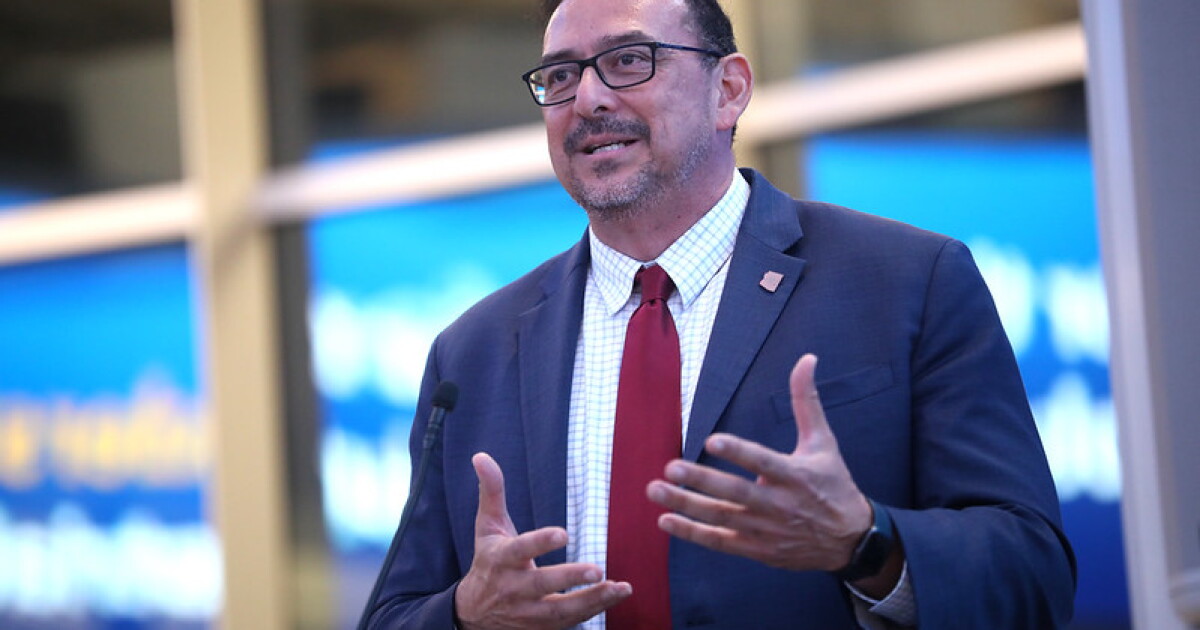
Adrian Fontes, Arizona’s Democratic secretary of state, is on a mission that sounds more like public health than politics: He wants to inoculate Arizonans against a contagion that resurfaces with every election cycle. The virus, as he describes it, is misinformation — the persistent, sometimes venomous claims that elections cannot be trusted, that machines are rigged, and that the voter’s will is being overturned by secret forces. Fontes believes the antidote is education, transparency, and a steady supply of facts. To that end, he is building a website, Arizona.Vote, designed not only to provide basic voting information but also to strengthen the public’s confidence in the electoral system before the next “little monster” of conspiracy theories raises its head. “You never know what’s the next little monster that’s going to rear its ugly head,” Fontes said. “But the reality is, the effort we are engaged in now are confidence builders against the potential of those little monsters. And we prepare folks to understand how the systems work so that they, themselves, are better equipped to deal with the potential questions.” His comments come at a moment when trust in American elections is under unprecedented strain, and Arizona has become a national epicenter of that doubt.
The scope of the problem Fontes is trying to address extends far beyond Arizona’s borders. Former President Donald Trump has repeatedly questioned the security of mail-in voting, even as he himself voted by mail in Florida’s primary last month. In Arizona, a significant portion of the Republican base still believes Trump won the 2020 presidential election, despite the official result showing Joe Biden defeating him by 10,457 votes in the state. That disbelief was so entrenched that Republican state senators hired an organization called Cyber Ninjas — a firm with no prior election audit experience — to review all 2.1 million ballots cast in Maricopa County. The audited hand count, conducted at the Arizona Veterans Memorial Coliseum in Phoenix, ultimately confirmed that Biden had won, and in fact found his margin was slightly larger than the machines had reported. Yet the myths did not die. Fontes says his new website is not aimed directly at conspiracy theorists, but rather at the broader public, providing a factual foundation that can withstand falsehoods when they arrive. The site includes basic logistics: the Oct. 5 registration deadline for the Nov. 3 general election, instructions for requesting an early ballot for voters not on the Active Early Voting List, and a listing of acceptable identification for in-person voting. It also allows voters to track their ballot and confirm that it was received and counted — a small but powerful tool for transparency in a state where every step of the process is now under a microscope.
At the heart of Fontes’s message is a simple but crucial fact: Arizona votes on paper. Every single ballot in the state is a paper ballot, fed into tabulators that count the marked ovals and bar codes. Contrary to persistent rumors, those tabulators are not connected to the internet. Before each election, they are subjected to mandatory “logic and accuracy testing,” in which a batch of sample ballots with known results is run through the machines to ensure they count accurately. After every election, Arizona law mandates a random hand count audit: party officials select a certain number of races and precincts, and those ballots are counted by hand to verify that the machine totals match the human count. This is not a secret process; it is a public one, conducted by Republican and Democratic officials working side by side. Fontes emphasizes that these safeguards already exist. But he also knows that for many voters, the existence of safeguards is not enough. They demand to see them work with their own eyes, and they are often told by politicians and influencers that the safeguards are meaningless. The website, he hopes, will offer the public the tools to check these claims themselves — to understand how the system actually functions, and to recognize when someone is manipulating their fears for political gain.
The need for such confidence-building is underscored by the legal and political turmoil Arizona has experienced in recent elections. After the 2022 election, two Cochise County supervisors, both Republicans, were indicted for attempting to conduct a full hand count of all ballots against state law. Peggy Judd accepted a plea deal; Tom Crosby’s case is still pending. Mohave County Supervisor Ron Gould, also a Republican, pursued his own effort to force a full hand count and went all the way to the Arizona Supreme Court in an unsuccessful bid to grant himself immunity from prosecution by Democratic Attorney General Kris Mayes. These cases illustrate the depth of distrust among some local officials, who argue that the state-mandated audits are insufficient and that only a full hand count can restore faith. But election experts counter that a full hand count is not only unnecessary but also less accurate than the current system, because human error increases with fatigue and volume. The random hand count audit, by contrast, provides a statistically reliable check on machine performance. Yet the claims persist. On Sunday, Republican Abe Hamadeh was still insisting he won the 2022 race for attorney general, despite the official tally showing Mayes beat him by 280 votes. Hamadeh blamed Democrat Katie Hobbs, who was secretary of state at the time, for allegedly overseeing a flawed process. Those claims have real consequences, not just for the individuals making them but for the officials who must administer elections under a cloud of suspicion.
The political fallout has been tangible. In Maricopa County, Republican Recorder Stephen Richer was ousted in the 2024 primary by Justin Heap, who campaigned on the promise of restoring “historically low voter confidence.” Heap went on to win the general election, giving control of the county’s election machinery to a candidate who ran largely on the premise that the system was broken. And in the race for secretary of state, Republican state Rep. Alexander Kolodin is hoping to defeat Fontes in November. During a televised debate, Kolodin said, “There’s no doubt that confidence in our elections here in Arizona is at an all-time low. And the responsibility of that sits squarely on the shoulders of Secretary Fontes.” It is a potent political attack, and one that Fontes rejects. He points out that Arizona has a thicket of laws, procedures, and audits designed to ensure accuracy, and that his office is simply trying to make those procedures more visible and understandable. But he also acknowledges that trust is not built overnight. It is built through repeated, transparent actions — through websites that allow voters to track their ballots, through logic and accuracy tests that are open to the public, through hand count audits that are performed by partisans of both parties, and through public officials who are willing to answer tough questions. He knows there will always be people who refuse to believe the results if their preferred candidate loses. But he believes there is a larger audience of Americans — and especially Arizonans — who can be reached with facts.
Fontes’s ultimate goal, as he describes it, is not to win every argument but to prepare people to resist demagoguery. He compares election misinformation to a disease: it mutates, it spreads, and it can only be fought with a robust immune system. The immune system, in this case, is a well-informed public. Arizona.Vote is part of that effort, but only part. Fontes is also traveling the state, speaking to civic groups, attending county fairs, and appearing on local media to explain how elections work. He is pushing for more voter education in high schools and community colleges. He is working with county recorders and election directors to standardize processes and make information more accessible. He is, in short, trying to make the mundane machinery of democracy visible and legible to ordinary people. “You never know what’s the next little monster that’s going to rear its ugly head,” he said. “But the reality is, the effort we are engaged in now are confidence builders against the potential of those little monsters.” That is why the website contains not just the deadlines and ID requirements, but also explanations of the hand count audit, the logic and accuracy tests, and the fact that Arizona uses paper ballots. It is a vaccination program, delivered one fact at a time. Whether it will be enough to counteract the flood of misinformation remains to be seen. But Fontes says he has no choice but to try. In a democracy, he argues, the work of protecting the vote is never finished. It is a constant, ongoing project, and the stakes are nothing less than the legitimacy of the government itself. As Arizona prepares for another election, the battle over trust will be fought not only at the ballot box, but in the minds of voters — and Fontes is determined to arm them with the truth.