



Organized Disinformation Campaigns Target Azerbaijan-Turkey Unity, Warns Top Analyst at Turkic World Forum
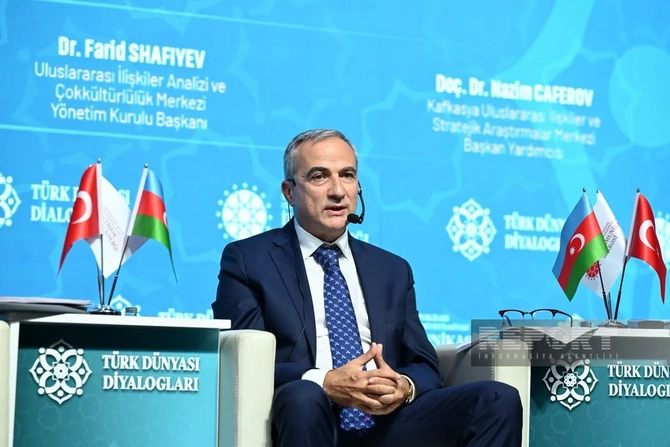
BAKU — September 15, 2026 — Farid Shafiyev, the Chairman of the Board of the Center for Analysis of International Relations and Multiculturalism, issued a stark warning on Tuesday about coordinated disinformation campaigns allegedly being waged against Azerbaijani-Turkish unity across multiple fronts. Speaking at a high-level panel session titled “Dialogues of the Turkic World: Common Future, Common Vision,” Shafiyev underscored that these organized efforts seek to undermine the strategic fraternal relations between Baku and Ankara. According to Report, a leading Azerbaijani news agency, Shafiyev framed the issue as a significant challenge not only for the bilateral partnership but for the broader cohesion of the Turkic-speaking world. His remarks come amid heightened geopolitical tensions in the South Caucasus and the Middle East, where the alignment of Azerbaijani and Turkish foreign policies has increasingly drawn the attention—and criticism—of various international actors. The panel session, which gathered policymakers, academics, and civil society representatives, served as a platform for Shafiyev to emphasize the need for collective resilience against foreign information manipulation. He argued that the strength of the Turkic world lies not merely in economic or military cooperation, but in the intellectual solidarity that binds its nations, a bond that hostile actors are now actively trying to erode through a steady stream of false narratives and provocations.
Shafiyev placed significant emphasis on the role of intellectual ties between Azerbaijan and Turkey in cementing the unity of the Turkic world. He argued that these connections—spanning academia, cultural institutions, think tanks, and civil society—are indispensable in creating a shared understanding of common interests and challenges. In his view, the deep-rooted historical, linguistic, and cultural affinities between Baku and Ankara provide an unshakeable foundation, yet they must be continuously nurtured through scholarly exchange and mutual intellectual engagement. The panel discussion, which was part of a broader dialogue among Turkic states, highlighted the need to move beyond superficial declarations of friendship toward substantive institutional cooperation. Shafiyev specifically called for the joint development of educational curricula, joint research projects, and shared media platforms that could present an authentic Turkic perspective to the global audience. He cautioned that without such intellectual solidarity, the Turkic states would remain vulnerable to external efforts designed to distort their history, misrepresent their intentions, and drive wedges between their peoples. By investing in these intellectual partnerships, Azerbaijan and Turkey can serve as the vanguard for a more coordinated and resilient Turkic bloc, capable of defending its interests in a rapidly shifting international order. This, he implied, is precisely why hostile circles are so determined to target these ties.
A key portion of Shafiyev’s address was devoted to dismantling what he described as completely unfounded allegations that the growing rapprochement among Turkic states amounts to the emergence of a new pan-Turkist ideology. He categorically rejected these claims, labeling them as a form of fear-mongering rooted in outdated historical anxieties rather than contemporary realities. Shafiyev explained that the cooperation between Azerbaijan, Turkey, and other Turkic nations is grounded in pragmatic mutual interests—economic development, energy security, transportation corridors, and regional stability—rather than any irredentist or ideological ambitions. He stressed that the accusation of pan-Turkism is a convenient smear tactic, designed to portray legitimate diplomatic and economic collaboration as a sinister expansionist project. This narrative, he warned, is being deliberately amplified by certain circles that feel threatened by the emergence of a more cohesive and independent Turkic voice on the international stage. By framing ordinary cooperation as a revival of a century-old ideology, adversaries hope to isolate the Turkic states, provoke suspicion among their neighbors, and create internal discord. Shafiyev’s rebuttal was unequivocal: the Turkic states are not seeking to redraw borders or impose their will on others; they are simply seeking to exercise their sovereign right to cooperate with their closest allies. He called on fellow participants to confidently counter these false narratives with facts, transparency, and a clear articulation of their benign and constructive vision.
Turning his attention to the volatile situation in the Middle East, Shafiyev acknowledged that Azerbaijan coordinates its policy toward the region with Turkey, a reality that has, in his words, caused significant concern among certain circles. He observed that this coordination—spanning issues of regional security, diplomatic strategy, and economic engagement—has become a lightning rod for criticism. In particular, he noted the organized spread of disinformation directed against the fraternal relations between Azerbaijan and Turkey in the context of the Israeli issue. This is a deeply sensitive area, as Azerbaijan maintains a pragmatic bilateral relationship with Israel, particularly in the fields of defense technology and energy, while Turkey has historically been a vocal critic of Israeli policies toward the Palestinians. The differing stances on Israel create a complex environment in which external actors can exploit perceived contradictions in Azerbaijani-Turkish coordination. Shafiyev suggested that disinformation campaigns are intentionally inflating these differences, fabricating stories of friction and mistrust where none exist. He argued that the reality is far more nuanced: Azerbaijan and Turkey engage in continuous dialogue on Middle Eastern affairs, seeking to align their approaches where possible and manage their differences with mutual respect where necessary. However, the false portrayal of a breakdown in relations serves a clear agenda—to destabilize the Turkic alliance by focusing on a deeply polarizing regional conflict. Shafiyev warned that the ultimate goal of these campaigns is to portray Azerbaijan as choosing sides in a way that would alienate one partner or another, thereby fracturing the unity that both nations have worked so hard to build.
The nature of these disinformation operations, according to Shafiyev, is neither accidental nor spontaneous. He described them as organized and systematic, indicating the involvement of well-resourced actors with a strategic interest in weakening Azerbaijani-Turkish unity. These campaigns operate across a variety of fronts, including social media bots, fake news websites, manipulated videos, and the weaponization of legitimate-looking analytical platforms. The content is often tailored to specific audiences: in the West, it may play on fears of authoritarian expansionism; in the Middle East, it exploits religious and political sensitivities; and in the South Caucasus, it attempts to revive old rivalries and ethnic tensions. Shafiyev stressed that the Turkic states must respond with a sophisticated and coordinated strategy of their own. He called for the creation of joint mechanisms for media monitoring, fact-checking, and rapid-response communications that could identify and neutralize disinformation in real time. Furthermore, he advocated for deeper collaboration between the intelligence and security services of the Turkic nations to trace the origins of these campaigns and hold their perpetrators accountable. Equally important, he argued, is the need for media literacy initiatives that empower ordinary citizens to critically evaluate the information they encounter. In a digital age where a single fabricated story can spread globally in minutes, building societal resilience is just as important as top-down policy responses. The Turkic world, he asserted, must not be a passive victim of information warfare; it must become an active and capable defender of its own truth.
In concluding his remarks, Shafiyev painted a broader picture of the challenges and opportunities facing the Turkic world in the coming years. He emphasized that the strength of the relationship between Azerbaijan and Turkey is not merely a bilateral affair but a cornerstone of regional stability in the Caspian Basin, the South Caucasus, and beyond. The attempts to disrupt this relationship through disinformation are, therefore, an attack on the very idea of a united Turkic future. He called on all participating nations in the “Dialogues of the Turkic World” to commit to a common vision that prioritizes truth, solidarity, and mutual respect. He warned that the information war will likely intensify as the Turkic states grow stronger and more assertive on the global stage. However, he expressed confidence that by pooling their intellectual resources, sharing their experiences, and maintaining open lines of communication, they can successfully counter these malign influences. The panel session itself was a testament to the power of dialogue, offering a space for open discussion and the development of shared strategies. Shafiyev’s direct quote, as carried by Report, serves as a potent summary of the urgency he feels: “I would also like to touch upon the events in the Middle East. Azerbaijan coordinates its policy regarding the region with Turkey, and this causes concern among certain circles. In particular, we are observing the organized spread of disinformation directed against the fraternal relations between Azerbaijan and Turkey in the context of the Israeli issue.” With these words, Shafiyev not only exposed a clear and present threat but also issued a call to arms for intellectual and political leaders across the Turkic world to stand united against a shadowy and persistent adversary. The future of their shared endeavor, he suggested, will depend on their ability to recognize this threat, understand its mechanisms, and respond with clarity, courage, and coordination.