








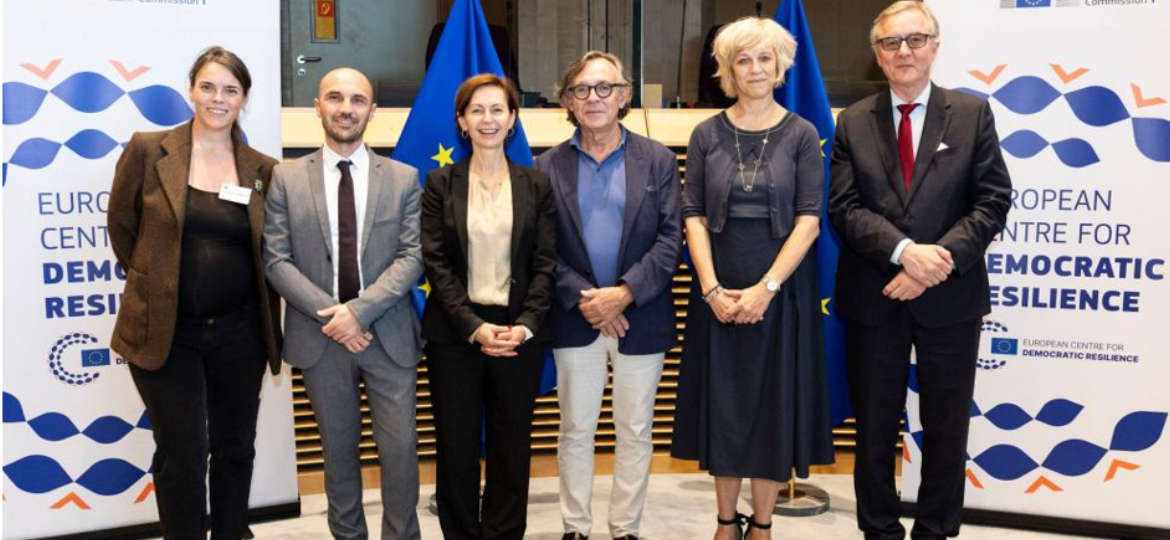
The European Digital Media Observatory (EDMO) has formally welcomed the launch, on 29 September, of the pilot phase of the Stakeholder Platform, an initiative established by the European Centre for Democratic Resilience. In an official statement, EDMO said it was honoured to contribute to the initiative and stressed its readiness to support the platform’s development through its extensive European network. The launch marks a significant step in the European Union’s ongoing efforts to defend democratic systems against foreign information manipulation and interference, known broadly as FIMI. The platform is designed to become a key structure for raising situational awareness and fostering preparedness against disinformation campaigns, a growing concern for governments, civil society, and international institutions. It will also support the goals of the European Union Democracy Shield, a broader policy framework intended to protect democratic processes, institutions, and public debate from external attempts to undermine trust and sow division. By connecting national operational capacities with EU-level coordination, the platform aims to strengthen the ability of member states and EU institutions to anticipate, detect, and respond to emerging threats. It will also support rapid response and escalation mechanisms, ensuring that when a foreign interference incident is detected, the necessary countermeasures can be launched quickly, in a coordinated manner, and with the input of relevant stakeholders from across the continent.
The Stakeholder Platform is intended to function as a central hub for situational awareness, bringing together information from a wide range of sources and enabling a more complete understanding of the threat landscape. Foreign information manipulation and interference is a particularly complex challenge because it combines disinformation, cyber operations, and influence activities, all of which can evolve rapidly and cross borders with ease. The platform will collect and analyse intelligence from governments, civil society organisations, open-source research, media monitoring, and other channels, with the aim of producing actionable insights for decision-makers. This includes identifying emerging false narratives, tracking coordinated behaviour, and mapping the spread of manipulative content across platforms and jurisdictions. A key objective is to help European institutions and national authorities move from a reactive posture to a more proactive approach, one in which threats are identified early and measures are taken before the information environment is corrupted. The platform will therefore play a crucial role in the EU’s broader democratic resilience architecture, acting as a bridge between local and national monitoring efforts and the strategic coordination that can only happen at European level. It will also help foster a shared understanding of what constitutes FIMI, avoiding fragmented responses and promoting a common operational language across member states. In an era where information threats can be launched by state actors or sophisticated non-state groups and spread in multiple languages simultaneously, the ability to connect real-time observation with long-term preparedness is essential. The pilot phase will test the practical feasibility of these arrangements and provide lessons that can inform the development of a permanent, fully resourced mechanism under the Democracy Shield.
A central element of the platform’s design, as highlighted by EDMO, is the meaningful involvement of civil society. Fact-checkers, academic researchers, media organisations, and media literacy practitioners will all have important roles to play in monitoring the information space, debunking false narratives, and educating the public about the tactics used by malicious actors. Their participation will be essential to the credibility and effectiveness of the platform. However, EDMO has made clear that any cooperation must fully respect the independence and editorial autonomy of these actors. This is fundamental to maintaining public trust, which is itself a prerequisite for democratic resilience. If civil society groups are perceived as being controlled or instrumentalised by governments, their work will no longer be trusted by the public, and the entire platform will lose legitimacy. EDMO’s statement therefore serves as a reminder that the fight against disinformation cannot come at the expense of the very values it seeks to protect. The involvement of independent fact-checkers, in particular, adds an essential layer of verification and accountability. Researchers contribute scientific rigour and contextual understanding, while media literacy practitioners can help translate monitoring insights into educational tools and public awareness activities. These actors also provide a counterweight to government power within the platform, ensuring that official responses are transparent and evidence-based. The challenge of maintaining independence while cooperating with state institutions is delicate, but it is exactly this balance that will determine whether the platform is trusted by citizens and other stakeholders across Europe. EDMO, as a network that itself consists of independent organisations, is particularly aware of this issue and is well placed to help set the conditions for a healthy relationship between state and civil society within the new platform.
EDMO has committed itself to contributing to the Stakeholder Platform in a practical and meaningful way, drawing on the capabilities of its national and regional hubs. These hubs are active across Europe and bring together local fact-checkers, academics, media professionals, and media literacy specialists. They are in a strong position to monitor and analyse the information space within their own countries and communities, identifying national and local specificities in disinformation narratives. At the same time, because they are part of a European network, they can compare patterns across borders and help identify coordinated campaigns that might otherwise appear unrelated. During the pilot phase, EDMO intends to use these hubs to collect data, provide analysis, and disseminate knowledge through targeted resilience-building activities. These activities could include training programmes for journalists, public officials, and educators; awareness-raising campaigns aimed at the general public; and the development of educational materials that teach citizens how to recognise and respond to manipulation techniques. The goal is not only to inform decision-makers at the European level but also to strengthen the capacity of local communities to resist disinformation. This is a crucial component of resilience, because the ultimate impact of FIMI is often felt at the level of individual voters, communities, and local democratic institutions. Paolo Cesarini, Chair of the EDMO Executive Board, captured this vision in his statement, saying: “EDMO stands ready to bring its field expertise and its European network to this effort, helping turn shared knowledge into practical resilience at local and national level.” He added that EDMO’s contribution would be guided by the principles of independence, integrity, transparency, neutrality, pluralism, inclusion, and scientific rigour that underpin the entire EDMO network. These principles are intended to reassure the public and civil society that the platform will remain an objective, credible, and non-partisan structure. EDMO’s existing experience, including its work during elections, health emergencies, and international conflicts, gives it a strong foundation for this new role, but it has also made clear that it sees itself as one participant in a much larger ecosystem of democratic defence.
The timing and political context of the platform’s launch are significant. European institutions have been increasingly focused on the danger posed by foreign interference and disinformation, particularly in light of events such as the war in Ukraine, rising geopolitical tensions, and the rapid advancement of generative artificial intelligence. The European Union has developed a range of instruments to address these threats, including the Digital Services Act, the European Democracy Action Plan, and most recently the European Democracy Shield. The Stakeholder Platform is meant to be an operational expression of these broader ambitions. It represents an attempt to move beyond high-level declarations and create a working structure that can actually be used by practitioners, authorities, and civil society organisations on a daily basis. The connection between national operational capacities and EU-level coordination is particularly important because disinformation does not respect borders. A campaign that begins in one member state may quickly spill over into several others, aided by social media and sophisticated distribution networks. Without a coordinating mechanism, individual countries may struggle to understand what is happening, let alone respond effectively. The platform is designed to fill this gap. It will not replace national efforts; rather, it will help connect them and make them more effective by ensuring that information is shared in a timely, secure, and structured manner. It will also provide a space for developing shared methodologies, common indicators, and mutually agreed response protocols. This is essential for building a truly European response to information threats. During the pilot phase, participants will be able to test these methods, identify obstacles, and refine their approaches in a realistic but less visible environment. The lessons learned will be invaluable for creating a final model that can be scaled up and sustained in the future.
Looking ahead, EDMO has emphasised that the pilot phase, while important, cannot succeed on its own. The longer-term future of the Stakeholder Platform will depend on the provision of sustainable support at the highest level of EU decision-making. In particular, EDMO has drawn attention to the upcoming EU Multiannual Financial Framework, the Union’s long-term budget, which will set spending priorities for many years to come. Without appropriate resources allocated to democratic resilience, the platform may remain an experiment rather than becoming a permanent and fully effective structure. Building resilience against foreign information manipulation requires sustained funding for technology, personnel, training, research, and civil society partnerships. It also requires stability, so that organisations involved in the platform can plan their work with confidence and build the long-term relationships that are necessary for trust and effective cooperation. EDMO’s call for sustainable support should be understood as a strategic warning: Europe’s growing capacity to detect and respond to disinformation is valuable, but it is also fragile. The infrastructure being developed now could be undermined if the next financial framework does not treat democratic resilience as an essential area of investment. The challenge is not only to launch new initiatives but to give them the resources and long-term mandate they need to survive and evolve. The pilot phase is an opportunity to demonstrate the value of the platform, but the institutional commitment must follow. The responsible bodies within the European Union, together with member states, will need to decide whether the fight against foreign information manipulation is truly a priority. If they do, the platform will be able to help shape a more resilient Europe, protecting democratic debate and public trust from those who seek to exploit them. If the momentum is lost, the initiative risks becoming another well-intentioned effort that failed to achieve its full promise. EDMO has expressed its readiness to contribute, but it has also made clear that the ultimate responsibility for success now rests with European political leaders and budget negotiators.


