









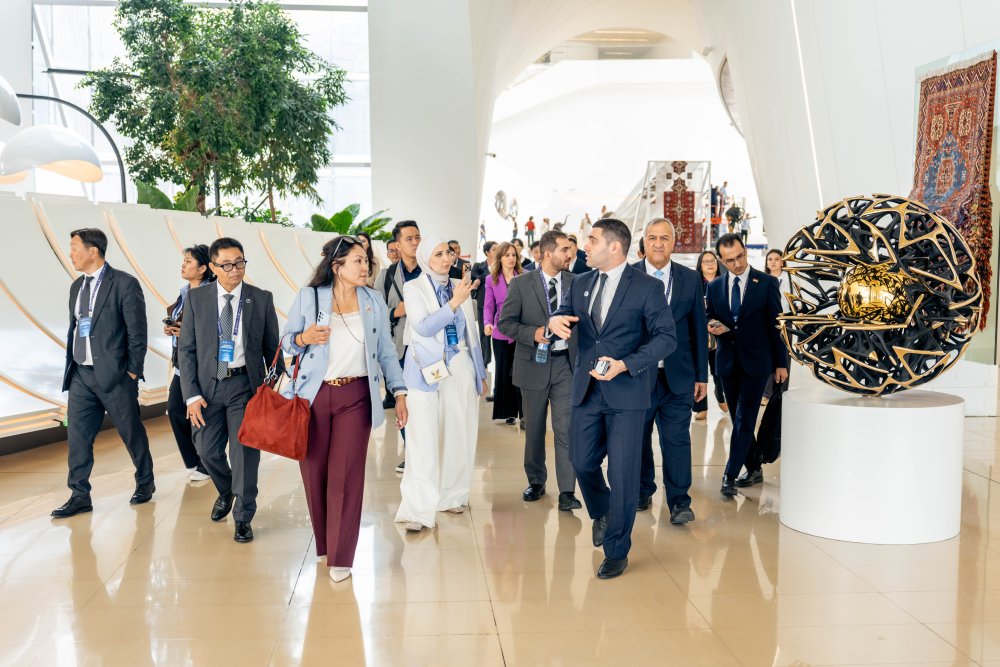
Asia’s Media Leaders Meet in Baku for First CICA Media Forum
BAKU — Officials, policy-makers, and senior media executives from across Asia gathered in Baku on Thursday for the inaugural media forum convened under the framework of the Conference on Interaction and Confidence Building Measures in Asia (CICA). The event was organized by Azerbaijan in its capacity as CICA chairman, with the support of the CICA Secretariat, and carried the theme “Building Trust through Media in a Polarized World.” For the countries of Asia, which together account for more than 90 percent of the continent’s territory, the meeting was an opportunity to weigh how journalism can be used not as a weapon of division but as a tool for mutual understanding. The discussions focused on the state of a global media landscape that is being transformed by digital platforms, artificial intelligence, and an increasingly rapid flow of information that often leaves fact-checking and professional ethics far behind. At the same time, the forum served as a reminder that media institutions in Asia have a shared responsibility to strengthen confidence among nations, especially at a moment when geopolitical rivalries and security challenges tend to dominate official discourse. The atmosphere in Baku was marked by a sense of urgency, as participants acknowledged that public trust in media is at a critical low in many parts of the world. The CICA chairmanship, held by Azerbaijan, gave the forum a diplomatic weight that went beyond journalism alone, linking the media directly to the broader goals of the conference: peace, stability, and cooperation across the Asian continent. Because CICA is not only a regional body but a platform where different political systems, cultures, and economies meet, the media forum was widely seen as a step toward creating a shared space for dialogue in an otherwise fragmented global information environment.
In an address delivered at the opening session, Azerbaijani President Ilham Aliyev described the world as going through a complicated period, characterized by fast-changing geopolitical realities, growing security challenges, and deep shifts in the media landscape. He argued that at a time when disinformation and hostile narratives are being used to widen divisions between states and peoples, the media should be seen as an important instrument of public diplomacy, mutual understanding, and regional cooperation. Aliyev’s remarks carried particular significance because they connected the future of media to the future of international relations. In a polarized world, he suggested, the search for truth and objectivity is not a neutral exercise; it is a political act that can either consolidate trust or deepen conflict. The Azerbaijani leader’s message was directed not only to journalists and media executives, but to governments, regulators, and international organizations. His point was that media cannot be reduced to a purely commercial sector or a purely technological arena; it is an essential pillar of statecraft and public life. By hosting the first CICA media forum, Azerbaijan signaled its intention to place communication policy on the same level as traditional confidence-building measures such as military transparency, economic cooperation, and cultural exchange. Aliyev’s speech also reflected a broader concern among Asian countries about the dangers of information manipulation and the need to create resilient, credible media ecosystems. His words were echoed by many participants who noted that journalism, when practiced responsibly, can help prevent misunderstandings, reduce tension, and open new channels of communication between countries that might otherwise view each other only through the lens of suspicion. The address set the tone for the entire forum, framing media not as a passive observer of politics but as an active participant in the effort to build a more predictable, peaceful, and cooperative international order.
CICA Secretary-General Kairat Sarybay reinforced that message when he told the forum that promoting constructive, fact-based dialogue has become a global priority. He argued that closer cooperation among CICA member states should go hand in hand with stronger ties among their media professionals. Sarybay’s statement was a clear acknowledgment that no government or international organization can afford to ignore the media’s role in shaping public opinion, influencing policy, and even determining the outcome of conflicts. In an era of fake news, deepfakes, and algorithmic amplification, the secretary-general said, the distinction between information and disinformation has become increasingly blurred. That blurring is particularly dangerous for Asia, a region of extraordinary diversity where misunderstandings can quickly escalate into diplomatic incidents or worse. Sarybay emphasized that the CICA process, which depends on mutual trust among states with very different political systems and historical experiences, cannot succeed without the active participation of journalists and media institutions. He called on member states to support professional media development and to encourage exchanges that would allow journalists from different countries to understand one another’s perspectives more fully. His comments suggested that the media forum should not be seen as a one-off event but as the beginning of a larger effort to create a regional information ecosystem based on shared values of accuracy, accountability, and respect. By linking media cooperation to the broader CICA agenda, Sarybay made it clear that journalism is not a side issue in international diplomacy but a central element of confidence-building in the twenty-first century. In this sense, his remarks reflected a growing convergence of opinion across the region: that the future of Asian cooperation will depend as much on how nations communicate as on what they do in the economic, military, and political spheres.
A similarly urgent perspective was offered by Salkyn Sarnogoeva, Kyrgyzstan’s Deputy Minister of Culture, Information, and Youth Policy, during a panel session. She told the gathering that building trust across Asia is a shared responsibility of all CICA members, and that in an age of disinformation and information warfare, government institutions, professional journalists, bloggers, and opinion leaders should work together to produce high-quality content that promotes unity. Sarnogoeva’s intervention was notable because it explicitly recognized that the modern media environment includes not only traditional news organizations but also social media influencers, independent content creators, and other non-traditional voices. Her call for collaboration among these different actors reflected an understanding that governments alone cannot control the narrative in a digital world; they need allies who are willing to promote facts, reject manipulation, and model constructive discourse. The Kyrgyz deputy minister also called for regular professional exchanges and shared experiences among media professionals in CICA member states. She argued that journalists who have had the chance to work with their counterparts in other countries are less likely to fall into stereotypes, more likely to check their sources, and better equipped to produce coverage that reflects the complexity of Asian realities. Her emphasis on unity was particularly significant given the many conflicts and tensions that exist in the region, from the Middle East to South Asia to the Far East. Sarnogoeva’s message was that media should not be allowed to become another battlefield. Instead, it should be a space where different nations can find common ground, exchange knowledge, and learn from one another. Her call for high-quality content was a direct challenge to the race-to-the-bottom logic of sensationalism and clickbait that often dominates digital media. In her view, professional standards and ethical commitments are not obsolete in the age of algorithms; they are more important than ever, especially in regions where young, rapidly growing populations rely heavily on social media for information.
Alongside the main sessions, a series of bilateral meetings added another layer of diplomatic activity to the forum. Ahmad Ismayilov, chairperson of Azerbaijan’s Media and Broadcasting Council, held talks with a number of international counterparts, according to a statement issued by the council. His meetings included discussions with Mehmet Daniş, chairman of the Turkish Radio and Television Corporation; Wajiha Qamar, Pakistan’s Minister of State for Federal Education and Professional Training; CICA Secretary-General Kairat Sarybay; and Kobuljon Akhmedov, director of the Center for Media Content Production under Uzbekistan’s Presidential Administration. The participants, the council said, agreed that rapidly changing communication trends demand closer cooperation and continuous exchange of experience among media institutions. They stressed the value of building ties in the media sector and pursuing joint projects in various formats. More specifically, they exchanged views on maintaining trust in the global information space, strengthening media literacy, reducing the impact of disinformation, improving the quality of media content, and adapting to the challenges posed by digital platforms. These bilateral interactions were more than routine diplomatic courtesies; they produced a shared diagnosis of a profession under pressure. Broadcasters and content producers from different countries are facing similar problems, including the rise of social media monopolies, the spread of false information, and the erosion of traditional funding models. The fact that representatives of Turkey, Pakistan, Uzbekistan, Kyrgyzstan, Azerbaijan, and the CICA Secretariat could sit down together and agree on these challenges suggests that there is genuine potential for regional cooperation in the media field. That cooperation could take many forms, from joint training programs for journalists to co-productions of documentaries and news programs, to the establishment of a regional platform for fact-checking and media literacy. The bilateral meetings also highlighted the role of Azerbaijan as an active intermediary, capable of bringing together diverse partners and creating an atmosphere of trust. For Azerbaijan, the forum was an opportunity to position itself as a hub for regional media dialogue, just as it has sought to be a hub for energy, transport, and international conferences.
The significance of the first CICA media forum extends far beyond a single meeting in Baku. CICA itself is a multinational forum that brings together 28 states across Asia, covering more than 90 percent of the continent’s territory, from China and Russia to Turkey, Iran, Pakistan, South Korea, and many others. Its stated purpose is to promote peace, security, and stability through dialogue and confidence-building measures. By adding media to that agenda, CICA is adapting to the realities of a world where information is both a strategic asset and a potential source of conflict. The forum reflected a broader conviction among Asian states that the global debate about media freedom, content regulation, and digital governance should not automatically be dominated by the West, but should include Asian voices and perspectives. At the same time, the outcomes of the forum were realistic in their scope: no one expected the meeting to solve the region’s information challenges overnight. Instead, the value of the event lay in its symbolic and institutional significance. It established, for the first time, a formal connection between the media sector and the CICA process, and it opened the door to future meetings, joint projects, and professional networks. The decision to launch this initiative under Azerbaijan’s chairmanship was not arbitrary; Baku clearly intended to make media cooperation a signature theme of its tenure. If that intention is followed by concrete actions — such as a regular media forum, an exchange program for young journalists, or a regional observatory on disinformation — it could become one of the most lasting contributions of the CICA process. In a world where trust is increasingly scarce, building confidence through media is not a luxury; it is a necessity. The Baku forum did not provide all the answers, but it asked the right questions. By bringing together officials, media leaders, and international institutions, it sent a signal that Asia is ready to discuss, coordinate, and act. The next step will be up to the 28 member states and their media organizations, which must decide whether the commitment expressed in Baku becomes the foundation of a new era of cooperation or simply another well-intentioned declaration. Given the scale of the challenges — geopolitical rivalry, digital transformation, and the global crisis of trust — the stakes could hardly be higher. The success of the first CICA media forum will ultimately be measured not by the number of speeches delivered, but by whether the media, as President Aliyev said, truly becomes an instrument of diplomacy, understanding, and regional cooperation.


