







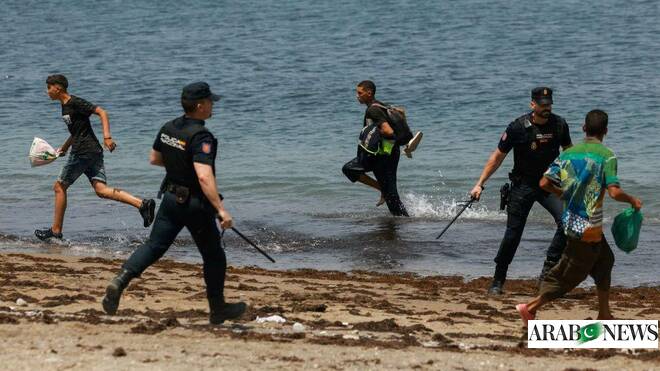
BRUSSELS – In a concerted effort to stem the tide of misinformation that exacerbated one of Europe’s most alarming migration crises in recent memory, the European Union announced on Tuesday that tech behemoths Meta and TikTok have agreed to a series of voluntary operational changes aimed at bolstering fact-checking capabilities. This collaborative push comes in the wake of the harrowing events in Ceuta, the Spanish exclave on Morocco’s northern coast, where a staggering 72,000 migrants and asylum seekers surged across the border in a desperate, chaotic rush late last month. The influx, triggered by a diplomatic dispute between Rabat and Madrid, quickly escalated into a humanitarian emergency, with thousands of people, including unaccompanied minors, arriving on European soil within a matter of days. However, the physical crossing was not the only battle being fought; a parallel war was waged across the digital landscape. Experts and investigators have since highlighted that social media became a dangerous accelerant for the migration wave, with misleading content and outright falsehoods circulating at lightning speed, enticing vulnerable individuals to undertake the perilous journey. The most notorious of these digital falsehoods was the viral rumor that “the Ceuta border is open,” a message that spread like wildfire across various platforms, creating a false sense of guaranteed entry and triggering a mass movement that overwhelmed local infrastructure and placed immense strain on Spanish and EU resources. The European Commission, the bloc’s executive arm, has responded by moving beyond mere rhetoric, initiating direct and urgent dialogue with the major online platforms to address the systemic vulnerabilities exposed by this crisis. The announcement in Brussels signifies a pivotal moment in the ongoing struggle between regulatory bodies and the vast, often opaque digital ecosystems that shape public perception on a global scale. The sheer scope of the movement, many of whom arrived without proper documentation or provisions, forced the Spanish government to deploy troops to the border and hastily set up temporary reception centers, while simultaneously navigating a tense political standoff with Morocco.
At the heart of the EU’s strategy is a newly established “ad-hoc escalation and cooperation mechanism” designed to facilitate a more fluid and rapid exchange of information between the platforms, the Commission, and local fact-checking organizations. The Commission’s spokesman, Balazs Ujvari, confirmed that Meta and TikTok have formally activated their respective crisis protocols, committing to a proactive approach in identifying and flagging posts that could incite further disorder or facilitate illegal border crossings. This mechanism functions under the broader framework of the Digital Services Act (DSA), the EU’s landmark legislative package aimed at holding online platforms accountable for the content they host. Crucially, Ujvari emphasized that the current activation is entirely voluntary, representing a goodwill gesture from the tech giants to cooperate with the bloc’s regulatory instincts. However, he was unequivocal in asserting that the Commission reserves the right to escalate its demands if the voluntary measures prove ineffective. “For now, we think that this is an effective tool. But of course, if needed, we are ready to go further,” Ujvari told reporters during a daily briefing. This statement serves as a clear warning to Silicon Valley that the EU is prepared to invoke the full weight of the DSA’s mandatory provisions, which include stringent obligations for platforms to remove illegal content and to conduct risk assessments during crises. The mechanism is specifically tailored to provide platforms with “better information from the fact-checkers” who are tasked with scanning for content related to potential new mass crossings or other destabilizing events. By establishing a direct communication channel, the EU aims to reduce the response time between the identification of a harmful falsehood and its suppression or correction, thereby mitigating the real-world consequences of digital misinformation. This involves setting up dedicated channels where fact-checkers can directly alert platform moderators to emerging threats, bypassing the often cumbersome and slow traditional reporting procedures. The move underscores the EU’s growing reliance on soft-power coordination before resorting to hard regulatory enforcement.
The genesis of this collaborative effort lies in the deeply concerning revelations about how disinformation functioned during the Ceuta crisis. Investigative reports and social media monitoring groups documented a torrent of malicious content that contributed to the panic and the surge of people heading toward the border. In addition to the “border is open” rumor, other false narratives included claims that Spain was offering amnesty to all arrivals, and doctored videos showed purportedly crowds of people freely entering European territory. The viral spread of such content often mirrors the tactics used by state actors and organized criminal networks, who leverage social media algorithms to amplify their messages to target audiences. The European Commission acknowledged this sophisticated threat by coordinating its efforts with Europol, the European Union Agency for Law Enforcement Cooperation. This partnership is crucial, as it allows the EU to cross-reference online activity with intelligence gathered on the ground regarding human smuggling operations. The hope is that by disrupting the information ecosystem that supports these networks, they can also disrupt the smuggling business itself. The ad-hoc mechanism will therefore not only focus on fact-checking but also on identifying the origins of the disinformation campaigns, potentially leading to criminal investigations. By pooling the resources of law enforcement, regulators, and private corporations, the EU is attempting to construct a comprehensive defense against the weaponization of information in humanitarian crises. The situation in Ceuta is a stark reminder that migration routes are not just physical pathways but are increasingly digital highways, where a single viral post can trigger a stampede of human desperation. Local fact-checkers in Spain and Morocco were on the front lines, struggling to keep pace with the sheer volume of misleading content, often finding that corrections reached audiences only after they had already made life-altering decisions.
Both Meta, the parent company of Facebook and Instagram, and TikTok have publicly acknowledged the gravity of the situation and outlined their specific countermeasures. A Meta spokesperson confirmed that a dedicated team is “monitoring the situation in Ceuta in real time and removing content that violates our policies – including content that offers to provide, facilitate or seek human smuggling services.” This proactive stance goes beyond reactive moderation, as the team is actively scanning for new forms of exploitation and illegal activity. Meta also relies heavily on its network of third-party fact-checkers, of which AFP (Agence France-Presse) is a prominent member, particularly in the Spanish language market. These partners work to review and rate potentially misleading content, which then gets flagged or downranked in users’ feeds. This includes collaborative features where fact-checkers can add context labels directly to posts, warning users that the content is disputed. Similarly, TikTok has underscored its strict rules against content that encourages or enables human smuggling and illegal border crossings. The short-video platform revealed that it is working closely with journalism and fact-checking organizations, specifically citing Newtral in Spain and MapExpress in Morocco. These partnerships enable TikTok to have localized linguistic and cultural expertise necessary to identify nuanced misinformation that might slip past automated algorithms. TikTok’s response highlights the unique challenge posed by its platform, which relies heavily on viral video content that can be manipulated or stripped of context. By engaging local experts, the platforms are attempting to ensure that their global policies are effectively applied to highly specific regional events. The commitment shown by these companies is a significant step, yet critics remain skeptical about the depth of their enforcement, questioning whether voluntary measures can truly outpace the sophisticated tactics of disinformation operators who continually adapt to evade detection. The move is part of a broader trend where tech companies are increasingly forced to position themselves as arbiters of truth in the absence of global regulatory consensus.
This development must be understood within the context of the EU’s aggressive regulatory push against Big Tech. The Digital Services Act, which took effect in stages, represents the most comprehensive set of rules ever enacted to govern online platforms. It demands that large platforms (those with over 45 million users in the EU) conduct rigorous risk assessments and implement measures to mitigate systemic risks, including the spread of illegal content and disinformation. While the current activation is voluntary, the DSA provides the Commission with the legal authority to impose binding emergency measures if a crisis necessitates it. The EU has a history of escalating from dialogue to compulsion; recent years have seen formal investigations into companies like Apple, Google, and Amazon over antitrust violations, resulting in billions of euros in fines. The Ceuta incident offers the Commission a perfect test case for the DSA’s crisis response mechanisms. By announcing the voluntary agreement, the EU is signaling a preference for cooperation, which is often more efficient and less legally contentious than formal enforcement actions. However, Ujvari’s warning that they are “ready to go further” directly threatens the use of interim measures, which would force the platforms to act under penalty of significant financial sanctions. The balancing act for Brussels is to maintain a collaborative relationship with the tech industry while retaining the authority to wield a big stick. The success of this voluntary approach could set a precedent for how the EU handles future crises, potentially streamlining responses to election interference, public health emergencies, or natural disasters. Conversely, failure could provoke a hardline legislative response, further tightening the screws on an industry already wary of European regulatory ambitions. The EU’s internal market commissioner, Thierry Breton, has been particularly vocal about the need for platforms to police their own ecosystems, frequently engaging in public spats with tech CEOs over content moderation policies.
As the situation in Ceuta gradually stabilizes, with Spain relocating many of the migrants and fortifying its border defenses, the digital skirmish continues to evolve. The agreement struck between the EU, Meta, and TikTok is a testament to the growing recognition that information integrity is a critical component of border security and humanitarian response. While the immediate crisis may have passed, the underlying threats of misinformation remain omnipresent, particularly in a region where migration flows are persistent and geopolitical tensions are high. The voluntary mechanism is, by definition, a temporary and flexible tool. Its effectiveness will be measured by how quickly false narratives are debunked and how effectively they are prevented from inciting further mass movements. The EU’s readiness to transition to mandatory measures under the DSA serves as a crucial safeguard, ensuring that the platforms do not become complacent. For the tech companies, this episode represents a delicate dance: they must satisfy European regulators to avoid heavy fines, while also protecting their global user bases from over-censorship accusations. The involvement of trusted fact-checkers like AFP, Newtral, and MapExpress is essential to maintaining credibility in this process. Ultimately, the Ceuta disinformation crisis has served as a wake-up call for both regulators and the private sector. It has demonstrated that in the digital age, a border is not just a physical line on a map but a complex information ecosystem that can be manipulated with devastating consequences. As the EU continues to refine its Digital Services Act and expand its crisis protocols, the lessons learned from Ceuta will undoubtedly inform future strategies, shaping a new era of accountability for online platforms. The world will be watching closely to see if this collaboration proves to be a pioneering model for global governance or just another well-intentioned but ultimately insufficient response to the relentless tide of digital deception.


