








Volcano Misinformation: How False Claims, Viral Images and Exaggerated Headlines Distort Eruptions and Endanger Public Trust
Volcanoes have always captured the human imagination, whether they are erupting or silent. But that fascination can become dangerous when it collides with rolling news coverage and social media, amplifying false claims, misleading images and long-standing misconceptions about how volcanoes behave. In a newly published study, an international team of volcanologists, science communicators and emergency experts set out to identify the most widespread myths about volcanic activity and understand how they take hold and spread. Drawing on their own experience as communicators and an analysis of 375 media articles published between 2017 and 2022, the researchers catalogued 18 common misconceptions, ranging from basic errors about ash and magma to exaggerated fears about “supervolcanoes,” “mega-tsunamis” and the Pacific “Ring of Fire.” Their goal is straightforward: to help journalists communicate volcanic hazards more accurately, and to help people from any background recognise misleading information before it shapes their decisions. The stakes, they argue, are far higher than simply getting the science wrong. Misinformation can distort people’s perceptions of hazards and risk, and influence how they respond to an eruption, whether by ignoring an evacuation order, fleeing unnecessarily, or abandoning an island economy in panic. With volcanic events increasingly covered in real time by rolling news and social media, the gap between what scientists know and what the public is told can grow dangerously wide.
Among the most common misconceptions identified in the research are fundamental misunderstandings of volcanic materials and structures. Volcanic ash, for example, is frequently described as “smoke” in news reports and social media posts. In reality, ash is not a product of combustion; it consists of tiny fragments of rock, crystals and volcanic glass, mixed with gases and water vapour in an eruption plume. That distinction may seem semantic, but it has practical consequences. People who think of ash as harmless smoke may underestimate its ability to damage lungs, aircraft engines, electronics and buildings, or may fail to take protective measures. Similarly, the term “magma chamber” often conjures an image of a vast underground tank of liquid magma waiting to burst to the surface. The reality beneath many volcanoes is far more complex, involving networks of molten rock, crystals and gas distributed through the crust, with only small pockets of melt interconnected at any one time. The researchers also found that attention-grabbing terms like “supervolcano” and “mega-tsunami” featured prominently in misleading coverage, often used to imply apocalyptic scenarios that are not supported by the geological record. Some misconceptions are more basic, reflecting a lack of familiarity with how volcanoes actually work, while others are the products of disaster films and tabloid headlines. But whether the error is dramatic or mundane, the study argues, each one can skew public understanding of volcanic hazards and make it harder for people to respond appropriately during a crisis.
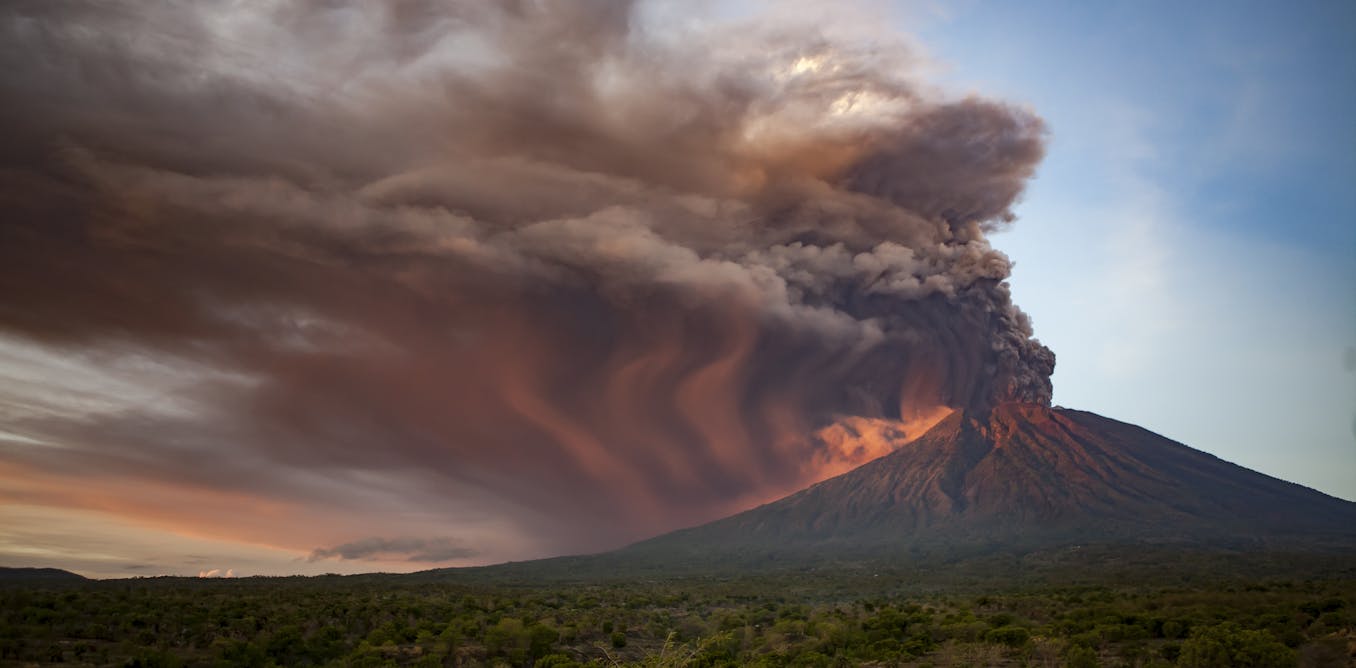
The research includes striking examples of misinformation spreading during real volcanic events. During Mount Agung’s 2017 unrest and eruption in Bali, old footage of other volcanoes was presented as current activity, while clouds and gas emissions were wrongly reported as eruptions. Some reports suggested an eruption could affect the entire island, contributing to tourist cancellations and leaving volcanologists to counter false information in real time. The impact was not just reputational; it had real economic consequences for a region dependent on tourism, and it demonstrated how quickly misleading images can cross borders on social media before any official correction can catch up. More recently, a 2025 eruption of Mount Etna in Sicily produced a pyroclastic flow within an area already closed to the public. Videos of tourists outside the affected area moving away were shared widely as people “fleeing for their lives,” creating the false impression that Sicily itself was unsafe. The resulting coverage fuelled public anxiety and tourism concerns, while exaggerating the actual danger posed by the eruption. These cases illustrate a larger pattern: a relatively contained volcanic event is amplified by decontextualised footage, dramatic narration and a lack of expert context, transforming a local hazard into an international panic. The visual nature of social media makes such distortion especially powerful, because images and videos are often shared faster than they can be verified, and sensational content tends to travel further and faster than measured scientific updates.
The study also examines long-standing myths surrounding Yellowstone volcano in the United States, which has often been portrayed as an “overdue” supervolcano capable of destroying humanity. Documentaries, disaster films and tabloid media have exaggerated the likelihood and potential impacts of a future eruption, while earthquakes in the region have been repeatedly portrayed as signs that an eruption is imminent. The researchers note that this framing ignores the geological reality. Yellowstone’s last 50 or so eruptions were lava flows with only local impacts, not catastrophic supereruptions. The concept of an “overdue” volcano is itself a misunderstanding: volcanoes do not follow schedules, and an eruption cannot be predicted simply because time has passed since the last one. By presenting such a volcano as a ticking time bomb, misinformation can create chronic anxiety among local residents and the broader public, and it can distract from the actual hazards that monitoring agencies are working to detect. It can also undermine public trust in science when the predicted catastrophe repeatedly fails to materialise. This pattern, the study suggests, is not unique to Yellowstone. It reflects a broader tendency in some media to equate the mere possibility of a large eruption with the likelihood of one happening soon, and to frame complex scientific uncertainty in the language of imminent doom rather than probabilistic risk assessment.
Given the speed with which misinformation can travel during a crisis, the researchers offer practical advice for navigating the flood of online information. The first step is to check the source. Start with organisations responsible for monitoring and managing the volcano, including volcano observatories, geological agencies and emergency management authorities. Scientists and other experts can also provide valuable context, but it is worth considering whether they are speaking within their area of expertise. The second step is to distinguish between what is possible and what is likely. Volcano science involves uncertainty, and scientists and emergency managers may discuss a range of scenarios because they need to prepare for what is more likely. But an alarming headline stating that a volcano “could” produce a massive eruption or tsunami can easily be written and read as suggesting that it “will.” Language matters, and journalists in particular have a responsibility to report uncertainty accurately. The researchers also advise caution before sharing images and videos encountered online, especially as AI-generated content becomes more common. Does the image actually come from the volcano being discussed? Has the same image appeared elsewhere with a different location or date? During Mount Agung’s unrest, for example, footage of a pyroclastic flow at Mount Sinabung was falsely attributed to Agung, while a 2009 image of Sarychev Peak has been reused in reporting of other eruptions. Similarly, 2007 photos of Anak Krakatau appeared in 2018 reports about Stromboli. Checking the provenance of visual content is no longer an optional extra; it is an essential part of media literacy in the age of viral misinformation.
The underlying message of the study is ultimately hopeful: even though volcanoes are complex and unpredictable, good communication can help people understand what is happening, what could happen, and what is most likely. That distinction is more important than we might think. Describing volcanic ash as “just smoke” can cause people to underestimate its hazards, while calling a volcano “overdue” can make an eruption seem inevitable and fatalistic. The researchers designed their guide to help journalists and individuals recognise such misconceptions, assess the evidence behind claims, and make better-informed decisions during volcanic events. For journalists in particular, the message is simple: there is no need to exaggerate the science. Volcanoes are interesting enough on their own. The study’s authors include experts from universities, volcano observatories and government agencies, and they acknowledge the contribution of co-author Sam Poppe, Assistant Professor in Planetary Volcanology at the Space Research Centre of the Polish Academy of Sciences. By providing a clearer picture of how volcano misinformation spreads and how to spot it, the team hopes to reduce the harm it causes and ensure that when the next eruption captures our imagination, what we are looking at is the real volcano, not a distorted, misleading image of it.


