








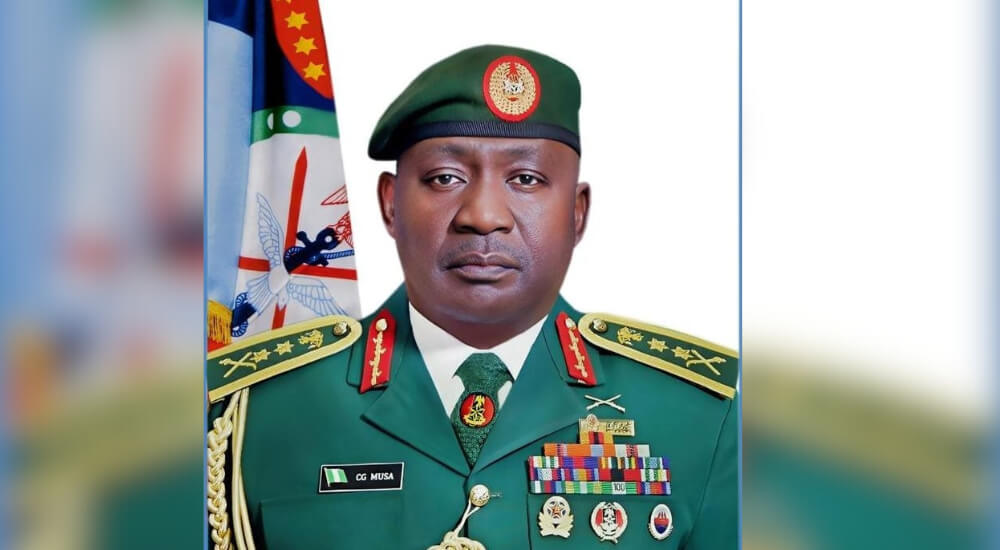
ABUJA — The Minister of Defence, General Christopher Musa (retd.), has warned that Nigeria’s 2027 general elections face a new and dangerous threat landscape in which artificial intelligence, cyber interference and coordinated misinformation could gradually corrode public confidence in democracy. Speaking at the 2025 Blueprint Newspapers Impact Series and Awards Ceremony on the theme “Security Challenges and the Integrity of Nigeria’s 2027 Elections,” Musa insisted that election security must no longer be conceived only as the deployment of armed personnel to polling units. The real challenge, he said, now lies in a largely invisible arena where perceptions are manufactured, facts are contested and trust is deliberately targeted. “Today’s threats rarely announce themselves with uniforms or conventional weapons. They emerge through cyberspace, spread through manipulated information, exploit economic hardship, inflame ethnic and religious divisions, and undermine confidence in public institutions,” the minister told the audience. He added that such threats are no longer limited to influencing how citizens vote, but could determine whether they continue to believe in the democratic process altogether. The minister’s speech therefore served as both a warning and a call to action, urging a comprehensive rethink of how Nigeria defends the integrity of elections, not only on the day of voting but in the months of campaigns, information warfare and institutional preparation leading up to it. With the next national polls less than two years away, Musa’s remarks underscored growing concern among security officials that conventional electoral violence, though still real, is being retired or supplemented by more fluid and harder-to-detect methods. At the event, attended by government officials, security chiefs, media executives and civil society actors, the Minister framed election security as an integral part of national security. He argued that no amount of physical force would protect an election if citizens no longer trusted the information surrounding it. While traditional threats such as terrorism, banditry, kidnapping, organised crime and communal conflict remain, the 2027 cycle will be the most technologically exposed in Nigeria’s history, and state institutions must move beyond reactive measures to adopt a proactive strategy that addresses both conventional dangers and the digital wildfires of disinformation.
Musa warned specifically that artificial intelligence has created a new set of vulnerabilities for which Nigerian institutions have yet to fully prepare. Advances in synthetic media and digital manipulation now mean that convincing falsehoods can be produced and circulated faster than fact-checkers or security agencies can respond. “Today, sophisticated technologies can generate convincing but entirely fabricated videos, cloned voices and manipulated images capable of misleading millions of people within minutes,” he said. The potential electoral consequences are grave: doctored footage of candidates, false audio recordings attributed to political leaders, and realistic but forged images of violence or fraud could be weaponised to trigger unrest, delegitimise results and provoke conflict even where none exists. The Minister also drew attention to the changing identity of the electoral threat actor. In previous cycles, the primary danger was often an armed individual or a violent mob seeking to disrupt voting or intimidate communities. In 2027, he argued, the most dangerous intervention could come from someone in a distant location using a laptop and a network of algorithmically amplified accounts. “The greatest threat to an election today may not necessarily be the individual carrying a weapon near a polling unit. It may well be the anonymous actor operating behind a computer screen, deliberately manipulating information, exploiting social divisions and attempting to weaken confidence in democratic institutions,” Musa said. This shift, he said, requires security agencies to develop capabilities far beyond physical policing. Cyber resilience, strategic communication, open-source intelligence, digital forensics and rapid-response units trained to counter online narratives must become central elements of election security planning. The Minister also acknowledged that digital threats do not operate in a vacuum. They interact with existing problems such as economic hardship, ethnic and religious fault lines, and widespread frustration with governance, making it essential to treat disinformation as a national security challenge rather than a mere public relations problem.
Turning to the operational side of election security, General Musa made clear that the success of the 2027 polls will be determined long before voting day. Drawing on the experience of the 2023 general elections, he warned that a last-minute surge of personnel and equipment could not compensate for inadequate intelligence, poor coordination or a failure to understand evolving threats. “Successful election security is not achieved through last-minute deployments. It is achieved through months of planning, intelligence-led operations, inter-agency coordination, effective communication and continuous assessment of emerging threats, and above all, through the confidence that citizens place in the institutions established to serve them,” he said. The Minister stressed that security must be understood as a continuous process, not a single event. “Security should never be viewed as an event. It is a process that begins long before campaigns commence and continues long after the final vote has been counted,” Musa observed. That means the machinery of election security should already be in motion, with threat mapping, risk assessment, capacity building and public trust-building integrated into the ordinary work of defence and security agencies. It also means that collaboration cannot wait for the election calendar. Police, military, intelligence, electoral officials and civil society must share information and align their planning well ahead of the campaigns. Musa noted that Nigeria’s existing security challenges, including terrorism, violent extremism, banditry, kidnapping, organised crime and communal conflict, will continue to demand attention even as digital threats intensify. A comprehensive approach must therefore combine traditional counterterrorism and law enforcement with new mechanisms to protect the information ecosystem. The Minister also called for continuous assessment during the electoral cycle, treating each phase as a learning opportunity rather than assuming that a peaceful voting day guarantees a trustworthy election.
In a key section of his address, General Musa sought to reassure the public about the role of the military in the electoral process. He insisted that the Armed Forces of Nigeria would remain constitutional, professional and non-partisan. “The Armed Forces of Nigeria are, first and foremost, defenders of the Constitution. Our mandate is to defend the sovereignty and territorial integrity of the Federal Republic of Nigeria and, where lawfully authorised, to provide Military Aid to Civil Authority in support of other security agencies,” he said. This statement was particularly significant in a country where fears of military involvement in politics and elections have deep historical roots. Musa sought to dispel those fears by anchoring the military’s role in constitutional loyalty rather than political convenience. “The Armed Forces owe allegiance neither to political parties nor to individual candidates. Our allegiance is to the Constitution of the Federal Republic of Nigeria. Our loyalty is to the Nigerian people,” he said. He did not stop at asserting principle; he offered a comprehensive vision for implementing election security, which he called the SECURE Framework. The six-pillar framework includes Strategic Intelligence Integration, Electoral Cyber Resilience, Civil-Military Coordination, Unified Strategic Communication, a Responsible Information Environment and Engaged Citizens. Under this framework, intelligence gathering and early warning systems form the foundation of election security, allowing authorities to anticipate and respond to threats before they escalate. Electoral systems, communication networks and digital infrastructure must be protected from cyber intrusion and sabotage. Civil-military coordination is crucial to ensuring that security agencies work seamlessly with the Independent National Electoral Commission and other democratic institutions. Unified strategic communication would allow the government and security agencies to counter false narratives with timely, transparent and credible information. A responsible information environment would require media, technology companies and civil society to discourage hate speech and disinformation, while engaged citizens would be equipped to identify manipulation and participate safely in the electoral process.
General Musa also directed attention to the wider institutional and social ecosystem that surrounds elections, arguing that the state alone cannot secure the integrity of democratic contestation. He called on political parties and candidates to reject violence and to conduct their campaigns with discipline and respect for the rules. He appealed to the media to maintain accuracy, balance and restraint in reporting, particularly during the volatile period surrounding voting and announcement of results. The Minister specifically addressed young Nigerians, who are often both the most active users of social media and the most frequent targets of electoral manipulation. He urged them to reject attempts to recruit them for political violence or to use them as instruments of disinformation. “Government alone cannot defeat misinformation; the media, technology companies, civil society organisations, educational institutions and citizens all share responsibility for promoting fact-based public discourse and rejecting narratives designed to incite violence or undermine confidence in democratic institutions,” Musa said. This broader framing recognises that electoral integrity is not just a matter of ballots and security presence; it depends on the health of the public space in which politics takes place. It also reflects an awareness that misinformation and fake news often find their most receptive audiences in communities already suffering from poverty, unemployment, inequality and weak social trust. Therefore, the Minister’s proposed strategy links electoral security to governance, transparency and civic education. He argued that democratic resilience—the ability of institutions to withstand pressure, citizens to identify falsehoods and voters to participate safely regardless of political affiliation—must be a central objective for all stakeholders. By assigning responsibility beyond the security sector, Musa positioned security agencies as partners in building a more robust democratic culture, not merely enforcers of order.
In his closing message, the Minister of Defence said the Ministry would work closely with the Office of the National Security Adviser, the Armed Forces, the Nigeria Police Force, the Department of State Services, the Defence Intelligence Agency and the Independent National Electoral Commission, among others, to ensure a coherent and effective preparation for the 2027 elections. He said planning should already be underway, and that the objective must go far beyond the successful conduct of another election. Preserving public confidence, protecting national unity and safeguarding democratic institutions are equally important. “The election of a President, Governor or Legislator is undoubtedly important. But there is something even greater that must emerge victorious in 2027: Nigeria herself,” Musa declared. The Minister’s words capture the deeper significance of the challenge he described. In an era of artificial intelligence, cyber interference and coordinated misinformation, elections are no longer simply contests of ballots and power. They are tests of whether citizens can agree on basic facts, trust shared institutions and accept peaceful transitions of authority. General Musa acknowledged that the greatest threat to 2027 may not be a violent uprising or a military coup but a slow erosion of belief in the democratic process itself. The success of the electoral process, he said, will ultimately be measured by whether Nigeria remains united, secure and confident in its democratic institutions after the votes have been counted and winners have been declared. His speech at the Blueprint Newspapers event thus stands as a significant official acknowledgment that the country has entered a new era of strategic competition—one in which the integrity of information may matter as much as the integrity of the ballot box.


