


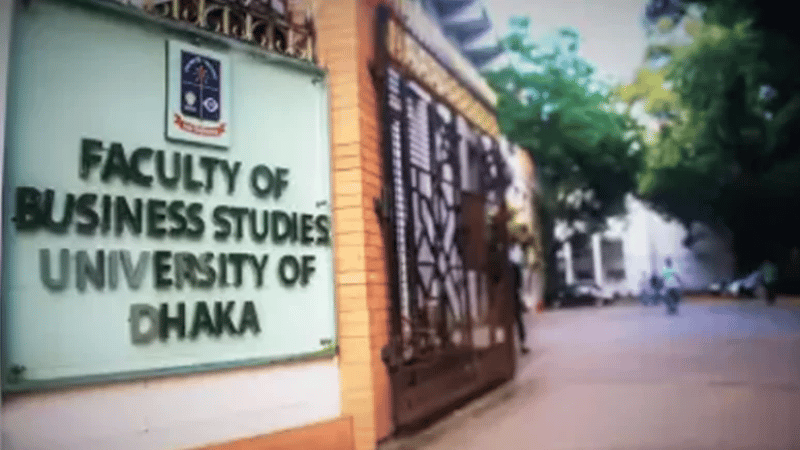
A lift at the academic building of Dhaka University’s Faculty of Business Studies has been out of order for a long time, turning a basic student convenience into a major campus dispute between the faculty administration and the Dhaka University Central Students’ Union (DUCSU). The students’ union claims it has already arranged a new lift and can have it installed within a day if the administration agrees. The Acting Dean of the faculty, Professor Al Amin, disputes that claim and says he had already taken the initiative to repair the old lift or install a new one if needed. He has accused DUCSU of spreading misinformation for publicity. The conflict has left students in a difficult position because the lift, which was installed for their use, remains non-functional while the two sides argue over who should get credit for fixing it. Faculty sources say the lift has been out of service for an extended period, causing problems for students, staff, and anyone with limited mobility who needs to use the building. The disagreement is not simply about the technical fault but about authority, accountability, and public perception, with both the administration and DUCSU trying to present themselves as the responsible party.
According to the Acting Dean’s account, he has been working on the lift since taking charge on September 3. In a Facebook post on Sunday night, Professor Al Amin said he had been trying to resolve various problems of the faculty, including the lift issue. He said that after speaking with the technical committee on September 6, he took the initiative to make the lift operational within 15 days and informed the faculty’s official Facebook group that a new lift would be arranged if needed. He also said that when DUCSU’s Career Development Secretary Mazharul Islam called him about the lift, he told the student leader that he was arranging the lift himself and did not need DUCSU’s help. The Acting Dean then described DUCSU’s public statements as misinformation in the name of publicity. He wrote, “Misinformation in the name of publicity without solving anything cannot be a political ideology.” His post suggests that he considers the students’ union more interested in claiming credit than in genuinely solving the problem. The dean’s remarks indicate that he wants the administration to be seen as handling the matter competently and independently, without appearing to depend on a student organization to provide basic facilities.
DUCSU leaders, however, have presented a very different narrative. Around 10pm on Sunday, Mazharul Islam wrote in a Facebook post that the lift in the Faculty of Business Studies academic building, installed in 2006, had been out of order for a long time. He said DUCSU had arranged a new lift and had already met the dean to inform him that the new lift could arrive whenever the administration wanted, with installation work to begin immediately. He sought the administration’s full cooperation. Speaking on the matter, Mazharul Islam said the issue was long-standing and that DUCSU had been demanding a new lift since the tenure of the previous dean. According to him, when the matter was raised at a DUCSU executive council meeting with the Vice-Chancellor in August, DUCSU was asked to take responsibility for the lift. He claimed that DUCSU then contacted various places and arranged a sponsor for a new lift. But after Professor Al Amin took charge and announced his plan to repair the old lift, DUCSU’s newly arranged lift was not accepted. Mazharul said the students’ union only informed students that they could bring the new lift within a day if the administration wanted. He rejected the Acting Dean’s accusation of misinformation, saying there was no scope for such a claim. This contradictory version of events highlights the deep mistrust between the student body and the faculty administration.
The dispute came to a head on Sunday when a meeting was scheduled between the Acting Dean and DUCSU Vice-President Sadik Kayem. According to Professor Al Amin, he agreed to meet Sadik Kayem at 11am, but DUCSU members other than Sadik Kayem arrived at his office shortly before noon. DUCSU General Secretary SM Farhad informed him that Sadik Kayem could not come because his mother was unwell. Professor Al Amin said he then told the delegation, “Thank you for your concern. However, I am arranging the lift, and you do not need to provide any assistance.” He later saw social media publicity claiming DUCSU had arranged the lift, despite his clear statement that no assistance was needed. The dean’s description of the meeting suggests that DUCSU’s offer was more about public relations than practical need. However, DUCSU leaders have not publicly disputed the basic facts of the meeting, but they insist their offer was genuine and their ability to install a new lift quickly was real. The meeting appears to have deepened the division rather than resolving it, leaving students to wonder why two parties that claim to have the same goal cannot cooperate.
The broader university administration has also become involved, and its statements do not fully resolve the conflict. Dhaka University Superintending Engineer Md Ahsan Habib said that the faculty dean had contacted him to make the lift operational and that work would begin on Monday. That statement aligns with the dean’s claim that the administration was taking action. But Vice-Chancellor Professor A B M Obaidul Islam appeared to distance the university from DUCSU’s claims. He said DUCSU was not given the responsibility of bringing a new lift and described its efforts as an attempt to involve him unnecessarily. He said, “DUCSU is trying to involve me intentionally here. I did not give any such responsibility to DUCSU. Why would DUCSU arrange a lift? DUCSU can inform the administration. The administration will arrange it.” This statement directly contradicts DUCSU’s assertion that the Vice-Chancellor’s office had asked it to take responsibility for the lift in August. The Vice-Chancellor’s comments place the burden clearly on the administration and cast doubt on DUCSU’s claims about being officially assigned the task. Still, the fact that the Vice-Chancellor felt compelled to address the matter publicly shows that the issue has become an embarrassment for the university, with a basic facility failure turning into a war of words among leaders who should be working together.
In the end, students at Dhaka University’s Faculty of Business Studies are left waiting for a working lift while the institution’s leadership remains divided. The competing claims from the Acting Dean, DUCSU, the Superintending Engineer, and the Vice-Chancellor have created confusion about the actual status of the lift and the timeline for repair or replacement. Neither side has fully explained why a problem that could supposedly be solved within a day has dragged on for so long, nor have they clarified who has the authority to accept DUCSU’s offer. If the lift can be repaired in fifteen days as the dean says, or if a new lift can be installed within a day as DUCSU claims, the logical step would be for both parties to coordinate and act quickly in the interest of students. But the current atmosphere suggests that institutional ego and political credit are taking priority. The lift may eventually be fixed, but the damage caused by this public dispute—lost time, trust, and goodwill—may be harder to repair. Students and observers will be watching to see whether the administration and DUCSU can set aside their differences and deliver the simple service that students have long been waiting for.