






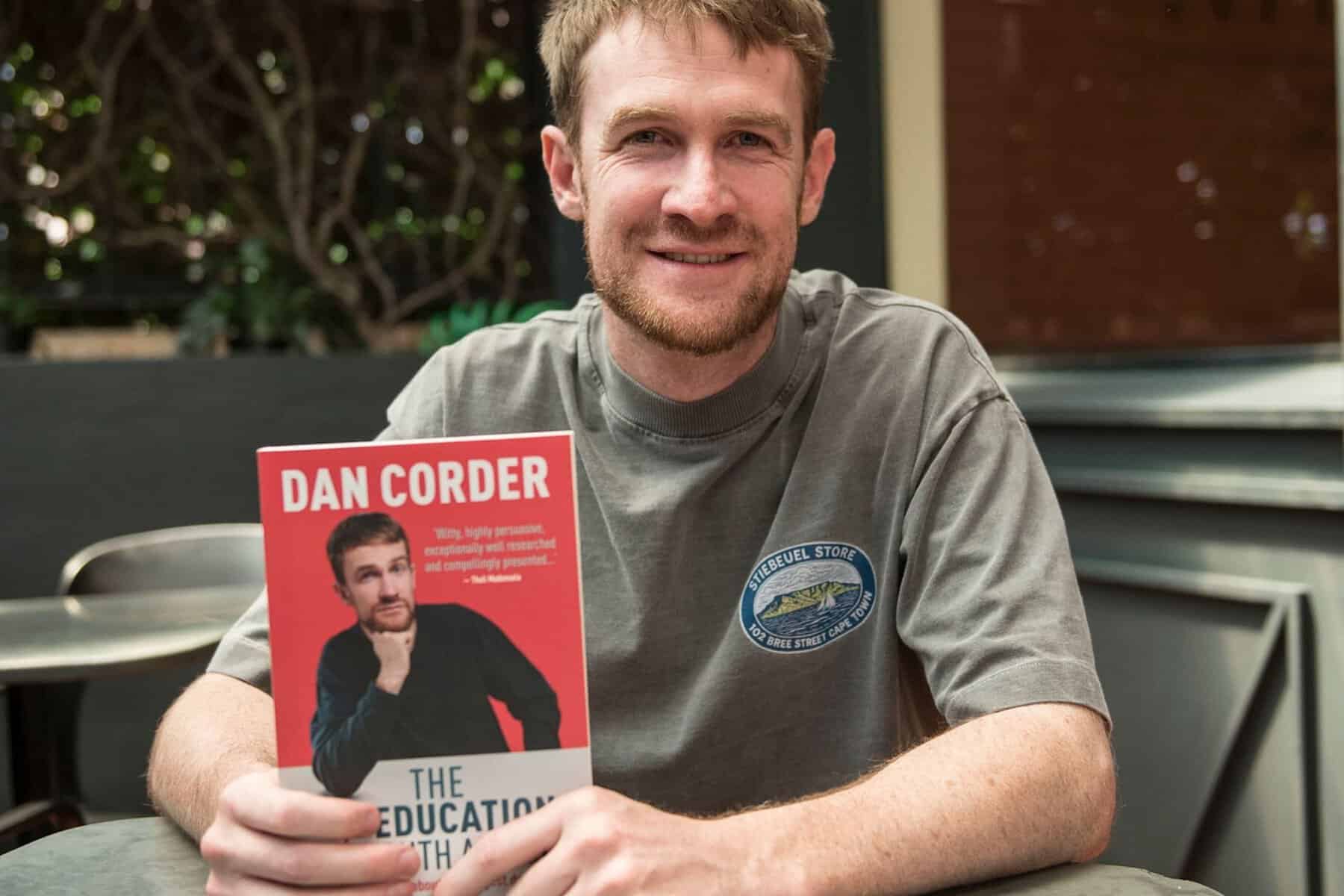
1. For anyone who has followed South African public life over the past decade, the feeling is unmistakable: the truth has become negotiable. A politician once conceded at a dinner party that the truth comprises 50% reality and the balance is whatever is made up for public consumption. That anecdote, recounted by Dan Corder in his new book The Miseducation of South Africa, captures a country where misinformation, conspiracy theories and political manipulation have become deeply embedded in the everyday textures of public life. Corder, a journalist, author, podcaster, comedian and broadcaster, does not claim to offer a manual for what South Africans should think, nor a set of conclusions everyone must accept. Instead, he argues, the country needs a collective wake-up call. His book is a challenge to read more, question more, and become better equipped to navigate a media landscape where the difference between fact and fiction is increasingly difficult to discern. The timing could not be more urgent. Social media, fake news and AI-generated fakes have made it easier than ever for those in the spotlight to get away with more, while voters seem comparatively meek in their collective demands for transparency and accountable governance. Misinformation is everywhere, and disinformation follows hot on its heels. Corder’s central warning is simple but uncomfortable: South Africans are vulnerable, not because they are gullible in some superficial sense, but because the country’s history and social conditions have created fertile ground for those who wish to bend reality for their own purposes.
2. Corder frames South Africa’s susceptibility as a structural problem rather than a case of naïve internet users being fooled by nonsense. “South Africa is one of the most vulnerable countries in the whole world to disinformation and misinformation,” he said. “We are a people divided by history, as well as in the present in terms of class and wealth, employment, education access and language.” Those divisions are not incidental. They mean millions of citizens do not enjoy equal access to high-quality information, and millions more speak languages that do not have built-out media ecosystems with a strong array of reliable publications that could be trusted to tell the truth. When the media landscape does not serve communities effectively, misinformation rushes in to fill the gap. But Corder goes further, arguing that South Africans are prone to conspiracy theories for a deeply historical reason. “We are built to think, ‘Oh no, but there’s something going on here.’ Because our history has been dominated by that being true,” he said. This is a crucial insight. Apartheid South Africa was a regime whose entire existence depended on state deception, fabricated narratives and the violent suppression of truth. It is rational, in some ways, for a people shaped by such a history to believe that powerful actors are lying. The problem is that this deeply ingrained wariness has become a generalised suspicion. It fuels the belief that every official story is a cover-up, every crisis is manufactured, and every leader is hiding something sinister. That outlook, while understandable, makes South Africans easy prey for those who want to sell a story. Corder’s point is not that people should become naive. It is that they should learn how to test claims, evaluate sources and think critically, rather than simply assuming that the most dramatic explanation is the correct one.
3. The mechanics of modern misinformation make the problem worse. Corder reminds us that the most effective lies are not complete fabrications. They are built on a small nugget of truth, carefully wrapped in falsehoods, and then amplified through social media until the distinction between the kernel of reality and the invented surrounding narrative becomes impossible to maintain. The politician’s dinner-party confession about the 50% formula is exactly the kind of partial truth that makes disinformation so sticky. Once a citizen accepts that one part of a story is accurate, the entire tale is swallowed. In South Africa, this dynamic has become a recurring pattern in politics. Misinformation can be weaponised with devastating effectiveness, especially during election campaigns. “The more that South Africans are vulnerable to disinformation and misinformation, the easier they are to mislead about political opponents or whoever is trying to appeal to them to vote for them,” Corder said. The result is a political culture in which voters are encouraged to see their rivals not as fellow South Africans with different ideas, but as enemies to be defeated at any cost. Social media provides the perfect vehicle for this manipulation. Algorithms reward outrage, engagement and shareability, not accuracy. AI fakes add yet another layer of complexity. A convincing video of a politician saying something they never said can circulate for days before it is debunked, and even then, the emotional impact lingers. The country’s history, its inequalities, its language barriers and its information ecosystem combine to create a uniquely dangerous environment where the truth is not just contested, but actively and strategically demolished.
4. The political consequences of this dynamic extend well beyond electioneering. Corder argues that misinformation has a profound effect on how South Africans view accountability and what they expect from politicians once power has been won. “I think South Africa has a culture of not being demanding enough of our politicians,” he said. “Our politicians work for us; this is literally their job, and we do not hold them accountable enough.” That lack of accountability is not accidental. It is sustained by the endless distractions of a hyper-partisan information environment. While South Africa’s social media users may be noisy, angry and permanently arguing with one another, that noise does not necessarily translate into collective pressure for better governance. On the contrary, it can dissipate energy that might otherwise be channelled into demanding that public officials deliver on their promises. “One of the effects of misinformation is to divide a populace so they can less effectively unite to demand political change,” Corder said. People become so consumed with fighting one another over competing narratives that the responsibility of the leaders becomes a sideshow. The road that is never fixed, the power that is never kept on, the public money that is stolen: all of this fades into the background while citizens direct their outrage at one another. In that sense, disinformation is not merely falsehood. It is a strategy of governance. Those who benefit from the status quo have every reason to encourage confusion, distraction and division, because a divided public cannot easily hold its servants to account. Corder’s book is therefore not just an examination of why South Africans believe nonsense. It is an argument that misinformation has become a structural barrier to political progress.
5. Yet The Miseducation of South Africa is not a polemical attempt to replace one version of reality with another. Corder is explicit that he does not want readers to simply agree with everything he says. “I don’t want somebody reading the book to just agree with everything I said,” he said. “I want someone who has read the book to think, ‘now I need to put into practice a more informed life.’” That is the point. The book is intended to encourage citizens to become more curious, to read more, to inquire more, and to be less passive consumers of whatever content happens to land in front of them. The goal is not certainty but competence. Corder wants South Africans to be able to think for themselves, not to be told what to think by politicians, media personalities or even authors. This is a subtle but important distinction. It recognises that the solution to misinformation is not a single truth forcefully repeated, but a more critical and questioning citizenry. In a society where distrust is high and the information landscape is polluted, the only durable defence is the ability to evaluate evidence, understand motives and follow the money. That requires a kind of intellectual confidence that many South Africans, especially those who have been poorly served by underfunded education systems, have never been encouraged to develop. Corder’s book is an attempt to help build that confidence. It is a call for people to stop outsourcing their reality-testing to social media influencers, talk-show hosts or party spokespeople. Instead, citizens need to become more comfortable with complexity, more willing to hold two contradictory ideas in their heads, and more determined to find out what is actually going on before taking sides.
6. In the end, The Miseducation of South Africa is a warning and a remedy at the same time. It warns that South Africa is dangerously exposed to the forces of misinformation at exactly the moment when those forces are becoming more sophisticated. It also warns that the country’s history of division and inequality, combined with the powerful amplification tools of social media and AI, creates a perfect storm. But the book’s deeper message is hopeful. If South Africans can learn to be more curious, more demanding and more attentive, they become harder to manipulate. They become better equipped to hold politicians accountable, to see through the partial truths that are wrapped around so many lies, and to unite around demands for real change instead of fighting one another over stories that have been deliberately engineered to divide them. Corder is not offering a list of facts for people to memorise. He is offering a method of engagement. “The takeout is, I should read more. I should inquire more. I should be more curious,” he said. “It’ll lead to me having a more fulfilled and satisfying life. And allow me to be a more effective participant in South Africa as a social project.” That is a challenge for every South African. The lies will not stop coming. The technology will not become less powerful. But a population that has learned to question, to verify and to demand evidence is far more difficult to deceive. In a country where the truth has so often been used as a weapon against ordinary people, learning to reclaim that truth, not by replacing one story with another, but by demanding better answers from everyone who asks for public trust, may be the most important political act of all.


