


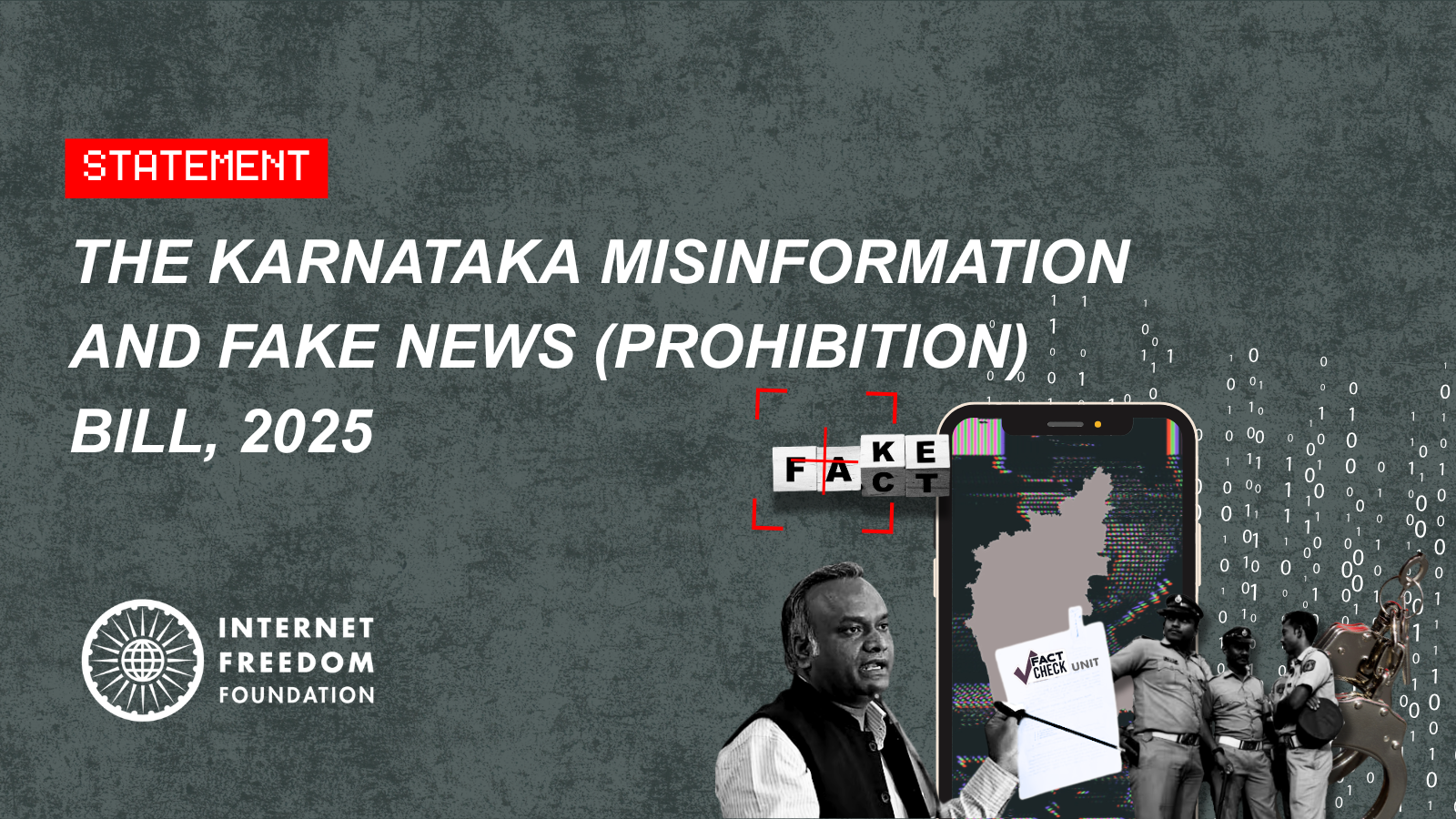
Karnataka’s Proposed "Fake News" Bill Sparks Censorship Concerns: A Threat to Free Speech and Democratic Discourse
Bangalore, India – The Internet Freedom Foundation (IFF), a prominent digital rights advocacy group, has issued a stern warning against the Karnataka government’s proposed "Misinformation and Fake News (Prohibition) Bill, 2025." Leaked details of the draft legislation, reported by the Times of India and the Deccan Herald, have ignited widespread concern over potential threats to freedom of expression and the democratic right to dissent. The bill proposes draconian penalties, including up to seven years imprisonment and hefty fines of ₹10 lakh, for disseminating information deemed "fake news." Critics argue that this vaguely worded provision, coupled with a government-controlled authority empowered to determine truth and falsehood, opens the door to selective enforcement and the suppression of legitimate criticism. The IFF emphasizes the crucial need for transparency and public consultation before such a consequential bill is tabled in the Assembly.
The core issue lies in the bill’s broad and ambiguous definition of "fake news," which fails to provide clear guidelines for distinguishing between genuine misinformation and protected forms of expression, such as satire, opinion, or critical analysis. This lack of clarity creates a chilling effect on free speech, as individuals and media organizations may self-censor to avoid potential prosecution. The IFF draws parallels to the now-defunct Section 66A of the IT Act, which was struck down by the Supreme Court for its vague language and potential for misuse. Similarly, recent legal challenges against the Union Government’s "fact-checking unit" established under the 2023 IT Rules underscore the constitutional dangers of granting the executive branch unchecked power to define and punish “misinformation.” The Bombay High Court, in its judgment, highlighted the inherent conflict of interest in allowing the government to act as the arbiter of truth, particularly concerning matters of public interest.
The IFF strongly advocates for a democratic and rights-respecting approach to combatting misinformation. Instead of resorting to criminal penalties, the organization urges the Karnataka government to focus on less restrictive measures, such as promoting media literacy, encouraging fact-checking initiatives, and establishing transparent mechanisms for corrections and platform due process. These approaches would empower citizens to critically evaluate information and hold purveyors of misinformation accountable without sacrificing fundamental freedoms. The IFF also emphasizes the crucial role of public participation in shaping legislation that impacts fundamental rights. The government’s failure to publish the full draft bill and solicit public feedback before its introduction in the Assembly raises serious concerns about transparency and democratic process. The IFF calls for a comprehensive public consultation, allowing citizens, media organizations, and experts to review the proposed legislation and offer valuable input.
The Karnataka government’s proposed "fake news" bill has sparked a broader debate about the balance between combating misinformation and protecting freedom of expression in the digital age. The bill’s critics argue that heavy-handed criminalization is not only ineffective but also counterproductive. It risks creating a climate of fear and self-censorship, hindering the free flow of information and undermining the very foundations of a democratic society. They emphasize that the best defense against misinformation is not censorship but rather an informed and empowered citizenry capable of critical thinking and discerning truth from falsehood.
Furthermore, the opaque nature of the draft bill’s development process raises concerns about the government’s motivations. Critics question whether the legislation is genuinely aimed at combatting misinformation or whether it serves as a pretext to suppress dissent and control the narrative. The lack of public consultation fuels speculation and undermines public trust. The IFF calls on the Karnataka government to demonstrate its commitment to transparency and democratic principles by immediately releasing the full draft bill and inviting public scrutiny.
In conclusion, the IFF’s cautionary message highlights the crucial importance of safeguarding freedom of expression in the face of growing concerns about misinformation. While addressing the spread of false information is undoubtedly a legitimate concern, the proposed Karnataka Fake News Bill’s reliance on criminal penalties and government-controlled oversight poses a grave threat to democratic values. The IFF’s call for a more nuanced approach, prioritizing transparency, public participation, and rights-respecting measures, offers a path towards a more effective and democratic solution to the challenge of misinformation. The Karnataka government must heed these concerns and reconsider its approach to ensure that its efforts to combat "fake news" do not come at the cost of fundamental freedoms. The future of free speech and democratic discourse in Karnataka hangs in the balance.