


Ceuta Border Crisis: Spain’s Prime Minister Accuses Israel and Russia of Spreading Disinformation
A Political Firestorm Erupts Over Migration Crisis
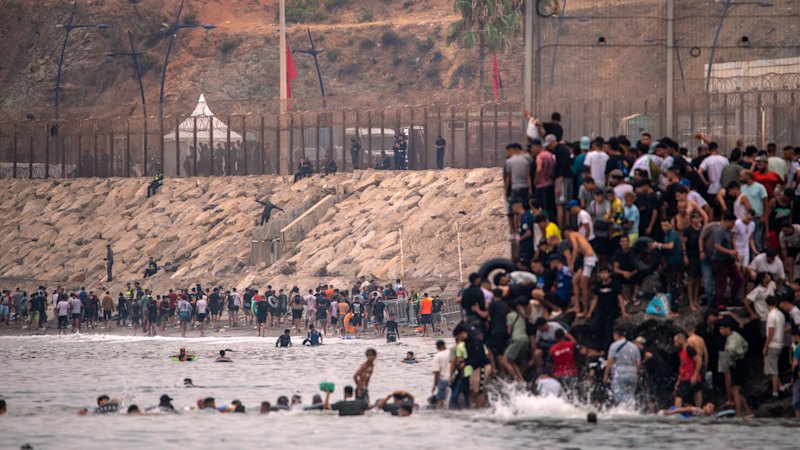
Spanish Prime Minister Pedro Sanchez has ignited a diplomatic firestorm by blaming networks in Israel and Russia for spreading online misinformation that allegedly triggered a massive migration crisis at the Ceuta border crossing four weeks ago. In a series of explosive claims made during an interview with Spanish broadcaster Cadena SER, Sanchez asserted that false information about asylum policies and border control measures had been deliberately circulated to destabilize Spain and divide European leaders. The crisis, which saw at least 72,000 migrants attempt to cross from Morocco into the Spanish enclave of Ceuta, has become a flashpoint for broader tensions over migration policies, European border security, and international relations. The Spanish leader specifically pointed to online posts that distorted a recent Supreme Court ruling, creating a false belief among migrants that entering Ceuta would automatically grant them asylum rights in mainland Spain. This misinformation, according to Sanchez, was weaponized by “far-right movements” and foreign actors to attack his government and exploit one of Europe’s most divisive political issues.
The Escalating Diplomatic Confrontation
The immediate response from Israeli Foreign Minister Gideon Sa’ar was swift and condemnatory, with the Israeli official accusing Sanchez of “lying shamelessly” to deflect attention from his own failures in managing Spain’s migration policies. This sharp exchange has escalated an already tense relationship between the two nations, particularly given Sanchez’s vocal criticism of Israel’s military operations in Gaza and Lebanon. The Spanish Prime Minister has positioned himself as one of Europe’s most outspoken critics of Israeli Prime Minister Benjamin Netanyahu, having officially recognized Palestine as a state in May 2024 despite strong objections from Jerusalem. Spain further angered Israel by becoming the first European Union member state to support South Africa’s genocide case against Israel at the International Court of Justice. These accumulated grievances have created a deeply adversarial dynamic between the two governments, with the Ceuta crisis now providing another battleground for their ongoing political warfare. The dispute highlights how migration issues have become entangled with broader geopolitical conflicts and diplomatic tensions.
The Ceuta Crisis: Facts and Circumstances
The dramatic events of July 30 saw thousands of migrants storm through border checkpoints between Morocco and Ceuta, creating a humanitarian and security emergency for Spanish authorities. The Spanish enclave, located on the northern coast of Africa and surrounded by Moroccan territory, suddenly found itself overwhelmed by a massive influx of people seeking entry into European territory. Many migrants reportedly believed they would be granted asylum in mainland Spain due to a June Supreme Court ruling that prohibited the summary deportation of asylum seekers without proper due process. While Spanish police ultimately managed to force most migrants back to Morocco, approximately 5,000 individuals remained in Ceuta, creating a continuing humanitarian challenge as local residents struggle to provide food, water, and basic services to the unexpected population. The crisis has strained resources and tested the patience of Ceuta’s residents, many of whom oppose having the migrants remain in their city. The situation has also exposed the vulnerability of Spain’s North African territories and the broader challenges facing European border security in the Mediterranean region.
Sanchez’s Claims and the Response from Intelligence Services
In defending his position, Sanchez made the significant assertion that no intelligence agency with which the Spanish government regularly collaborates had raised any concerns about Moroccan involvement in sparking the crisis. This included Spain’s own National Intelligence Centre, suggesting that the government had conducted thorough investigations before dismissing theories that Morocco had deliberately encouraged migrants to cross as a political pressure tactic. The Spanish leader rejected speculation that Morocco was seeking to leverage the migration crisis in its long-standing territorial dispute over Ceuta, which it claims as sovereign territory. Instead, Sanchez insisted the crisis was manufactured through social media disinformation that distorted the Supreme Court ruling and falsely suggested Spanish authorities would be powerless to return migrants to Morocco. However, his claims have been met with skepticism from various quarters, with critics questioning how social media misinformation alone could have triggered such a massive and coordinated migration movement. The controversy has drawn attention to the growing role of disinformation in shaping migration patterns and political narratives across Europe.
Europe’s Migration Tensions and Spain’s Controversial Policies
The Ceuta crisis has highlighted the deep divisions within the European Union over migration policy and border control measures. Italy has chosen to extend its suspension of Schengen Agreement rules with Spain for another 15 days despite protests from Madrid, reflecting growing concerns about uncontrolled migration across European borders. The Schengen pact, which allows free movement between 29 member states, has come under increasing strain as countries seek to protect their borders while maintaining the principle of open travel within Europe. Sanchez has also faced criticism from other European leaders over his decision to grant residency status to 500,000 undocumented migrants, a policy that could potentially allow these individuals to travel freely to neighboring countries under EU rules. The scale of this amnesty program is substantial, with more than one million undocumented migrants already having applied for residential status in Spain, although the government has yet to determine how many applications will be approved. This approach has made Spain a target for criticism from those who argue it is too lenient on migration and from those who believe it lacks adequate border control measures.
A Larger Geopolitical Battle Unfolds
The Ceuta crisis has become yet another front in the broader geopolitical struggle between Europe and external actors seeking to influence political outcomes on the continent. Sanchez’s accusations against Russia and Israel reflect growing concerns about foreign interference in European affairs through disinformation campaigns and social media manipulation. The Spanish Prime Minister maintains that the “far-right movement” capitalized on the migration crisis to attack his government and divide European leaders on one of the continent’s most sensitive issues. The briefing from Israel’s Foreign Minister, who dismissed Sanchez’s claims as “shameless lies” designed to distract from domestic failures, demonstrates how migration policy has become intertwined with international conflicts, particularly the ongoing Israel-Palestine situation. The crisis has also exposed the vulnerability of European border territories to sudden mass movements of people and the difficulty of managing such events in an era of viral misinformation and political polarization. As Spain continues to grapple with the aftermath of the Ceuta crisis economic pressures, humanitarian concerns, and political recriminations are likely to persist.