









News Analysis: Confusion, Contradiction, and a Crew’s Crisis — The Strange Public Messaging Around the USS Abraham Lincoln
The months-long deployment of the USS Abraham Lincoln has become a public-relations battlefield, and critics say the official narrative from U.S. Central Command and Navy leadership is riddled with contradictions that resemble disinformation more than straightforward military communication. The aircraft carrier has been at sea for more than 260 days, far beyond original expectations, and families of the crew have grown increasingly vocal about the absence of a return date. In early August, Acting Navy Secretary Hung Cao stood before roughly 200 family members in San Diego and declared that relief was on the way: the USS Theodore Roosevelt strike group was preparing to relieve the Lincoln. Within days, however, the Wall Street Journal and Stars and Stripes reported that the USS George Washington had been headed to the Middle East instead, a rotation officials called long-planned. The inconsistency did not end there. When President Donald Trump was asked on August 14, on the tarmac, whether families of the crew were concerned, he answered, “No, they’re not.” Asked whether eight and a half months at sea was too long, he said, “No, no, no. Not nearly long enough.” He then boarded Catering Container One, a phrase that has become part of the story’s strange texture. The effect, according to critics, is a command climate in which no one can give a straight answer: one official promises a relief ship, another sends a different one, and the President dismisses the very idea of family distress. The question that haunts the episode is simple: who is actually leading?
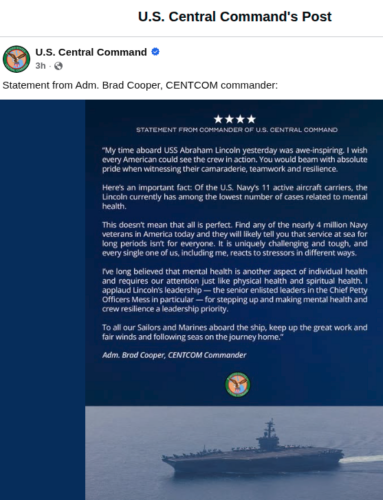
The commander of U.S. Central Command, General Michael “Erik” Kurilla, visited the Lincoln at sea and met with sailors and Marines for the second time this year. His previous visit, in February, included U.S. Special Envoy for Peace Missions Steve Witkoff and Jared Kushner, a detail that drew notice because of the title “Special Envoy for Peace Missions” during what critics call an endless war. During the latest visit, Kurilla addressed the entire ship’s company, thanking them for their “tremendous dedication and courage.” But the message contained no return date, no acknowledgment of the August 3 incident in which a sailor went overboard in what the Navy itself classified as a mental health episode, and no explanation for why the deployment had been extended from an original expectation that it would end in May. Instead, the praise redirected pressure onto the lowest ranks. The acting Navy secretary and senior leaders applauded the Chief Petty Officers Mess for “stepping up” to absorb the strain, effectively turning fleet-level planning failures into a problem that senior enlisted personnel must manage through “resilience.” Critics note that the phrase “journey home” is meaningless without an ETA, and that no amount of praise for the crew can conceal the fact that the deployment’s planning failures are the primary stressor. By celebrating the crew’s endurance, the leadership avoids confronting its own role in creating the conditions that require endurance in the first place.
The contradictions around relief have become the defining feature of the deployment’s final months. Acting Navy Secretary Cao’s August 6 promise to families was unambiguous: the Theodore Roosevelt would relieve the Lincoln. But within a week, the story had shifted, and the George Washington was named as the replacement, with officials claiming the decision had been long-planned. If that were true, critics ask, why would Cao have told families a different ship was preparing to relieve them? The President’s comments on August 14 did nothing to clarify matters. Asked about crew welfare, he said families were not concerned. Asked about the length of the deployment, he said it was not nearly long enough. The disconnect between the President’s remarks and the visible anguish of the families gathered in San Diego was stark. The tarmac exchange, captured on video, showed a commander-in-chief seemingly indifferent to the human cost of an open-ended naval commitment. The phrase “another, very similar, ship” became a symbol of the administration’s approach: a vague, almost surreal substitution of one vessel for another, as if the sailors on board were interchangeable parts. For the families, the lack of a clear timeline has transformed anxiety into anger. The August 6 meeting in San Diego, where Cao faced roughly 200 family members, was not a routine information session; it was a confrontation. The families demanded answers, and the answers they received did not hold up for a week. The question of who is actually in charge, and who can be trusted to tell the truth, hangs over the entire episode.
Most disturbing, however, is the Navy’s use of mental health statistics to rebut concerns about the crew’s well-being. In a statement responding to reports of increased suicidal ideation and mental health emergencies aboard the Lincoln, CENTCOM cited a low number of mental health cases as evidence of crew wellness. But the metric inversion is not subtle. On a ship where a sailor went overboard on August 3 and required transfer off the vessel for care, and where Military Times reported that multiple sailors had attempted to go overboard, the Navy declining to provide a precise number, a low caseload measures barriers to reporting, not health. Sailors in crisis do not always seek help because they fear the professional consequences, loss of clearance, removal from the ship, stigma. If the culture punishes those who speak up, the official count will always look better than the reality. Worse, evacuating sailors in crisis off the ship lowers the on-board count as a matter of arithmetic, whatever the intent. Every time a situation becomes serious enough to require a medevac, the “health” statistic improves. The comparison is rigged in another way as well. The Lincoln is the only carrier stuck on a 260-plus-day deployment. The other ten carriers in the U.S. fleet are largely in port or in maintenance, where crews have shore access to care and every incentive to use it. Comparing the raw number of cases on the Lincoln to cases on other ships is meaningless without rates, timelines, and control for deployment status. And the phrase “among the lowest” is anti-plan speak: no number, no source, no timeframe. It is unverifiable language from a force that lives and dies by verification.
The command’s response to outside reporting has only deepened the distrust. On August 14, CENTCOM issued a statement that dismissed what it called “rampant misreporting” about the Lincoln’s deployment and announced an 84.4% reenlistment rate, apparently to prove the crew was thriving. But in making that argument, the command lumped together two very different kinds of claims. The first was a report from Iran’s Tasnim News Agency claiming seven sailors had died on the Lincoln, a story based on a single anonymous source, with no corroboration, which appeared to be an enemy information operation targeting the exhausted American crew. The second was reporting from Military Times and Stars and Stripes about increased suicidal ideation and mental health emergencies, based on interviews with sailors and families, and confirmed by the Navy’s own acknowledgment of the August 3 overboard rescue. By placing both reports under the same “baseless claims” label, CENTCOM effectively declared the American military press to be enemy propaganda. The overboard incident was never denied; the command confirmed the rescue inside the same statement, offering confirmation as a rebuttal. This is a category error of the highest order. An adversarial foreign outlet known for disinformation is not the same as a reputable American military news organization. Treating them identically erases the distinction between fact and fabrication and suggests the command is more interested in managing the message than in being honest about the crew’s condition. Critics note that a four-star commander should not be shipping mental health statistics at all; that is a public relations campaign, not a leadership communication. The PR campaign appears to have been ratcheted up after the San Diego family meeting, when Cao was confronted over conditions and the absence of a return date. The result was a misfire.
There is a historical echo that observers have begun to raise. During the Second World War, British intelligence noticed something curious about German propaganda: when the Allies admitted defeats openly, Nazi listeners concluded that the Allies must be extremely confident, convinced of their eventual victory. Open admission of setbacks was a sign of strength. Failure to admit failures, by contrast, was a sign of weakness. The analogy to the Lincoln affair is imperfect but instructive. CENTCOM’s refusal to acknowledge the mental health crisis, its dismissal of credible American reporting as “baseless,” its contradictory relief schedules, and its emphasis on reenlistment rates as proof of well-being all point not to confidence but to fragility. The command cannot keep its categories straight in a single paragraph: calling the enemy’s lie a lie is correct, but calling American reporting the same thing is not. In this fog of contradictions, the crew and their families are left without clarity. The President hiding from questions on a tarmac, the acting Navy secretary promising one ship and delivering another, the commanders citing low case counts while evacuating sailors in crisis, all of it adds up to a portrait of leadership that has lost its moral authority. The Navy’s own records show a sailor went overboard on August 3, and Military Times reports at least several more attempts. The numbers may be low, but the message they send is not about wellness; it is about silence. The line that resonates most from the original analysis is the final one, a bitter, half-rhetorical question: “Who would have predicted for 2026 a president hiding from Iranian missiles in a food box, while calling American military families the liars.” It is a strange image, and an even stranger reality. The Lincoln’s sailors deserve a return date, a reliable relief plan, and leaders who speak truthfully about their sacrifices. Instead, they are receiving talking points that contradict each other within days, statistics that obscure more than they reveal, and public reassurance from officials who appear unwilling to confront the actual conditions aboard the ship. The Central Command message may have been intended to reassure, but in the absence of honesty, it has accomplished the opposite: it has convinced many observers that the deployment has become an unmanageable exercise in endurance, and that the people in charge are more worried about their own credibility than about the lives of the crew.


