


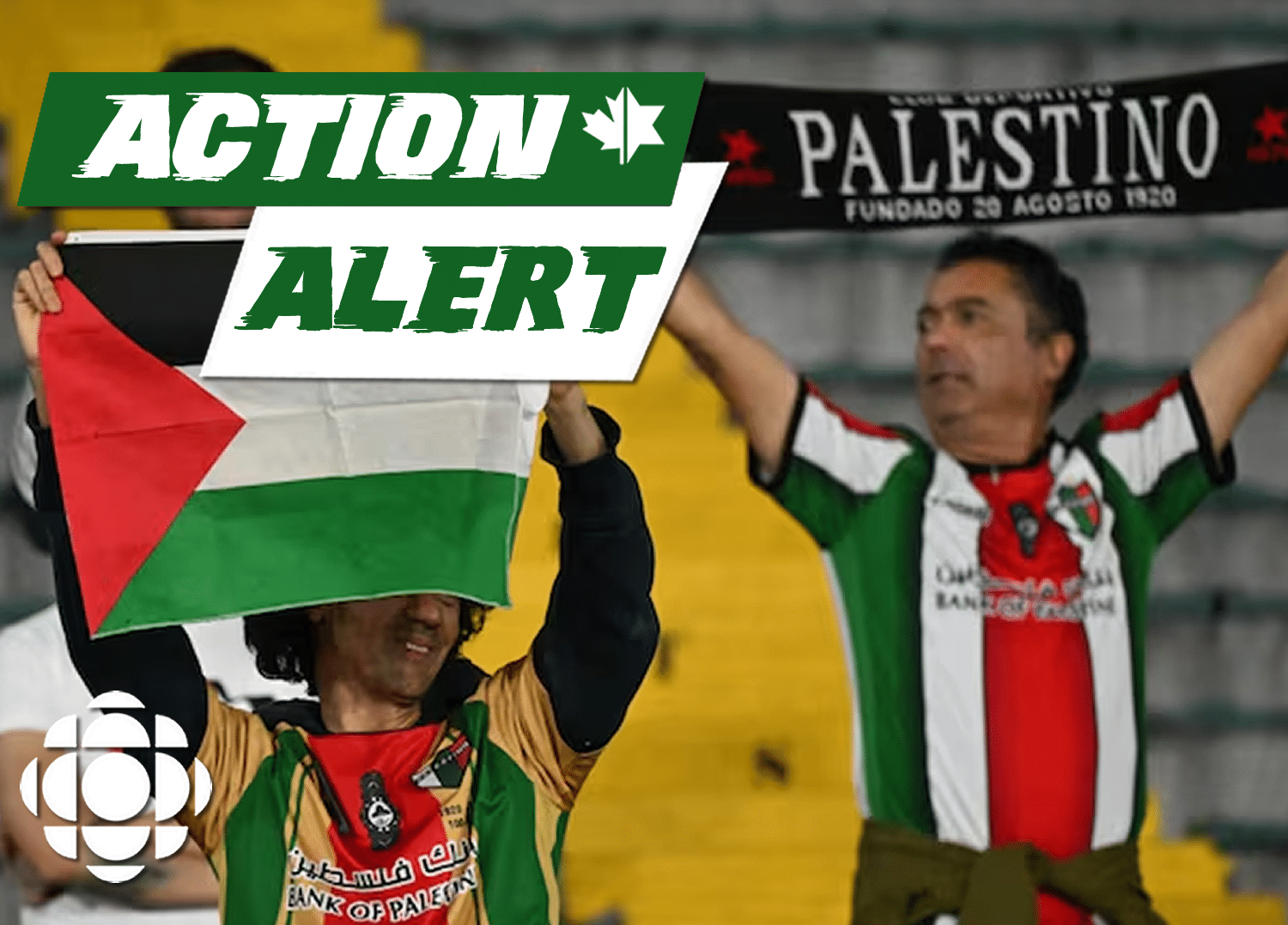
A Biased Narrative Masquerading as Sports Journalism: CBC’s Rachini and the Story of Club Deportivo Palestino
A recent CBC News article by Mouhamad Rachini, titled "The Chilean soccer team that became a symbol of Palestinian nationalism," has drawn criticism for its biased portrayal of Club Deportivo Palestino, a Chilean soccer team closely associated with Palestinian identity. While ostensibly a piece about sports and culture, the article promotes a one-sided narrative of the Israeli-Palestinian conflict riddled with historical inaccuracies and omissions, raising concerns about journalistic objectivity and the politicization of sports. Rachini, whose previous reporting and social media activity have revealed strong anti-Israel sentiments, frames the team’s existence as a symbol of Palestinian resistance and survival, overlooking crucial historical context and furthering a revisionist account of the conflict.
One of the most glaring issues is the article’s depiction of a "pre-1948 Palestine," suggesting a sovereign Palestinian state existed before Israel’s independence. This claim ignores the historical reality of the British Mandate for Palestine and centuries of Ottoman rule before that. No independent Palestinian state existed in the modern era prior to 1948. The use of maps depicting a unified "Palestine" in place of Israel reinforces a politically motivated narrative that denies Israel’s historical and legal legitimacy. These visual representations contribute to misinformation and hinder productive dialogue by perpetuating a false historical narrative. The article’s implication that Palestinian national identity has existed for centuries is equally misleading. While cultural affinities existed, a distinct Palestinian national identity, as understood in modern political terms, emerged more concretely in the mid-20th century, particularly through the PLO.
The article’s portrayal of the 1948 war is also skewed. Rachini links the creation of Israel directly to Palestinian displacement, referring to the "Nakba" (catastrophe) without acknowledging the context surrounding Israel’s declaration of independence in accordance with the UN Partition Plan. The article fails to mention the immediate invasion by five Arab armies aimed at destroying the newly formed state. This omission creates the false impression that Israel’s existence stemmed solely from the displacement of Palestinians, ignoring the legitimate international recognition of its founding and the subsequent war initiated by Arab states. Furthermore, the article uses the term “Nakba” uncritically. This term, laden with political baggage, frames the events solely as a Palestinian catastrophe while denying Israel’s right to exist. The article omits crucial details, such as the calls by Arab leaders for civilians to evacuate temporarily, anticipating a swift Arab victory. This historical context complicates the narrative of forced displacement often associated with the Nakba.
Rachini’s framing of Club Deportivo Palestino’s symbolism further reinforces the article’s biased perspective. The team’s emblem, featuring the aforementioned map of "pre-1948 Palestine", is presented as an expression of solidarity, without acknowledging its problematic implications. The article celebrates the club’s politicization, ignoring the potential for such activism within the sporting arena to be divisive. Sports, ideally, should transcend political divides. By presenting the club’s political stance as unequivocally positive, the article effectively endorses a specific political narrative within a context that should remain neutral. This blurs the line between sports and political advocacy, potentially alienating fans who seek refuge from political discourse in the world of sports.
Furthermore, the article draws parallels between the experiences of Palestinians in Gaza and the Chilean diaspora, suggesting the club provides "relief" and demonstrates Palestinian survival. This simplistic framing equates cultural affinity with modern political nationalism and ignores the complex historical evolution of Palestinian identity. While celebrating diaspora pride is legitimate, the article’s narrative conflates it with a political stance, potentially pressuring individuals within the diaspora to conform to a specific political viewpoint.
Rachini’s article raises serious concerns about journalistic integrity. The selective presentation of historical facts, the use of loaded language, and the omission of crucial context all contribute to a biased and inaccurate portrayal of the Israeli-Palestinian conflict. This article is not an isolated incident; Rachini’s previous work, including an article on anti-Israel protests among European soccer fans, displays a similar pattern of biased reporting. His public expression of anti-Israel views on social media raises further questions about his ability to cover this complex issue objectively. The CBC’s continued allowance of Rachini to report on the Israeli-Palestinian conflict, despite these evident biases, is troubling.
The article is ultimately an example of advocacy journalism disguised as cultural commentary. By presenting a highly selective and politicized narrative, it fails to provide readers with a balanced understanding of the complex issues at play. This type of reporting not only misinforms the public but also contributes to the polarization of an already sensitive and deeply contested historical narrative. The CBC’s editorial oversight in this instance is questionable, and the network’s credibility is at stake if such biased reporting continues unchecked. The incident highlights the importance of journalistic ethics and the need for media outlets to ensure balanced and objective coverage, especially on sensitive topics like the Israeli-Palestinian conflict.