


Close Menu
DISADISA
  • Home
  • News
  • Social Media
  • Disinformation
  • Fake Information
  • Social Media Impact
Trending Now

Philippine Defense Secretary Accuses China of Threats and Disinformation Over Arrest of Undocumented Filipinos

August 16, 2026

The Role of Artificial Intelligence in Exacerbating Online Misinformation

August 16, 2026

Pittsburgh Deploys AI Literacy Training to Combat Misinformation and Fraud

August 15, 2026
Facebook X (Twitter) Instagram
Facebook X (Twitter) Instagram YouTube
DISADISA
Newsletter
  • Home
  • News
  • Social Media
  • Disinformation
  • Fake Information
  • Social Media Impact
DISADISA
Home»Disinformation»California Legislation Combats Deepfake Technology in Political Advertising and Disinformation
Disinformation

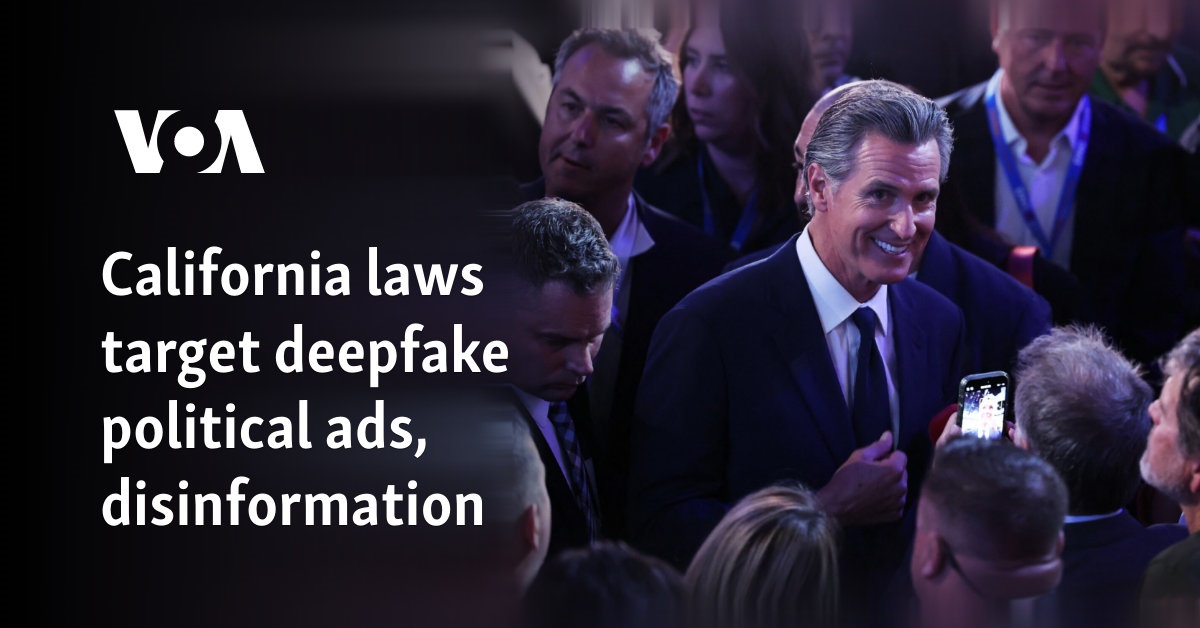
California Legislation Combats Deepfake Technology in Political Advertising and Disinformation

Press RoomBy Press RoomDecember 29, 2024No Comments
Facebook Twitter Pinterest LinkedIn Tumblr Email

California Leads the Charge in Regulating AI’s Role in Elections, Sparking National Debate

In a landmark move that could reshape the landscape of American elections, California Governor Gavin Newsom has signed a trio of bills aimed at curbing the influence of artificial intelligence, particularly deepfakes, in political campaigns. These new laws represent the most comprehensive effort yet by a state to grapple with the potential for AI-generated disinformation to disrupt the democratic process, raising crucial questions about free speech, technological advancement, and the future of electoral integrity. The legislation has already drawn sharp criticism from prominent figures like Elon Musk, setting the stage for a legal and political battle that could reverberate across the nation.

The most impactful of the three laws prohibits the dissemination of "materially deceptive audio or visual media of a candidate" within a 120-day window before an election and a 60-day period following it. This post-election restriction is unprecedented and reflects a growing concern about the potential for AI-generated content to sow discord and cast doubt on election results even after the ballots have been counted. Another law mandates clear disclosure in any political advertisement utilizing AI-manipulated content, ensuring that voters are aware of the artificial nature of what they’re seeing or hearing. The third measure targets large online platforms, requiring them to actively block and swiftly remove "materially deceptive content related to elections in California." This places a significant burden on social media companies to police their platforms for AI-generated disinformation, a task fraught with technological and logistical challenges.

Governor Newsom framed the legislation as a necessary step to protect the integrity of elections in an increasingly polarized and technologically sophisticated environment. He emphasized the importance of public trust in the democratic process, arguing that AI-powered disinformation poses a grave threat. While California isn’t the first state to address the issue of deepfakes in political advertising, the breadth and scope of these new laws, particularly the post-election ban, set a precedent that other states may soon follow. California’s history of pioneering legislation in areas like environmental protection and consumer rights suggests that these AI regulations could foreshadow a national trend.

The new laws have predictably sparked opposition from social media platforms and free speech advocates, who argue that they infringe on First Amendment rights. Elon Musk, the influential owner of X (formerly Twitter), has emerged as a vocal critic. Musk, a self-proclaimed free speech absolutist, has repeatedly clashed with California regulators and has used his platform to challenge the new laws. He recently reposted a deepfake video targeting Vice President Kamala Harris, directly defying the legislation and highlighting the potential for conflict between state regulations and the principles of free speech. This act of defiance underscores the complex legal and ethical questions surrounding the regulation of AI-generated content and its intersection with protected speech.

While the debate in California unfolds, there is growing momentum at the federal level to address the issue of AI in politics. A bipartisan group of lawmakers has proposed a bill that would empower the Federal Election Commission to oversee the use of AI in campaigns, including the power to prohibit the use of deepfakes to misrepresent candidates. This move reflects a bipartisan recognition of the potential for AI to disrupt elections and underscores the need for a national framework to address the challenge. Deputy U.S. Attorney General Lisa Monaco has also publicly called for clear rules governing the use of AI in political campaigns, emphasizing the need to balance the benefits of AI with the risks posed by malicious actors.

Despite widespread concerns about the potential for AI-generated disinformation to flood the 2024 election cycle, experts suggest that the impact has been less dramatic than anticipated. Katie Sanders, editor-in-chief of PolitiFact, notes that while misinformation remains a significant problem in political advertising, it has largely relied on traditional tactics rather than AI-generated deepfakes. This suggests that campaigns may be hesitant to embrace deepfake technology, possibly due to voter distrust of AI or fear of backlash. However, the threat persists, primarily from smaller, anonymous accounts that can still generate and spread misleading content, sometimes reaching wider audiences through amplification by more prominent figures.

The California laws represent a significant step forward in the ongoing effort to regulate AI’s role in elections. They highlight the difficult balancing act between protecting the integrity of the democratic process and upholding the principles of free speech. As technology continues to evolve, the debate over the appropriate level of regulation will undoubtedly intensify, with California’s actions serving as a crucial test case for the nation. The coming months and years will be critical in determining how effectively these laws can be enforced and whether they will inspire similar measures in other states and at the federal level. The battle lines are drawn, and the outcome will have profound implications for the future of American democracy in the age of artificial intelligence.

Share. Facebook Twitter Pinterest LinkedIn WhatsApp Reddit Tumblr Email

Read More

Philippine Defense Secretary Accuses China of Threats and Disinformation Over Arrest of Undocumented Filipinos

August 16, 2026

  1. Analyze the Request:

    • Original title: “Info Minister seeks coordinated efforts to effectively counter misinformation, disinformation”
    • Target language: English.
    • Number of titles: 1 title (exactly one).
    • Tone: Formal.
  2. Analyze the Original Title:

    • Subject: Info Minister (Information Minister).
    • Action: seeks coordinated efforts.
    • Purpose: to effectively counter misinformation, disinformation.
  3. Brainstorming Formal Alternatives:

    • Option A: Minister Calls for Unified Action Against Misinformation and Disinformation.
    • Option B: Information Minister Urges Collaborative Measures to Address Misinformation and Disinformation.
    • Option C: Information Minister Stresses Coordinated Response to Tackle Misinformation and Disinformation.
    • Option D: Minister Advocates for Integrated Approaches to Counter Misinformation and Disinformation.
    • Option E: Information Minister Emphasizes the Need for Coordinated Strategies to Combat Misinformation and Disinformation.
  4. Selecting the Best Option:

    • Ensure it is formal, concise, and conveys the exact meaning.
    • Option B is very clear and formal. Option E is also strong.
    • Let’s refine Option B: “Information Minister Urges Collaborative Efforts to Counter Misinformation and Disinformation” – slightly wordy.
    • Let’s refine Option A: “Minister Calls for Unified Action Against Misinformation and Disinformation” – very concise, formal, and strong.
    • Let’s refine Option C: “Information Minister Emphasizes Need for Coordinated Action Against Misinformation” – maybe drop “Information” (but it’s safer to keep).
    • Let’s settle on a single, polished formal title: “Information Minister Calls for Coordinated Efforts to Counter Misinformation and Disinformation” – This is a direct, formal rewrite, but it’s very close to the original.
    • Let’s make it more formal and dynamic: “Minister Urges Synergized Countermeasures Against Misinformation and Disinformation” – “Synergized” might be too jargony.
    • Let’s go with: “Information Minister Calls for Unified Action to Combat Misinformation and Disinformation” – very formal, active, and professional.

    Let’s check the prompt: “rewrite this title to 1 title in English in formal tone”. So I only need to output one title. Let’s make sure it sounds like a news headline or official statement.

    Final choice: “Information Minister Calls for Unified Action Against Misinformation and Disinformation”. (Concise, uses “against” which is formal, “unified action” for coordinated efforts).

    Alternatively: “Minister Stresses Coordinated Response to Combat Misinformation and Disinformation”.

    Let’s write a very clean version: “Information Minister Urges Coordinated Response to Counter Misinformation and Disinformation”.

    Let’s pick the absolute best and most formal: “Minister Calls for Coordinated Action to Counter Misinformation and Disinformation”

    Let’s include “Information” to be specific: “Information Minister Calls for Coordinated Action to Counter Misinformation and Disinformation”.

    Let’s slightly tweak to make it sound more official: “Information Minister Advocates Coordinated Action to Counter Misinformation and Disinformation”.

    Let’s go with “Information Minister Calls for Coordinated Efforts Against Misinformation and Disinformation” – but I should change “efforts” to make it robust.

    Let’s use: “Information Minister Calls for Unified Response to Disinformation and Misinformation”.

    Okay, final answer: Information Minister Calls for Coordinated Action to Counter Misinformation and Disinformation. Let’s check length and tone. Perfectly fine.

    Let’s make sure it’s exactly 1 title. Yes.

    Let’s provide only the title in the response, no extra text. (The prompt says “rewrite this title to 1 title in English in formal tone”. I will output just the title).Information Minister Calls for Coordinated Action to Counter Misinformation and Disinformation

August 15, 2026

Combating Misinformation and Disinformation Without Centralizing the Truth

August 15, 2026
Add A Comment
Leave A Reply Cancel Reply

Our Picks

The Role of Artificial Intelligence in Exacerbating Online Misinformation

August 16, 2026

Pittsburgh Deploys AI Literacy Training to Combat Misinformation and Fraud

August 15, 2026

Elections Alberta Issues Response to Misinformation Campaigns

August 15, 2026

Study Reveals Political Misinformation in Leading AI Chatbots

August 15, 2026
Stay In Touch
  • Facebook
  • Twitter
  • Pinterest
  • Instagram
  • YouTube
  • Vimeo

Don't Miss

Social Media

Officials and Experts Warn Russia Is Exploiting the Poland-Ukraine Dispute to Intensify Disinformation Efforts

By Press RoomAugust 15, 20260

Russia Exploits WWII Massacre Dispute to Drive Wedge Between Poland and Ukraine, Officials Say Russia…

Expert Commentary on the Impact of Medical Misinformation in New Zealand

August 15, 2026

Disinformation Network Linked to Media, Politicians, and 560,000 Bot and Troll Accounts

August 15, 2026

Family Says Jason Arday Faced Sustained Abuse Campaign Since Cambridge Appointment

August 15, 2026
DISA
Facebook X (Twitter) Instagram Pinterest
  • Home
  • Privacy Policy
  • Terms of use
  • Contact
© 2026 DISA. All Rights Reserved.

Type above and press Enter to search. Press Esc to cancel.