




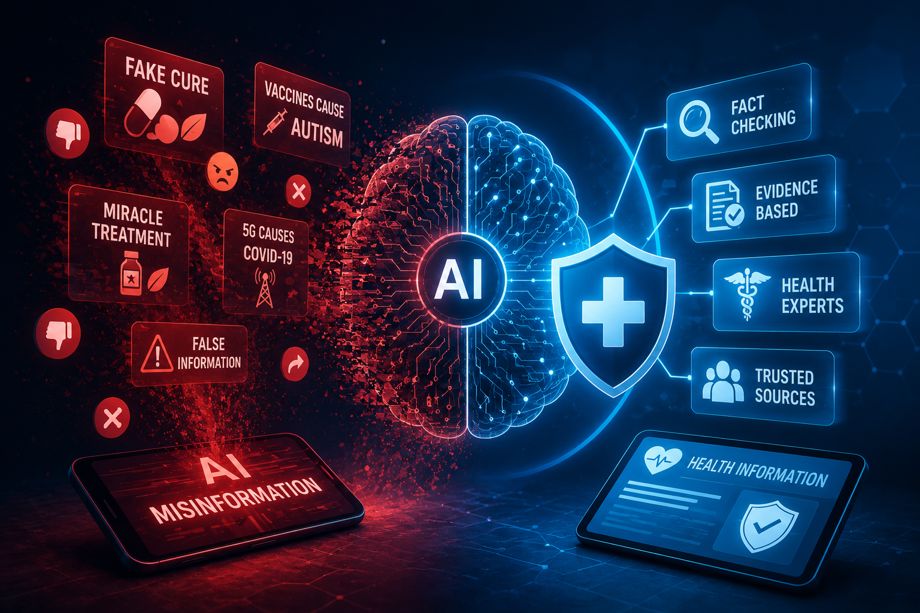
Artificial intelligence is being discussed as a defence against health misinformation online, yet its real value may lie less in automatically deciding what is true or false and more in helping health professionals understand what people are worried about, where misleading narratives are emerging, and how credible information should reach different communities. That is the central argument of a new mini review titled “AI-enabled health communication to address misinformation on social media,” written by Yuqi Hu of the University of California, San Diego, and published in Frontiers in Communication. The review examines research published between 2000 and 2026 and brings together evidence from public health, communication and computer science to consider how AI could become part of a wider health communication response rather than simply serving as an automated misinformation detector. The scope of the problem is considerable. Health misinformation has already been documented across subjects ranging from infectious diseases and vaccines to cancer, diet, reproductive health, tobacco and e-cigarettes, while generative AI has created another route for producing convincing but inaccurate material at scale. Exposure to misleading health claims can weaken health literacy, encourage unsafe choices and interfere with prevention or treatment, making the problem far more serious than an occasional incorrect social media post. The review argues that public health responses have often focused on correcting false claims after they spread, but AI may offer a deeper value by revealing the underlying anxieties, emotions and information gaps that allow misinformation to take hold. Instead of treating misinformation as a purely technical problem of truth and falsehood, health communicators can use AI to understand the human context behind false beliefs and respond in ways that are culturally, emotionally and practically relevant.
The strongest potential use identified in the review is AI-enabled social listening, where technology helps health communicators understand not only which false claims are circulating but also the questions, emotions, uncertainties and information gaps surrounding them. Traditional monitoring based on keyword searches, surveys, focus groups, manual media reviews and expert analysis can struggle with the enormous volume and speed of social media conversations. Machine learning and natural language processing systems can scan much larger amounts of content, classify potentially misleading posts or claims and identify patterns that deserve closer human attention. The opportunity goes deeper than simple detection. Topic modelling, semantic clustering and large language model-based summarisation can reveal emerging narratives and recurring concerns, while sentiment and emotion analysis can indicate whether a conversation is being driven by fear, anger, confusion, distrust or uncertainty. Network analysis and bot-detection techniques can help identify influential accounts, coordinated amplification and the communities through which misinformation travels. That context matters because different kinds of misinformation require different kinds of responses. A vaccine rumour rooted in fear of side effects may need a very different response from one driven by distrust of institutions or confusion about scientific evidence. The review also warns that AI does not necessarily see every community equally well. Models can misunderstand sarcasm, memes, humour, coded language, multilingual conversations and local references. Training data dominated by particular languages or populations can cause systems to overlook misinformation affecting immigrant, refugee, low-income and low-resource-language communities. Monitoring public conversations also creates legitimate privacy and surveillance concerns, making human interpretation and community involvement essential rather than optional.
Once a harmful narrative has been identified, the review suggests that AI could support the creation and delivery of corrective messages, fact-check explanations, plain-language summaries, multilingual information, chatbot responses and social media content adapted to different platforms. Large language models can help summarise evidence, simplify technical medical information and draft several versions of a message, allowing health communicators to speak to different audiences quickly. Research has already explored AI-generated pro-vaccination messages, responses to vaccine myths and communication intended to reduce misconceptions around mental health. Another possibility is prebunking, which tries to prepare people before misinformation reaches them. Instead of correcting every false claim after it spreads, communicators can teach audiences to recognise tactics such as cherry-picking evidence, emotional manipulation, fake expertise, conspiracy framing and false balance. AI could identify recurring manipulation techniques and create topic-specific exercises or interactive media-literacy material, although the review stresses that much of this work has yet to demonstrate effectiveness in real-world social media environments. Chatbots offer a more conversational approach because users can ask questions when they are uncertain rather than simply receiving a static correction. The evidence remains modest; one 2026 study found that short large language model chatbot conversations increased parents’ immediate intentions to vaccinate against HPV compared with receiving no message, yet the effect did not last, and the chatbot did not outperform standard public health materials. Personalisation adds another possibility, allowing communication to be adjusted for language, health literacy, emotional concerns, previous misinformation exposure, platform culture and local context. But it also creates risks when systems make assumptions about people from incomplete online signals, potentially reinforcing filter bubbles or existing information inequalities.
A major weakness in the current evidence, according to the review, is how AI systems are evaluated. Researchers frequently report accuracy, precision, recall, F1 scores, processing speed or the quality of generated text, yet a model that detects misinformation accurately has not necessarily helped a person understand a health issue or make a safer decision. ChatGPT assistance has shown inconsistent effects on people’s ability to distinguish reliable health information from misinformation, and some AI systems with strong technical results have not yet been tested for their effect on actual audiences. Research on social media vaccine interventions also shows stronger evidence for improving knowledge, confidence and attitudes than for producing actual increases in vaccination. The review argues that future evaluations need to measure comprehension, credibility, belief accuracy, trust, risk perception, intentions, behaviour and sharing. Researchers should also examine whether an intervention narrows or widens gaps associated with language, literacy, socioeconomic circumstances, platform access and institutional trust, while watching for unintended consequences such as greater exposure to false claims, increased scepticism or excessive dependence on automated advice. AI tools should also be compared with existing alternatives such as clinician communication, community-led messaging, peer correction, established public health materials and non-AI media-literacy interventions, rather than assuming that an AI-generated message is better simply because it can be produced quickly or personalised at scale. The review’s message is that technical performance alone is not enough; the real test is whether AI helps people make healthier decisions, whether it reduces rather than worsens inequality, and whether it earns the confidence of the public and health professionals alike.
The review also highlights an uncomfortable contradiction: generative AI can support health communicators while making health misinformation cheaper, faster and easier to produce. AI can generate fluent, persuasive and audience-specific misinformation in many languages and formats. Synthetic text, images, voices, videos and deepfake-style material could make misleading health narratives more personalised and harder to identify, while the same false story can be repeatedly rewritten for different audiences and platforms. This makes governance central to responsible use. Social listening can cross an uncomfortable line between understanding public concerns and surveillance, especially when people do not expect their posts to be classified or used to create targeted interventions. Unequal model performance across languages, dialects and communities creates another risk of leaving underserved populations with poorer information support. The review calls for privacy protection, data minimisation, transparency, documentation of data sources and model limitations, clear review and error-correction procedures, human oversight, community consultation, independent auditing and ways for the public to provide feedback. The overarching message is that AI should support health communicators, clinicians, public health professionals and trusted community messengers rather than replace them. Future research also needs to move beyond the English-language, COVID-19 and vaccine settings that dominate current evidence, while recognising that different social platforms, communities and health topics require different communication strategies. Without careful governance, the same technology that promises to help public health could deepen mistrust, invade privacy and amplify the very misinformation it is meant to fight.
In summary, AI may give public health teams faster ways to spot emerging misinformation and respond at scale, but trust cannot be automated so easily. The most useful systems are likely to be those where machines handle scale, analysis and drafting while people provide the judgment, cultural understanding, scientific responsibility and human connection that credible health communication still depends on. AI can help health professionals know what people are worried about and where false narratives are forming, but a credible health message still depends on human messengers who understand the community and are trusted by it. The review concludes that the future of AI in health communication rests not on building perfect automated truth detectors, but on creating systems that augment human capacity, protect privacy, advance equity and remain firmly anchored in the human relationships that make communication credible. This means developing, testing and deploying AI with the same care that public health applies to medicine. In the fight against misinformation, the objective is not to replace human judgment with machines but to arm those who have the judgment with better tools. As generative AI continues to evolve, both the risks and opportunities will grow. The review’s call to action is clear: AI should be part of a wider, people-centred strategy that combines technological scale with human insight, so that health communication remains accurate, respectful and effective across the diverse communities it is meant to serve.