



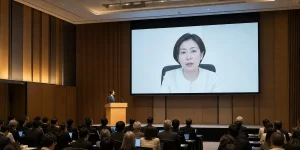






KYIV, Ukraine — The National Security and Defense Council of Ukraine has announced that Anahit Khoperia has been appointed acting head of the Center for Countering Disinformation, effective October 1, 2026. The appointment places a seasoned insider at the helm of one of the country’s most important institutions in the war against Russian information aggression. The NSDC, in a press release, said Khoperia would continue her work in the field of countering information threats and strengthening Ukraine’s information resilience. She assumes the role after Andriy Kovalenko resigned as head of the NSDC’s Information and Communication Department on September 28, with President Volodymyr Zelensky accepting the resignation. Although the change is the latest in a series of top-level personnel shifts in Ukraine’s security sector, officials have framed Khoperia’s promotion as an affirmation of continuity and institutional memory rather than an overhaul. Since Russia launched its full-scale invasion in February 2022, Ukraine’s information defense has been a critical front, with disinformation campaigns targeting soldiers, civilians, allies, and political decision-makers. The Center has played a central role in exposing false narratives, tracking coordinated influence operations, and helping citizens resist manipulation. Khoperia’s elevation from within the CCD means she does not need an introduction to its complex daily operations, international partnerships, or the threat landscape. In wartime, such continuity is valuable.
Anahit Khoperia is a lawyer by profession, with a legal education and a career spanning several key public institutions. In 2015, she graduated from the Law Faculty of Taras Shevchenko National University of Kyiv, one of Ukraine’s most prestigious academic institutions. In 2023, she defended her dissertation and earned a Ph.D. in Law, giving her a strong scholarly foundation that complements her practical experience. She began her professional career in the fields of international law and public administration, working at the National Anti-Corruption Bureau of Ukraine, the Ministry of Justice, the State Tax Service, and Ukrzaliznytsia, the state-owned railway company. This broad range of positions is significant. At the National Anti-Corruption Bureau, she gained firsthand knowledge of the mechanisms of corruption and institutional integrity. At the Ministry of Justice, she was exposed to legal and regulatory matters affecting the state. At the State Tax Service, she saw the inner workings of fiscal enforcement and government administration. At Ukrzaliznytsia, she encountered the challenges of managing a strategically vital infrastructure enterprise during times of reform and war. Together, these roles gave her an unusually comprehensive understanding of how Ukrainian state institutions operate, where they are vulnerable, and how information operations can exploit those vulnerabilities. Her legal training, in particular, is essential for the Center’s work, because countering disinformation involves navigating questions of media freedom, data protection, national security, platform accountability, and administrative law.
Khoperia joined the Center for Countering Disinformation in June 2021, just months before the start of the full-scale Russian invasion. During her tenure, she has served as manager of international cooperation, deputy director, and head of the Department for Countering Information Threats to National Security. Each of these positions prepared her for the responsibilities she now assumes. As manager of international cooperation, she was responsible for building and maintaining relationships with foreign partners, including governments, think tanks, international organizations, and civil society groups. As deputy director, she helped manage the Center’s operations and policy direction during some of the most intense years of information warfare in modern European history. As head of the Department for Countering Information Threats to National Security, she led one of the Center’s core functional divisions, analyzing hostile narratives, identifying coordinated manipulation operations, and developing responses to protect Ukraine’s national security. She also invested in her own professional development, completing training programs at the Aspen Institute Kyiv and Total Defense, and participating in the U.S. State Department’s International Visitor Leadership Program. Those programs are not merely ceremonial. The Aspen Institute Kyiv focuses on leadership, ethics, and societal responsibility. The Total Defense program is aimed at preparing Ukrainian security and public-sector professionals for comprehensive national resilience. The U.S. State Department’s IVLP brings emerging leaders from around the world to the United States to meet with government officials, experts, and representatives of civil society. Taken together, these experiences demonstrate that Khoperia has been deliberately cultivated as a leader who understands both the strategic and operational dimensions of information security.
As acting head of the Center for Countering Disinformation, Khoperia will continue the mission of countering information threats by strengthening Ukraine’s information resilience. The phrase is not a bureaucratic abstraction. Information resilience means the ability of the state, society, and individual citizens to withstand false narratives, resist psychological manipulation, and maintain cohesion under pressure. In a country at war, this is a matter of survival. Russian information operations have evolved dramatically since 2014, and especially since 2022. They now include weaponized social media content, amplified conspiracy theories, propaganda disguised as journalism, fake videos and audio, fabricated government announcements, and coordinated attacks by bot networks. The goal is often not to convince everyone of one particular lie, but to create chaos, confusion, distrust, and apathy. Under Ukrainian conditions, false narratives can undermine mobilization efforts, spread panic about front-line settlements, cast doubt on Western military aid, divide political elites, and weaken confidence in Ukraine’s leadership. Khoperia’s immediate priorities are likely to include maintaining around-the-clock monitoring of the information space, rapid fact-checking, coordination with domestic and international platforms, and supporting media literacy initiatives. Her legal background will also be useful as Ukraine continues to develop legal tools and policy mechanisms to counter foreign interference while respecting democratic principles. She will have to balance urgency with professionalism, as misinformation often spreads faster than official clarification.
The Center for Countering Disinformation operates under the National Security and Defense Council, which coordinates security and defense policy in Ukraine. The Center was established in 2021, before the full-scale invasion, to respond to growing threats in the information space. Since then, it has evolved into a central node in Ukraine’s broader resilience system. It monitors streams of online content, analyzes dangerous trends, prepares reports, publishes warnings, and regularly exposes coordinated disinformation campaigns. It also works with journalists, grassroots fact-checkers, researchers, universities, and foreign partners. The Center has become known internationally as an example of a government institution that takes disinformation seriously and is prepared to act publicly against it. In many countries, the term “countering disinformation” raises concerns about censorship, propaganda, or state control of speech. Ukraine has faced such criticism too, including from Russia, which routinely accuses Kyiv of suppressing dissent. For Ukrainian officials, however, the Center’s work is a defensive measure, not an attack on press freedom. The distinction is delicate but fundamental. The more urgent the information threat, the more essential it is for a governing institution to operate transparently, follow legal procedures, and maintain credibility. Khoperia’s law degree and anti-corruption experience are particularly important in this respect. A counter-disinformation institution led by someone with experience in legal standards and institutional integrity is better positioned to avoid the traps of overreaction, misinformation, or abuse. Her prior work at the National Anti-Corruption Bureau also reinforces the link between institutional trust and information security: citizens are less vulnerable to false narratives when they trust the institutions defending them.
Looking ahead, Khoperia’s appointment represents both a handover and a continuation. She inherits a Center with significant wartime expertise, but also an institution facing immense pressure and limited resources. The information landscape is becoming more dangerous, not less. Advances in artificial intelligence now allow the creation of realistic deepfakes, automated propaganda, and personalized manipulation at a scale that was unimaginable a few years ago. Public attention in Western countries is increasingly divided among multiple crises, which gives hostile actors more space to operate. Khoperia will need to strengthen Ukraine’s partnerships with international allies while adapting tactics to a fast-changing media environment. Her career trajectory suggests she is prepared for that challenge. She is part of a younger generation of Ukrainian professionals who began their careers after the Revolution of Dignity, rose through the ranks during wartime, and now hold senior positions in national security. Her appointment as acting head is also a signal that the NSDC values institutional memory and professional expertise over political outside appointments. There is no indication from the council of a broader disruption; rather, the change is described as a continuation of her existing work in a new role. For Ukraine’s Western partners, Khoperia is likely to be a familiar and credible interlocutor, already known for her international cooperation and training. For the country’s information-defense community, her leadership brings hope that the fight against disinformation will remain grounded in law, evidence, and resilience. In the end, the test will not simply be the number of false stories debunked, but whether Ukraine’s society becomes stronger, more informed, and more resistant to manipulation. Anahit Khoperia now has a central role in meeting that test.


