


Meta Shifts from Professional Fact-Checking to Community-Based Approach, Mirroring X’s Strategy
In a significant policy shift, Meta, the parent company of Facebook, Instagram, Threads, and WhatsApp, has announced the termination of its third-party fact-checking program in the United States. This decision marks a departure from the company’s previous reliance on professional fact-checkers to combat misinformation and a move towards a community-driven approach, mirroring a similar strategy adopted by X (formerly Twitter) under Elon Musk’s ownership. Meta’s acknowledgment of X’s influence on this decision is noteworthy, signaling a potential shift in the competitive landscape of social media platforms and their approach to content moderation.
The move has sparked concerns among critics who fear that abandoning professional fact-checking will exacerbate the already pervasive issue of misinformation online. Meta, however, argues that its previous approach led to excessive content policing, effectively amounting to censorship. This argument resonates with conservative voices who often perceive content moderation as an infringement on freedom of speech. Meta executives, including Chief Global Affairs Officer Joel Kaplan and CEO Mark Zuckerberg, have emphasized the company’s commitment to free expression, even if it means accepting the inherent "messiness" that comes with it. Zuckerberg acknowledged the trade-off involved, admitting that while the new approach might lead to less effective detection of harmful content, it will also reduce the number of legitimate posts and accounts inadvertently removed.
Navigating the Tightrope Between Free Speech and Misinformation Control
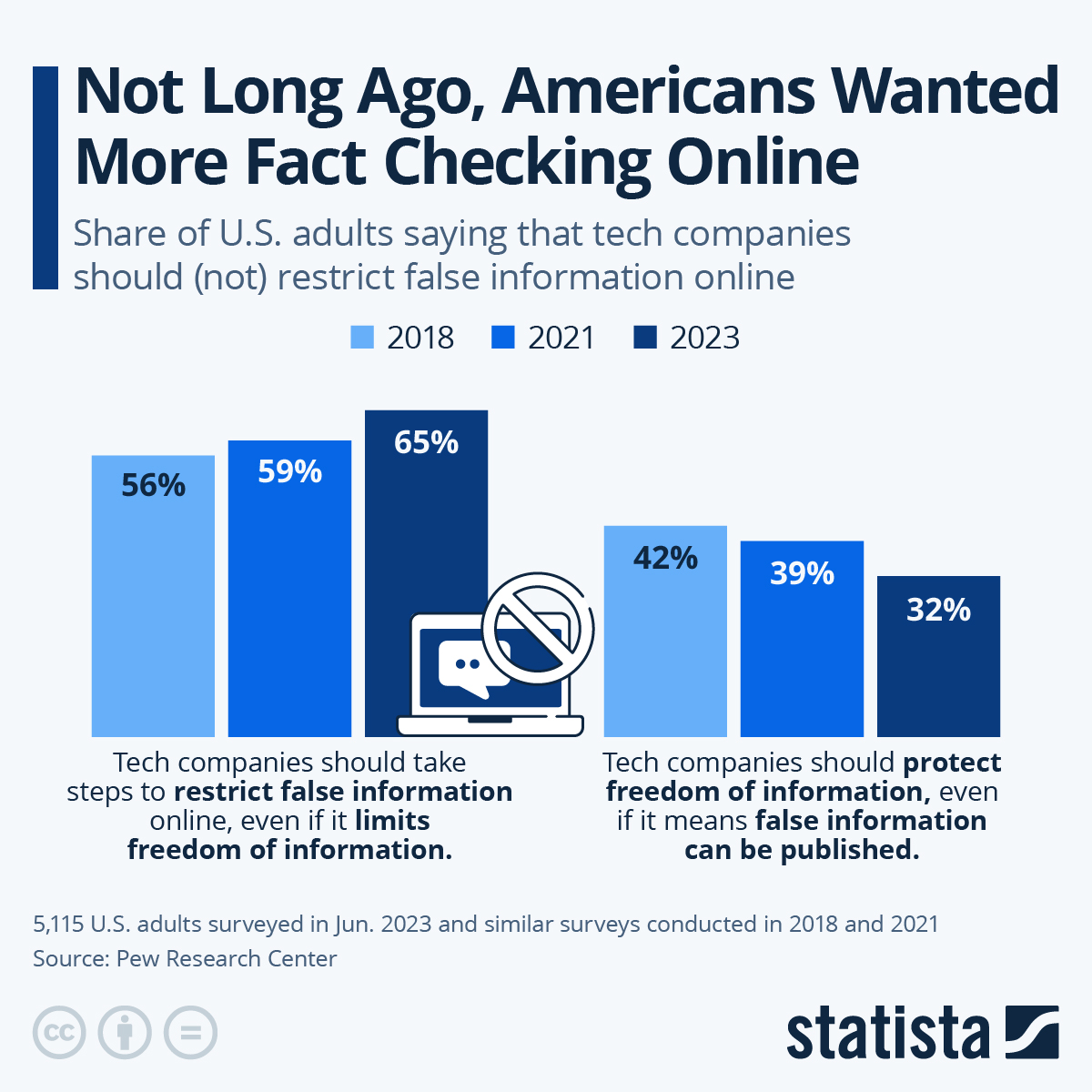
The debate surrounding the balance between free speech and content moderation has intensified in recent years. Accusations of biased content moderation, particularly from conservative circles, have prompted a reevaluation of the role and responsibility of social media platforms in regulating online discourse. The prevailing narrative, often championed by figures like Elon Musk, frames content moderation as a tool to silence dissenting voices and manipulate public opinion. This narrative, however, contrasts with public opinion data. Multiple surveys conducted by the Pew Research Center over the past five years consistently reveal a growing desire among Americans for stronger action from tech companies to combat misinformation, even if it means some limitations on free speech. This discrepancy highlights the complex challenge facing social media platforms: balancing the demands for unfettered expression with the need to curb the spread of false and harmful information.
Meta’s shift towards community-based content moderation aligns with a growing trend in the tech industry to decentralize authority and empower users in shaping online communities. This approach theoretically allows for a more democratic and participatory system, where the collective wisdom of the community determines what constitutes acceptable content. However, the effectiveness of such systems hinges on the assumption of a well-informed and unbiased community, a condition that is often difficult to achieve in practice. The potential for manipulation, brigading, and the amplification of existing biases within online communities poses a significant challenge to the success of community-based moderation models.
Meta’s Calculated Gamble: Appeasing Conservatives and the Incoming Trump Administration
Many observers interpret Meta’s policy change as a strategic move to align with the incoming Trump administration. The historically strained relationship between Zuckerberg and Trump during the latter’s first presidency suggests that Meta is seeking a more favorable relationship this time around. Trump’s vocal criticism of Meta’s content moderation practices, coupled with his influence over a significant portion of the American electorate, likely factored into Meta’s decision-making. By embracing a less interventionist approach to content moderation, Meta aims to appease conservative voices and minimize potential conflicts with the new administration.
This strategic shift carries significant risks for Meta. While catering to conservative concerns might improve the company’s political standing, it could alienate other segments of its user base who prioritize the mitigation of misinformation. Furthermore, a lax approach to content moderation could expose Meta to increased scrutiny from regulators and civil society organizations concerned about the spread of harmful content on its platforms. The delicate balancing act between political expediency and social responsibility will continue to challenge Meta’s leadership in the years to come.
The Future of Content Moderation: A Complex and Evolving Landscape
Meta’s decision to abandon professional fact-checking marks a pivotal moment in the ongoing evolution of content moderation practices. The shift towards community-based approaches reflects a broader trend in the tech industry to decentralize authority and empower users in shaping online spaces. However, the potential pitfalls of this approach, including the susceptibility to manipulation and the amplification of existing biases, necessitate careful consideration and ongoing evaluation. The effectiveness of community-based moderation hinges on the ability to foster a well-informed and unbiased community, a task that requires continuous effort and innovative solutions.
The future of content moderation remains uncertain. As social media platforms grapple with the challenges of balancing free speech with the need to combat misinformation, the search for effective and equitable solutions will continue. The ongoing debate surrounding content moderation underscores the crucial role of these platforms in shaping public discourse and the importance of finding a sustainable balance between freedom of expression and the protection of online communities from harmful content. Meta’s decision to abandon professional fact-checking is a significant development in this ongoing debate, the ramifications of which will continue to unfold in the years to come. The effectiveness of community-based moderation in mitigating misinformation and fostering healthy online discourse remains to be seen.
The Challenges and Opportunities of Community-Based Moderation
The transition to community-based moderation presents both challenges and opportunities for Meta. While it offers the potential for greater user engagement and a more democratic approach to content regulation, it also carries the risk of amplifying existing biases and creating echo chambers where misinformation can thrive. The success of this approach will largely depend on Meta’s ability to implement effective mechanisms to ensure the integrity and impartiality of community-based moderation systems.
One of the key challenges lies in mitigating the influence of bad actors who may attempt to manipulate community-based systems for their own agendas. Protecting against coordinated disinformation campaigns and ensuring that the voices of marginalized communities are not drowned out by more dominant groups will require sophisticated algorithms and robust moderation tools. Furthermore, educating users about the importance of critical thinking and media literacy will be essential in fostering a responsible and discerning online community.
However, the shift towards community-based moderation also presents an opportunity for Meta to tap into the collective intelligence of its vast user base. By empowering users to participate in the moderation process, Meta can potentially access a wider range of perspectives and insights that can help to identify and address harmful content more effectively. The key will be to leverage the strengths of community-based moderation while mitigating its inherent risks.
Meta’s Strategic Gamble and the Future of Online Discourse
Meta’s decision to abandon professional fact-checking represents a calculated gamble with potentially far-reaching consequences. By prioritizing free expression over the mitigation of misinformation, Meta risks exacerbating the already pervasive problem of false and misleading information online. This decision could further erode trust in online platforms and contribute to a more polarized and fragmented information landscape.
However, it could also usher in a new era of user empowerment and decentralized content moderation. If successful, community-based moderation could offer a more democratic and participatory approach to regulating online discourse. The ultimate outcome of Meta’s gamble remains to be seen, but it is clear that the future of content moderation and online discourse hangs in the balance.